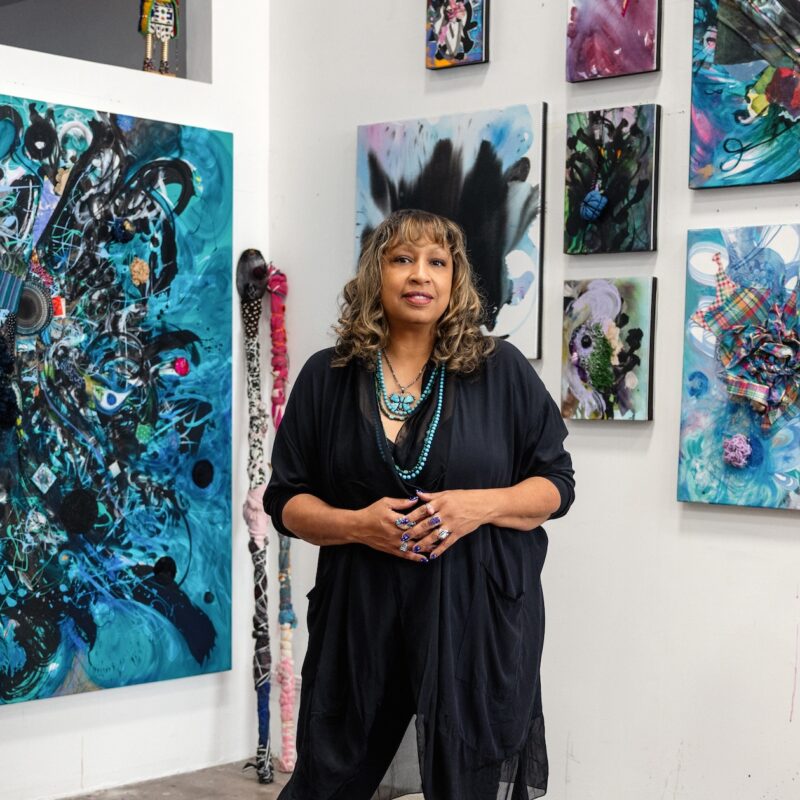
Shinique Smith is a Baltimore-born abstract painter and sculptor who manipulates mountains of fabric. Amassed over twenty years, these raw materials—denim, wool, cotton, and lace—abound in a cacophony of polka dots, stripes, florals, and paisleys, festooned with ribboned strips and cords. In hues of navy, turquoise, coral, and fuchsia, all wrapped, twisted, and collaged into pillars, Smith’s Bale Variant series towers like ancient monoliths, giving one a sense of knowledge preserved, but just out of reach. Her work asks: when faced with an unfamiliar shape, do we concede the shape is simply over our heads? Or do we seek out a means of understanding?
Since she was a little girl, Smith has confronted the inscrutable. She describes her mother as “an open and knowing seeker of knowledge,” and her childhood was a kaleidoscope of the Methodist church, Catholic school, the Tibetan Meditation Center, Black physicists, and numerologists. In their home, she would browse illustrations of Krishna next to the Bible next to books on telekinesis. There were mandalas and the shapes of sacred geometry. Across these varied spiritual texts and images, Smith could see a line connecting seemingly distant cultures and belief systems.
It seems apropos that Smith works with fabric as her medium through which to consider the other side of the veil. Even at a small scale, her sculptures feel ingrained with the esoteric. In her 2024 solo exhibition Shinique Smith: Parade at the Ringling Museum of Art, tiny bundles of wound and bound fabric were set in gallery vitrines like the religious figurines one might venerate in the privacy of one’s home.
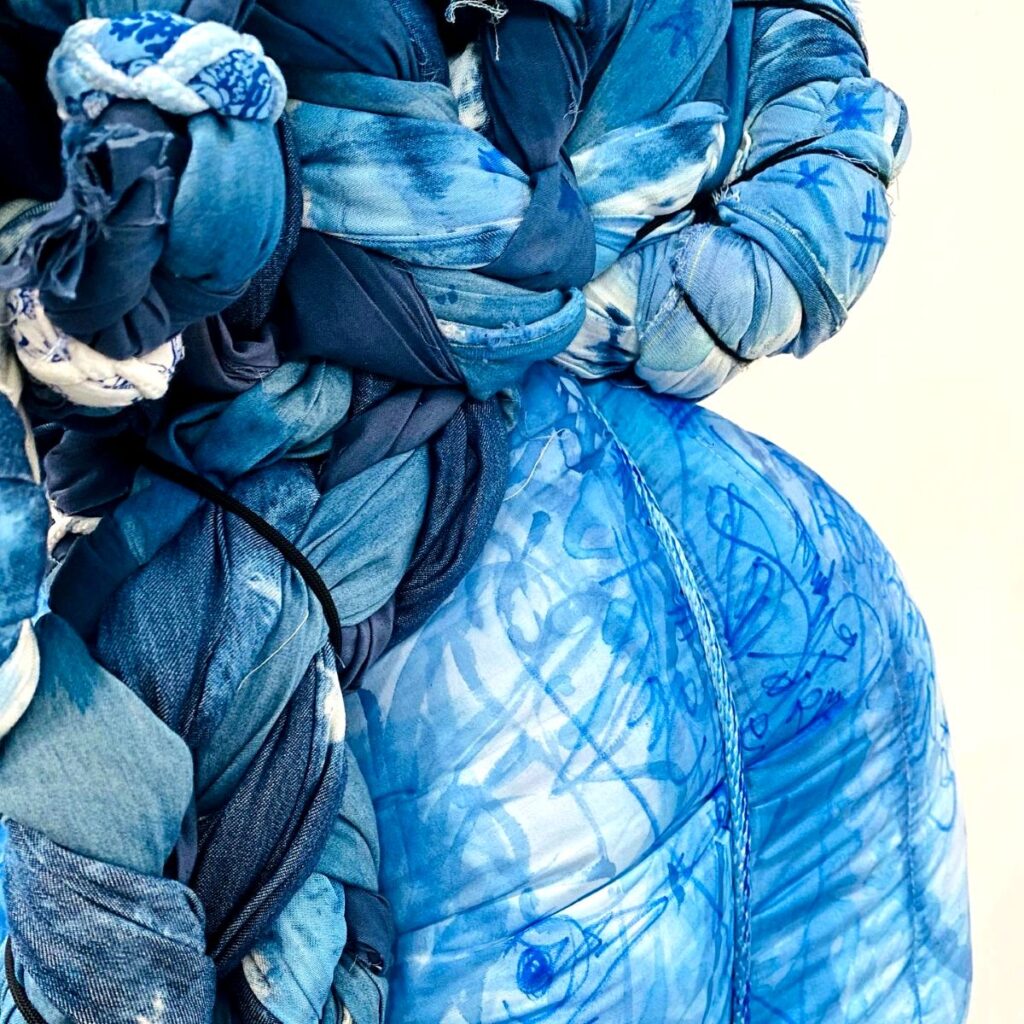
Some of Smith’s objects appear as little more than a wrapped knot of fabric. They could fit in one’s palm—yet they carry spiritual weight like a mojo bag, a receptacle for intention that is ritually prepared and breathed into life. These statuettes recall an earlier series Smith made in 2017. With titles such as Talisman for Inner Sight and Talisman for Eternal Delight, the bunched and strung sculptures are contextualized as metaphysical tools rather than a decorative art.
Recognition and transformation live at the heart of Smith’s sculptural work. Fabrics from daily life are remade and repurposed, painted and bleached, stuffed and tied into otherworldly shapes. But Smith also elevates materials that are considered spent or wasted—and therefore overlooked as banal—into new shapes that can inspire wonder or joy. In response, one might more readily remember one’s own ability to transform and be transformed. A talisman is designed to be carried around with us, something we can clasp or call upon when our circumstances seem too opaque or too grave. They make the capacity for transformation portable. Movement is embedded in the form.
Whereas the movement of Smith’s sculptures feels potential—present and real but bound and therefore constricted—her paintings are much more kinetic. She physically moves around her studio from canvas to canvas, brushing a stroke here and a stroke there, as if the act of mark-making were a wave curling in on itself until the tide draws back then swells once more against gravity.
In Portal (2024), verdant brushstrokes loop into one another. Cream, soft pink, and deep blue hues eddy on the canvas. While there is no clear vanishing point with coordinates one could graph, a space does open in the center of the painting—like a break in a forest through which one might discover a sunlit clearing. Smith also adds fragments of fabrics from her archive to the canvas, initiating a dialogue between her sculptures and painting, as if one of her Bale Variants burst open, the knots pulled free, and this wild portal has been released.
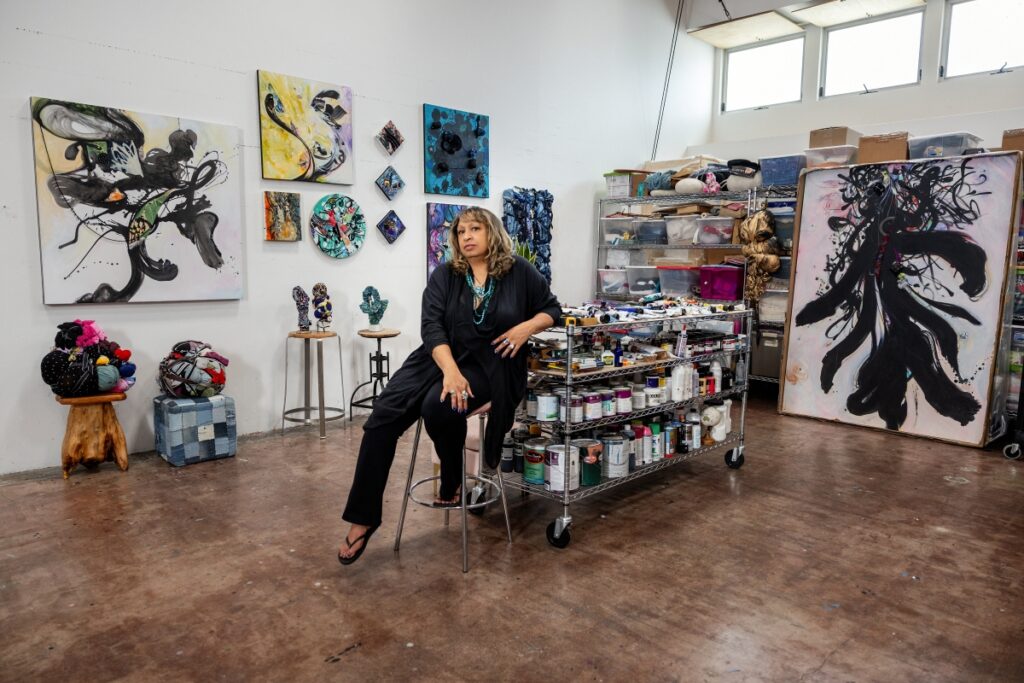
One challenge of making art that engages with the celestial is that criticism comes easily. During her formal education at Maryland Institute College of Art (General Fine Arts BFA ‘92, Mount Royal School of Art MFA ‘03), Smith was instructed to reel in her more metaphysical content and praised, once she got “away from her hokey spiritualism.” But why was an artist like Betye Saar considered deeply spiritual while Smith’s spiritual work considered kitschy? Those early critiques shaped—and constricted—the start of Smith’s career, but today she leans into her enchantment with the transformative forces some strive their whole lives to understand. This evolution feels like a homecoming.
Smith was raised in Edmondson Village and attended Frederick Douglass High School and Baltimore School for the Arts. Though she now lives in Los Angeles, Baltimore remains her original home. “All my creativity, spirituality, and skills that I utilize today—and wherever I go—came from Baltimore,” Smith says. “The city is very much who I am.”
Her paintings show evidence of this embedded identity, many of which showcase vibrant color and fluid, thick black lines characteristic of street art. In Memories of My Youth Streak by on the 23, (2019), the quick, swirling gestures of the 21-foot-wide work evoke a playful, sprawling script that echoes the alleyway tags Smith and her friends would leave for one another in the 80s. The titles of her work also nod to Baltimore: Eutaw Place (2018) and Bale Variant No 0027 (Charm City Girl Stele) (2022), both works recently acquired by the Baltimore Museum of Art.
A teenage girl once surprised Smith by asking why butterflies appeared in so many of her works. The butterflies were everywhere and Smith hadn’t noticed, though obviously she had put them there. “Then years later,” Smith says, “you find out that you come from the Black Butterfly,” the shape of the predominantly Black neighborhoods that radiate out from Baltimore’s Inner Harbor, segregated by redlining and, in many cases, economically depressed as a result.
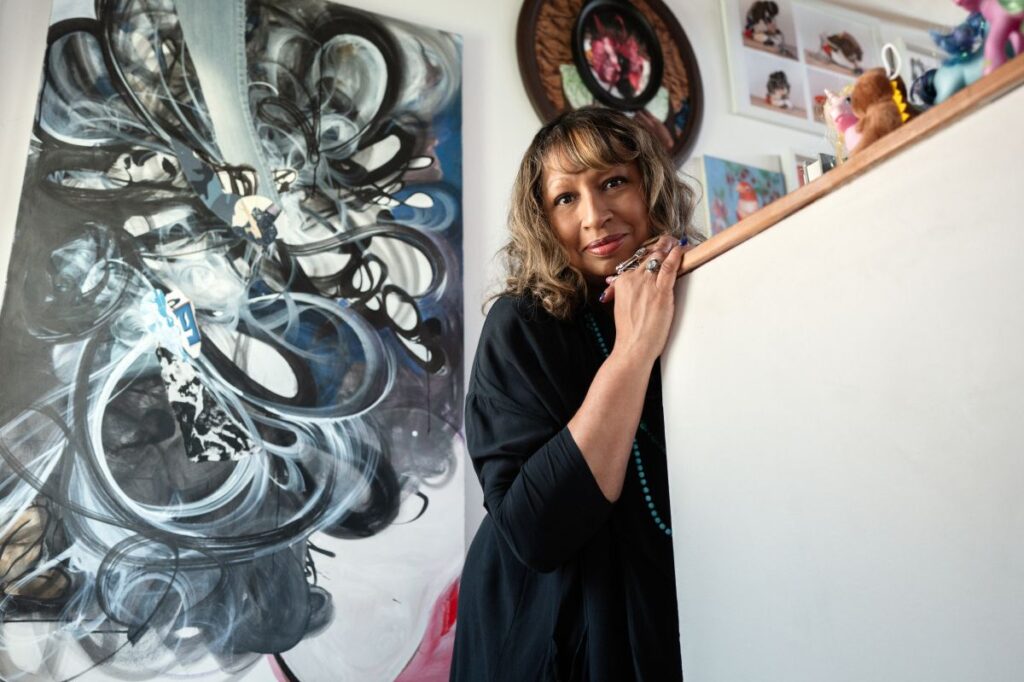
Shinique SmithWhen you come from the concrete, concrete doesn’t go away. I could ignore it and block it, but there’s something about the brick and concrete where I came from.
Butterflies are more than a motif in Smith’s work; they are further evidence of how deeply embedded Baltimore is in her identity. “When you come from the concrete, concrete doesn’t go away. I could ignore it and block it, but there’s something about the brick and concrete where I came from,” she says. “Riding the bus and seeing a butterfly and dreaming of transformation. It’s harder than if you were in a bucolic environment, where dreaming of the idyllic is easy because you are already there.”
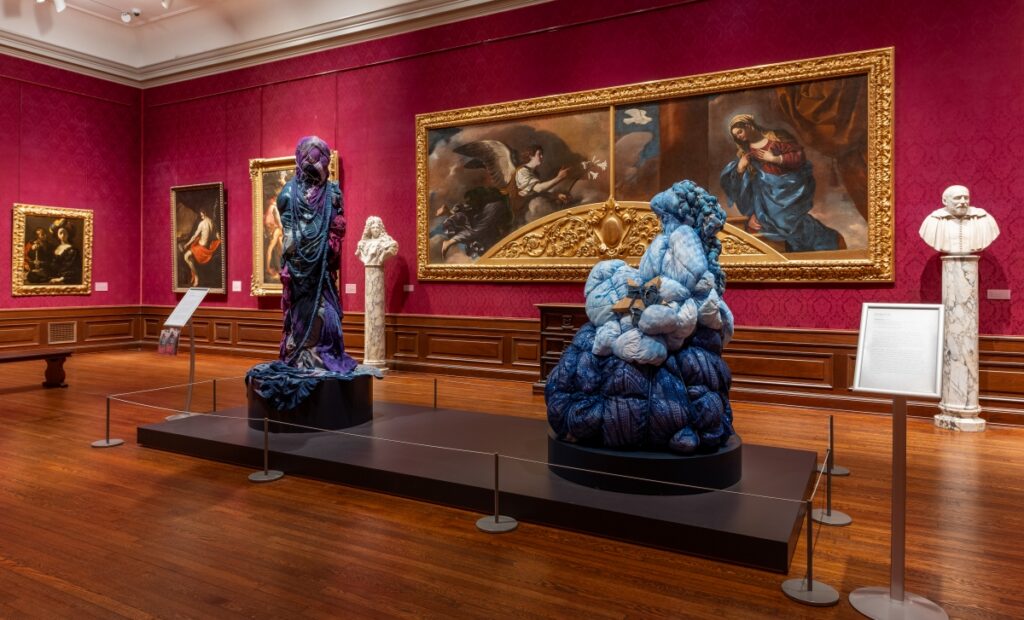
That dream of transformation is incarnated in Smith’s more explicitly figurative sculptures, recently exhibited in the Parade exhibit. The works posed in dialogue: Stargazer (2022) tilts her head up toward Grace stands beside (2020), mirroring Guercino’s Annunciation (1628-29), hung in the background in a gallery of Baroque paintings at The Ringling.
Originally sponsored by the Baltimore Museum of Art, Smith created Grace in response to a monument of a wide-winged Glory lifting a confederate soldier to heaven, a statue the city of Baltimore removed from Mount Royal Avenue in 2017. Now, paired with Stargazer, Grace underscores a different throughline across four centuries of art, offering an update to the story of the Annunciation: a human answers the call to make space in their terrestrial life for the miraculous, the celestial gestates within the body. But working with the celestial is still work, and birthing it still requires labor.
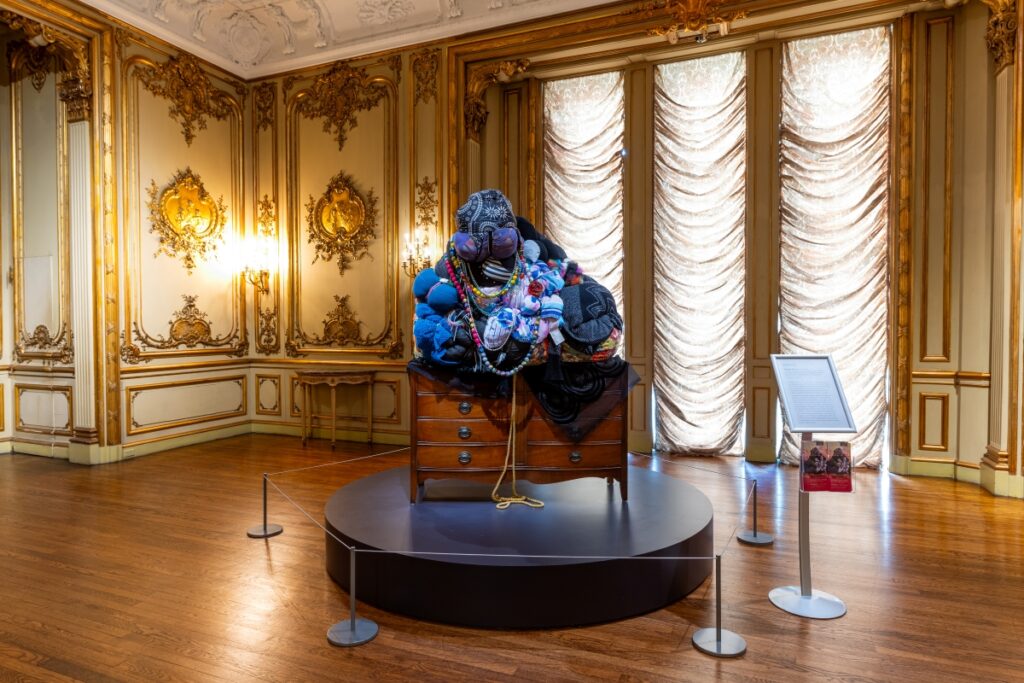
Mitumba Deity II (2018/2023) was the most provocative sculpture of the show. A humped, lumpy figure sits atop a dresser, wearing a black-and-white patterned headwrap. She has bulging purple fabric eyes and long strands of colorful beads hanging heavy on her neck. One isn’t predisposed to think of a bale of fabric as a deity, as something holy or deserving of reverence—and this is Smith’s greatest skill. She isn’t randomly stuffing, stretching, and tying up fabric. There is no chaos here, just as one who reads enough cross-cultural metaphysical texts grows to understand the universe is not inherently chaotic.
Shinique SmithWhen you hold grace, you can elevate yourself beyond feelings of anger, jealousy, and fear. You don’t know where it’s taking you, but you know it’s lighter and brighter—away from gravity.
As a viewer, one encounters many unexpected gestures in Smith’s work, in the same way one would be surprised to walk into the bedroom and see one’s ancestor reclining across a chest of drawers. But the surprise isn’t born from randomness or chaos; it’s born from craft, skill, experience, and dialogue with material. When we view Smith’s sculptures, we are viewing an object that has been assembled by human attention. When she takes on the celestial as her subject, we’re seeing a unique representation of something that is, by its very definition, abstract.
“When you hold grace, you can elevate yourself beyond feelings of anger, jealousy, and fear,” she says. “You don’t know where it’s taking you, but you know it’s lighter and brighter—away from gravity.” Smith gives shape to subjects that are challenging to incarnate, and because she does that work with her hands, this particular vision of the celestial—of the universal—is also, ultimately, intimately personal.
Shinique Smith’s work can be seen in the following museum exhibitions, all presently on view:
Rubell Museum DC: Material Witness through Fall 2026
Indianapolis Museum of Art: Newfields Bold: New Voices in Contemporary Art until June 28, 2026
Santa Barbara Museum of Art Remixed: Entwined Histories and New Forma until August 30, 2026
Studio Museum in Harlem: From Now: Collection in Context, through Fall 2026