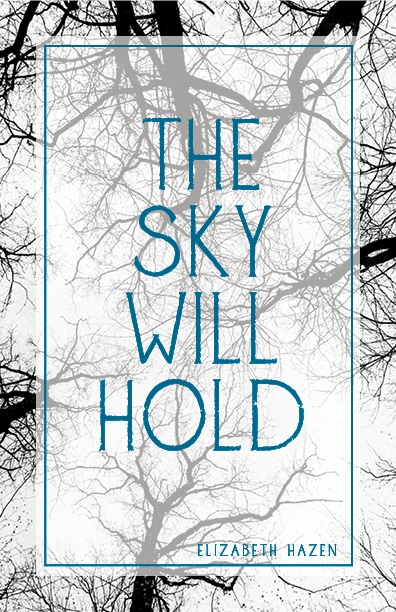
It has been six years since the publication of poet Elizabeth Hazen’s second collection, Girls Like Us—a courageous book addressing her personal experience with trauma and addiction in a patriarchal world. Since then, her life has changed, but her spirit and sharp observational skills remain. Hazen is a fierce, at times startling, confessional poet in the tradition of Sharon Olds and Anne Sexton. Now 47, she is older, sober, remarried, and part of a larger family, including a child from her first marriage nearing adulthood.
Her third collection; The Sky Will Hold, was just published this spring by Riot In Your Throat Press, a writer-focused small press dedicated to feminist voices. In her new book, Hazen is in mid-life re-evaluation mode as the remnants of early adulthood fade behind her. She has aged some, true, yet still a bundle of worry and wonder. She remains unafraid to explore the shadow side but also wings through glimmering epiphanies.
Jack LivingstonAll is up for re-inspection: aging, body issues, the slippery cracks inside marriage, being a stepmother, a mother, a wife, a complicated woman.
The Sky Will Hold is a slim volume packed with 43 poems. In it, Hazen reflects on the meaning of everything passing through her world. All is up for re-inspection: aging, body issues, the slippery cracks inside marriage, being a stepmother, a mother, a wife, a complicated woman. She makes us focus anew, helping us see ourselves within her everyday stories.
While the works are carefully composed with meter and rhythm, they are never overly fussy. She is more of an accessible lyric poet than an experimentalist (though she can do both—the use of Zillow as a metaphor for a blended family in one poem is a clever and solid trick). The book can be read in one sitting, and reading it aloud enhances the experience even more.
The Sky Will Hold, is divided into two parts. The first is a series that loosely explores aspects of being in a new blended family, particularly the role of the author as mother (originally the book was going to be all step-mother poems, but thankfully expanded), the second part moves forward and also is anchored in motherhood, but with an older child launching into the world. As a father to a twenty-year-old son, I particularly related to these works, sometimes with a sense of parental love/grief and tears.
Hazen’s poems are a tapestry of expressive phrases and startling line breaks, sneaky rhymes, leaping into new realizations. The sun/sky are repeatedly referenced. Sometimes they come to burn as the author’s anger flares; she admits to the kind of jealousy we all feel but rarely speak of. She gets caught in her own startled gaze and lists the new insults with ruffled acceptance: wrinkled skin, crow’s feet, arthritic joints, oh no!
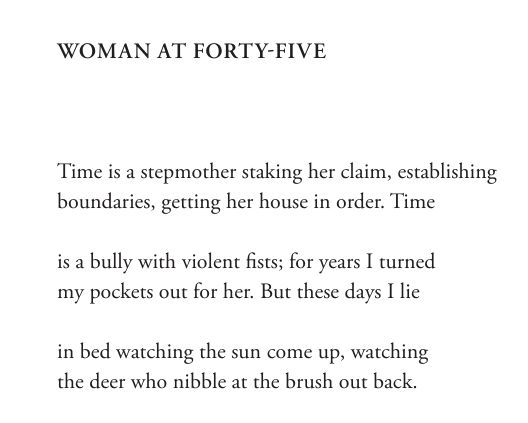
This awareness of time and aging is now accepted and balanced by her gratitude for the positives in her life. Her gratitude is never gooey, more like a wonder inside an ever-changing, eternal storm. She takes her oldest, first-time-smitten son for a long road trip west to start a new chapter in his life, and along the way, in one of many strong works documenting the trip, they end up at Four Corners Monument, a touristy place where you can be in many locations at once (Arizona, Colorado, New Mexico, and Utah).
She writes at the end of that poem: “First Love at Four Corners”/ We marveled that day at the intersection of time/ and space, how far we had come, how easy it was/ to become greater than we were. / That day/ we transformed, simple trinkets turned to stars.
This poem reveals a common theme in the writer’s work: how multiple layers of time and life are constantly stacked together running in tandem—like in quantum physics. In the poet’s work, it’s the way memory runs electric through us all, colliding and overlapping.
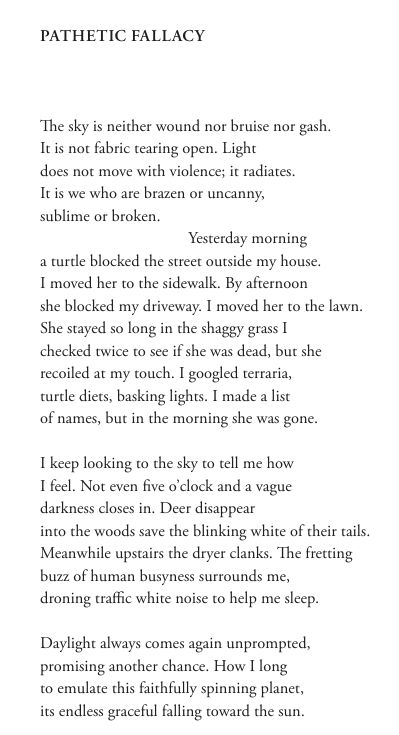
Scenes from the real world are painted throughout. Hazen now lives near Baltimore’s lush Druid Hill Park and walks there often. She is attracted to the outdoors and hiking. There, she encounters animals galore, and they appear throughout the book. There is a torrent of deer running through the forest, later chowing down on the writer’s garden—sometimes pests, sometimes miracles. A stoic turtle appears lumpen in her yard, so still it seems dead, then it vanishes suddenly the next day. Crows, foxes, and hummingbirds buzz around. She sees a waddling groundhog from her window, which sparks a laughable but oh so human worry about fitting into one’s clothes with a widening bum.
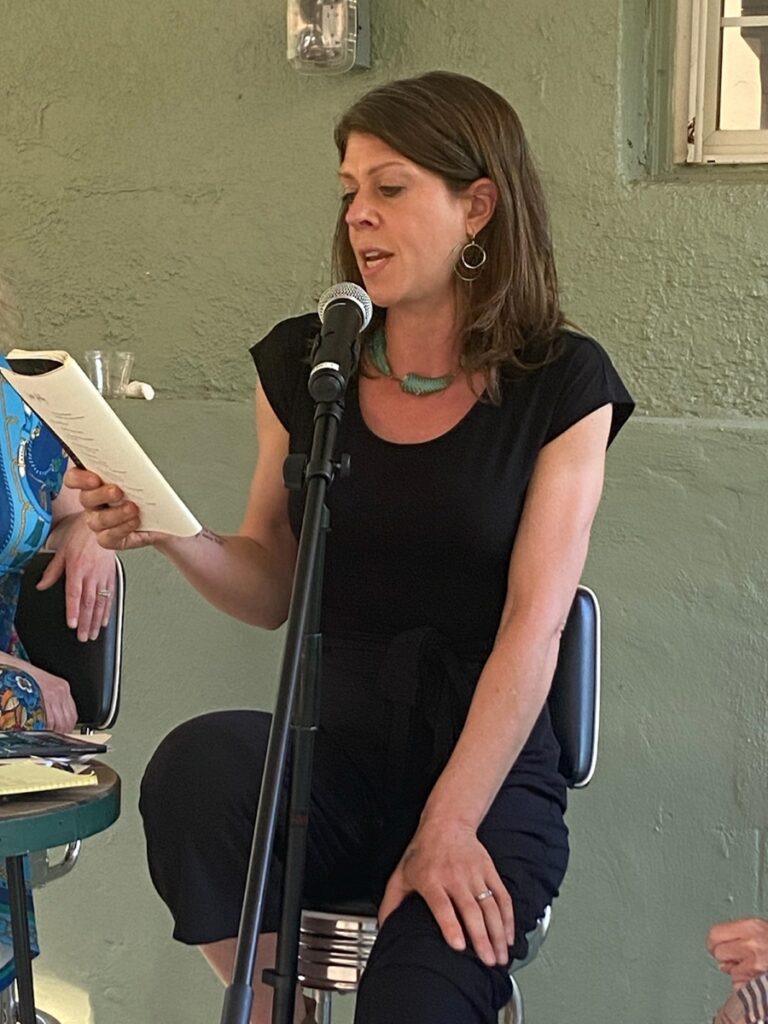
Jack LivingstonHazen’s poems are a tapestry of expressive phrases and startling line breaks, sneaky rhymes, leaping into new realizations.
Hazen’s vulnerability is clear in “When Your Mother Died I Drank Again,” where she boldly faces her past with addiction, a topic she says she has tired of, and has mostly moved away from in this book. Sharing a relapse connected to death with the raw honesty of a detailed twelve-step confession, she emphasizes themes of connection and insightful truth.
She tells the reader in “A Kind of Magic,” I know you’ve been thinking: how/does she have so much time to look out windows. She’s correct; the reader will come across a lot of meditative window-gazing here. It pays off as her nature-watching yields many questions that lead to insight. Windows also act as a framing device, a lens through which to see but from a distance.
Much of Hazen’s work is cinematic—storytelling that carefully documents and reframes what she witnesses, combined with well-considered voice-over. Her style was established in her first collection, Chaos Theories, which chronicled her life as a young mother and her divorce.
When I interviewed Elizabeth recently, she was humorous and thoughtful, especially radiant when talking about her family and second marriage. She currently teaches creative writing through Goucher College, working with incarcerated men at Jessup Correctional Facility (she has a decades-long teaching career, including a long stint in secondary schools and then making the adjunct rounds). She is well known and admired on the Baltimore writing circuit. She often writes essays for this magazine.
We discussed her predilection for poetic structure, especially “the glose,” a form that borrows lines from another, usually more famous poem and incorporates its text. There are five included in this book, including one for fathers! They are clever and extremely well composed, but I found her other works more “to the bone” moving. I suspect “form” oriented poets will disagree.
Elizabeth Hazen’s writer-origin story is well known; even I had heard it before somehow. A librarian gave her a copy of Lawrence Ferlinghetti’s beat classic, A Coney Island of the Mind, when she was twelve. The book is a great start for any precocious young writer; it’s real, whimsical, and challenges the status quo. It was meant to be read live with the era’s jazz. As a sourcebook, it leads in many directions due to Ferlinghetti’s famous City Lights bookstore and imprint. Elizabeth was taken with writing and from then on, she was off to the races. She considered herself a writer ever since—no plan B. She has supportive parents and a brother who is a visual artist, always a plus when deciding to pursue the creative life.
The author told me of her affinity for fairy tales, especially now, given their myriad inclusion of stepmothers. This is another connection to seminal poet Anne Sexton, who mined the form in deep, dark ways. Hazen’s work is less “dark” but rooted in deep honesty, a place where hope and worry coexist; she aims to connect and make sense of the mysterious every day.
One particularly compelling poem near the end of her book, “Driving My Son Home from the Tattoo Parlor,” embodies this. It includes the phrase the author used for the book’s title. In the poem, as the title implies, she recounts taking her teenage son to get his first tattoo—a star on his wrist—on the way back following a storm, they suddenly see a rainbow burst out stretching over Baltimore. Throughout the poem, the poet reflects on her child’s life and worries about potential regret over having participated in this permanent rite of passage. The poem concludes: / The light is always shifting, but the sky / through everything contains spectrums and stars. / Constant and merciful, the sky will hold.
As the collection’s title and this poem suggests, Hazen invites us to look through the tangled branches of deeply rooted trees up at the universe and trust that all will endure.
Elizabeth Hazen will be reading at the following launch events for The Sky Will Hold:
Saturday, April 4th at The Ivy Bookshop‘s back patio: 5928 Falls Road, Baltimore, MD 21209. 4-6 pm
April 6 at Manor Mill’s Open Mic and Featured Poet Reading Series
April 18 at The Writer’s Center with Rose Solari
Order your copy of The Sky Will Hold here or from The Ivy Bookshop in Baltimore.