There isn’t much that Democrats and Republicans agree on these days on Capitol Hill. But a decade-long collaboration around a major work of American art, Alexander Calder’s Mountains and Clouds, has given both sides of the aisle something to celebrate together. One crucial piece of the puzzle came from Maryland.
Calder is in many ways the quintessential American artist. His bold, often enormous, simply colored metal sculptures reference the natural world. His beloved miniature Circus captures the vernacular culture of the American big top, with its animals, performers, and stages for action. All of his work brims with an expansive energy, where joy and play are celebrated, and there’s a sense of openness and possibility rather than intellectual hoops to jump through.
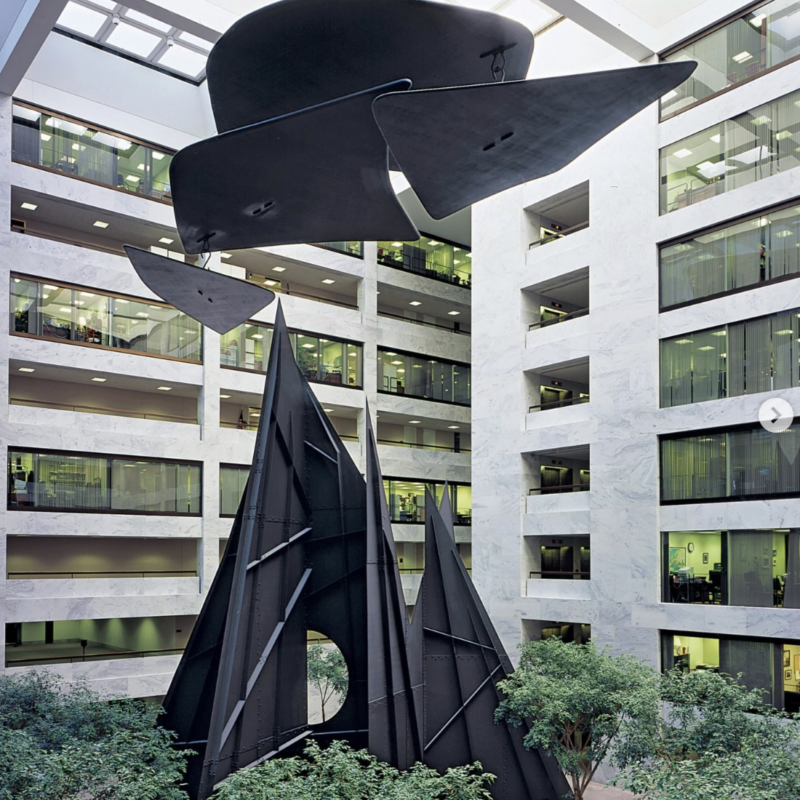
Mountains and Clouds is also his final statement. Designed for the nine-story atrium of the Hart Senate Office Building, it pairs a 51-foot black steel stabile of five triangular peaks and two arcs with a mobile of four black clouds suspended overhead. It is the only work in which Calder split those two forms into separate parts of one composition. He presented his final model in Washington on November 10, 1976, and died of a heart attack in New York the next day. With the estate’s permission, the piece was fabricated after his death, completed in 1986, and dedicated in May 1987.
From the start, the sculpture had a complicated life. Calder wanted the clouds to drift slowly above the mountains, turned by a motor, but the mechanism never worked as intended, and the clouds sat still for decades. After the 2011 Virginia earthquake raised safety concerns about some 4,300 pounds of aluminum hanging above Senate staffers, the clouds came down in December 2014. A structural study by the Architect of the Capitol later judged them unsafe to rehang and recommended rebuilding them to Calder’s original intent, whenever money could be found.
For years, the atrium held only mountains. Senator Chris Murphy (D-Conn.), whose home state was Calder’s longtime base, kept raising the issue at budget hearings, at one point wondering aloud whether he would live long enough to see the clouds return. Not every colleague shared his enthusiasm. When the clouds first came down, some senators openly questioned whether fixing a sculpture belonged on Congress’s to-do list.
Alexander Calder presented his final model in Washington on November 10, 1976, and died of a heart attack in New York the next day. With the estate’s permission, the piece was fabricated after his death, completed in 1986, and dedicated in May 1987.
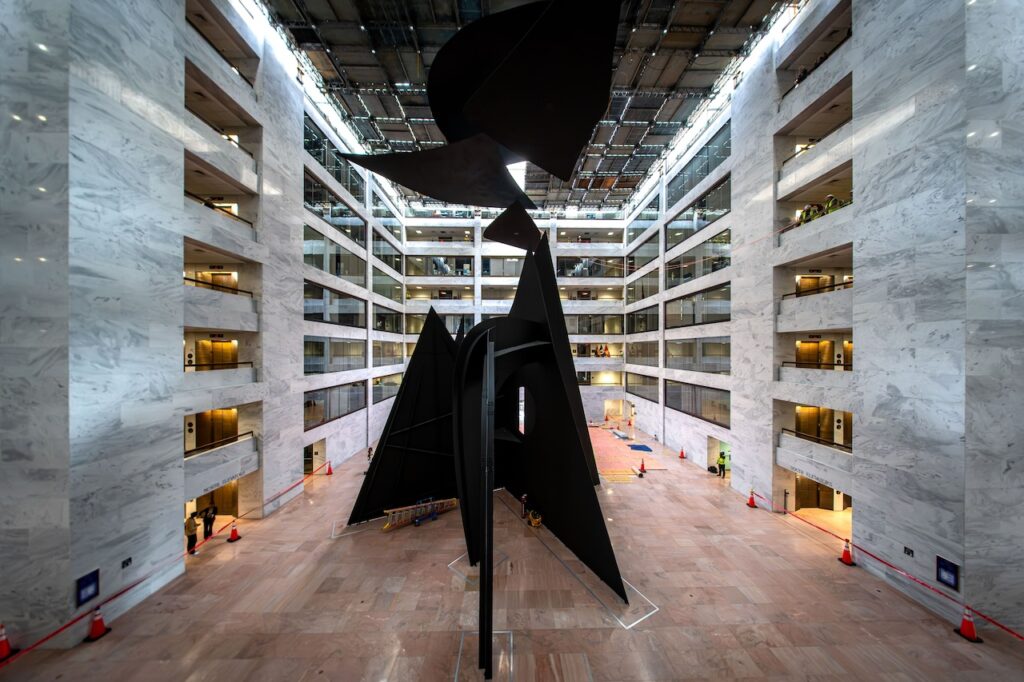
The eventual answer was a ten-year public-private partnership among the US Senate, the Calder Foundation, and philanthropists Jon and Kim Shirley, longtime Calder collectors. About $12 million in private funding paid for four new clouds made from a lighter carbon-fiber composite, an engineering upgrade that makes the mobile safer and more likely to move the way the artist imagined. But new materials raised an old question: what exactly should they look like?
Calder’s large-scale works are finished in a particular ultra-matte black that soaks up light instead of bouncing it back. On a monumental sculpture, that flatness matters. It turns each plate into a crisp silhouette, so the eye reads shape and edge rather than surface and glare. Against the white marble of the Hart atrium, that contrast is the entire drama of the piece.
By the time the clouds were being rebuilt, the paint was no longer in distribution. Without it, the new clouds risked looking different from the original mountains, and from what Calder intended.
This is where Maryland comes in. As reported in the New York Times, before her 2024 election to the Senate, Angela Alsobrooks, then Prince George’s County Executive, learned about the problem and introduced the Calder Foundation to the US Army Research Laboratory, which operates in her county. Researchers there told the foundation they could reproduce the color. According to her Senate office, Calder Black is now being produced in Prince George’s County.
“I am so proud of the role Prince George’s County is playing in rehabilitating Alexander Calder statues all over the globe – including Mountains and Clouds here in the United States Senate,” said Senator Alsobrooks. “I am especially proud to know that one day, when I no longer walk the halls of the United States Senate, Mountains and Clouds will still be standing, proudly, and serve as a symbol of working together, progress, and all the good Maryland has fought for – from paint to justice.”
Alexander S. C. Rower, Calder’s grandson and president of the Calder Foundation, told the Times that the paint may have seemed like a small, fussy detail, but it was essential to honoring his grandfather’s vision.
Crews began hoisting the new clouds into the Hart atrium in late September, reuniting mountains and clouds for the first time in 12 years. The Calder Foundation marked the moment on social media, noting that 2026 is also the 50th anniversary of the artist’s death. Balancing and motorizing the mobile is still underway. If all goes to plan, the clouds will begin to turn in November, something visitors haven’t seen since the early 1990s.
The timing feels meaningful. The Hart Building houses offices for up to 50 senators from both parties, and their staffs pass beneath the sculpture every day. Tyler Blackwell, curator of contemporary art at the Speed Art Museum in Louisville, wrote on social media that the restoration had him thinking about art’s potential to serve as a shared language for people with sharply different points of view.
“Art connects us, speaks to us, and supports us,” said Senator Alsobrooks. “When I was diagnosed with ADHD as a young girl, my parents didn’t fear, instead they put me in the Howard University Children’s Theatre Program, and I found that art and theater was a new way to express myself and use my talents. Now when constituents step into my office, their fears and angers may subside for a moment as they take in the beautiful Maryland art on the walls. And it is my sincere hope that the Mountains and Clouds do bring us closer together so the Senate can work to serve the American people for good.”
Calder built sculptures that respond to the air around them, but what finally set this one back in motion was a chain of people: a senator who wouldn’t let it go, private donors willing to pay for it, a foundation guarding a legacy, and a county executive who knew who to call. For Marylanders, there’s an extra reason to look up when those clouds start to drift. The black that makes them read as clouds is now made right down the road.
Bibliography
Alsobrooks, Angela. “ICYMI – Senator Alsobrooks Helps Locate Magic Calder Paint.” Press release, Office of US Senator Angela Alsobrooks, October 1, 2026.
Architect of the Capitol. “Structural Analysis: Calder’s Mountains and Clouds.” aoc.gov.
Artnet News. “Connecticut Senator Fights to Restore Calder Sculpture.” December 2014. news.artnet.com.
Artnet News. “A Mighty Calder Restored at Last.” Newsletter item, October 2026. (Confirm URL.)
“Calder’s Clouds Return to Capitol Hill, but Motion Must Wait.” Art in Context, October 2, 2026. artincontext.org.
Calder Foundation. “Mountains and Clouds, 1976/1986.” calder.org.
Calder Foundation (@calderfoundation). Instagram post announcing the return of the Mountains and Clouds mobile, 2026. instagram.com.
Blackwell, Tyler. Social media post on the restoration of Mountains and Clouds, October 2026.
Diaz, Olivia. “Calder’s Clouds Return to Senate Office After a Mountain of Problems.” New York Times, fall 2026. (Confirm publication date and URL.)
Roll Call. “Calder Clouds Are Rising on Capitol Hill.” September 25, 2026. rollcall.com.
Roll Call. “‘We Have Half a Piece of Art’: Chris Murphy Continues Quest to Reinstall Calder Clouds.” May 2024. Republished at murphy.senate.gov.
Smithsonian Magazine. “After a 12-Year Absence, Alexander Calder’s Mammoth Last Sculpture Finally Returns in Full to Capitol Hill.” October 1, 2026. smithsonianmag.com.