The eclectic mix of items on display at the entrance of Collecting Maryland at The Maryland Center for History and Culture (MCHC) are an apt introduction to the creative curation that goes into this pivotal exhibition.
As you turn the corner to enter the second-floor space, a stunning album quilt awaits. Its style was popular in the 1840s and consists of a collection of sewn-together appliquéd blocks that resemble a scrapbook or album. This example pops with red on its border and in the floral designs within each square.
Beside the quilt is a white-painted wood sculpture of the wealthy Mayer family, ancestors of Brantz Mayer who founded the Maryland Historical Society (which became MCHC in 2020) in 1844. The foursome sits on top of a pedestal that is engraved with a quote from Homer: “Of all the gifts Of Heaven, more precious none I deem, than Peace ‘Twixt wedded pair, and union undissolved; Envy torments their enemies, but joy Fills ev’ry virtuous breast, and most their own.”
The patriarch, Christian Mayer, gazes dotingly at his seated wife and their two small children. The elder stands beside her mother and the other, still a baby, is cozy in her lap. Finally, in a delightful contrast to this domestic tribute, hangs a red and blue neon sign from Tattoo Charlie’s, a parlor originally located on East Baltimore Street’s infamous Block. Tattoo Charlie’s became the first licensed tattoo parlor in the country in 1962, and along with some sketches, an early tattoo gun, and jars of ink, visitors can view the legal document.
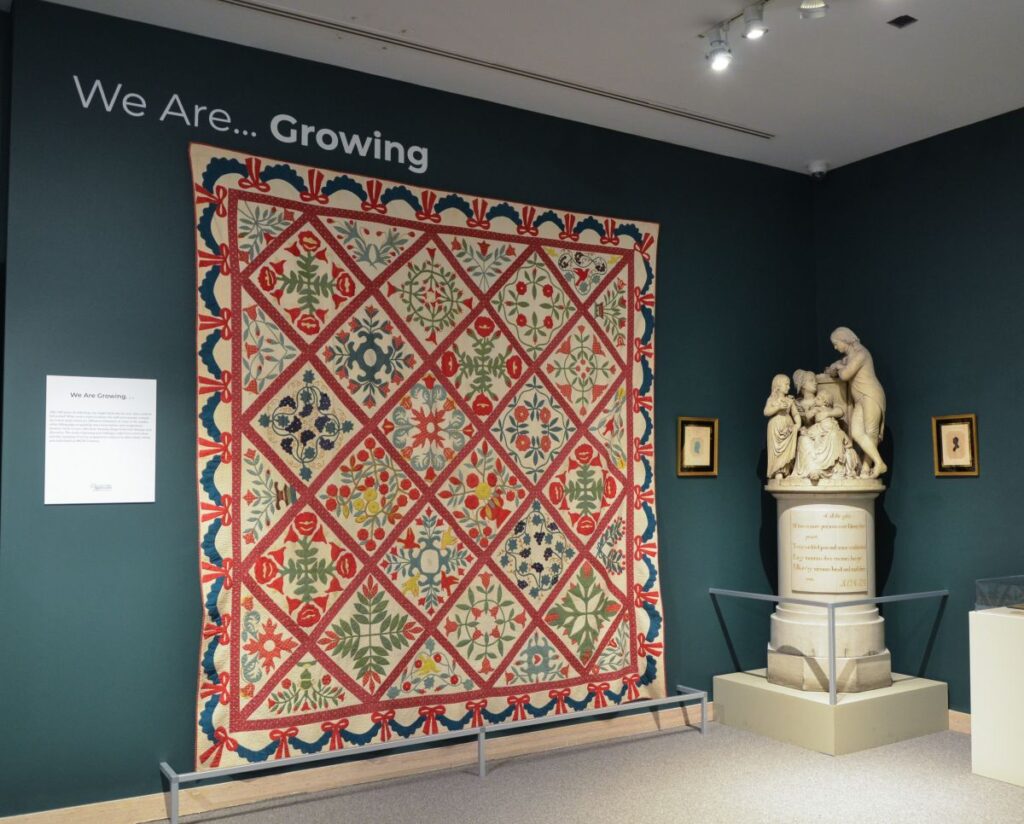
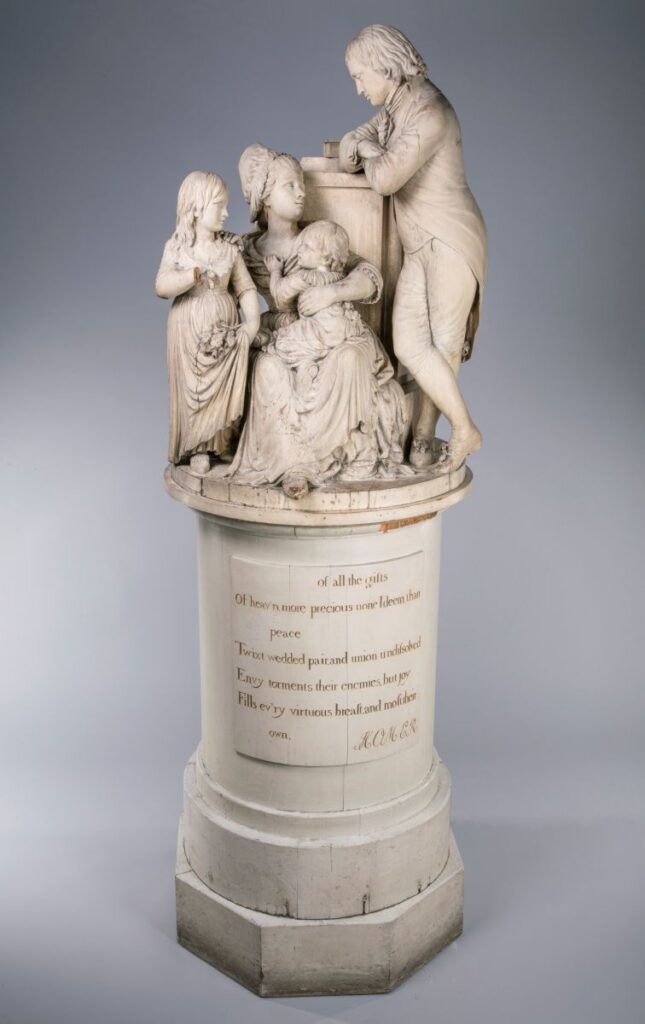
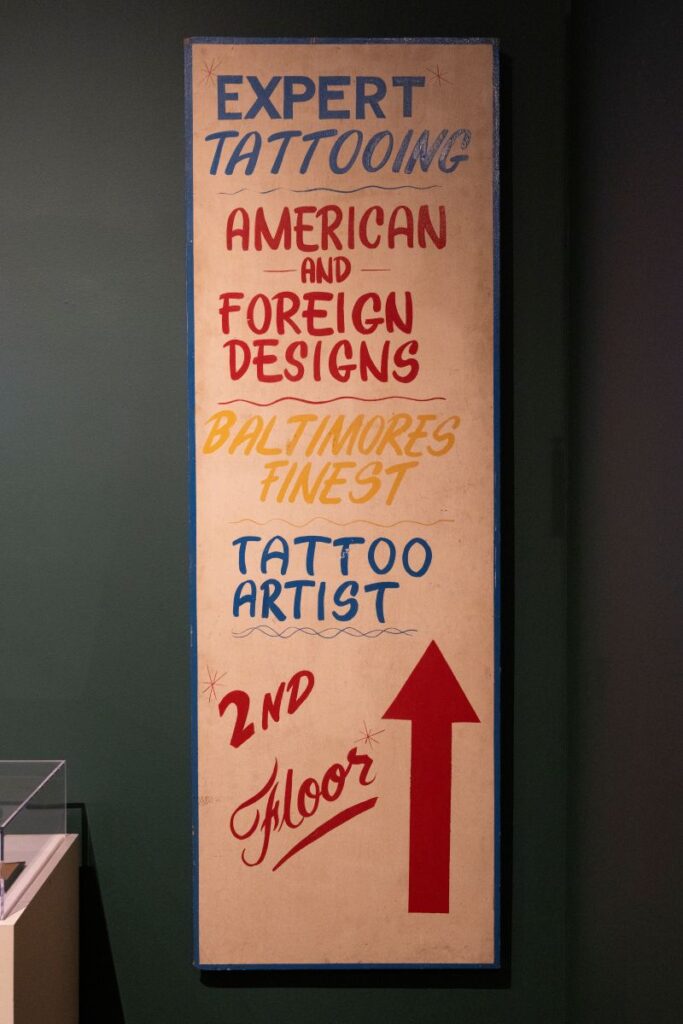
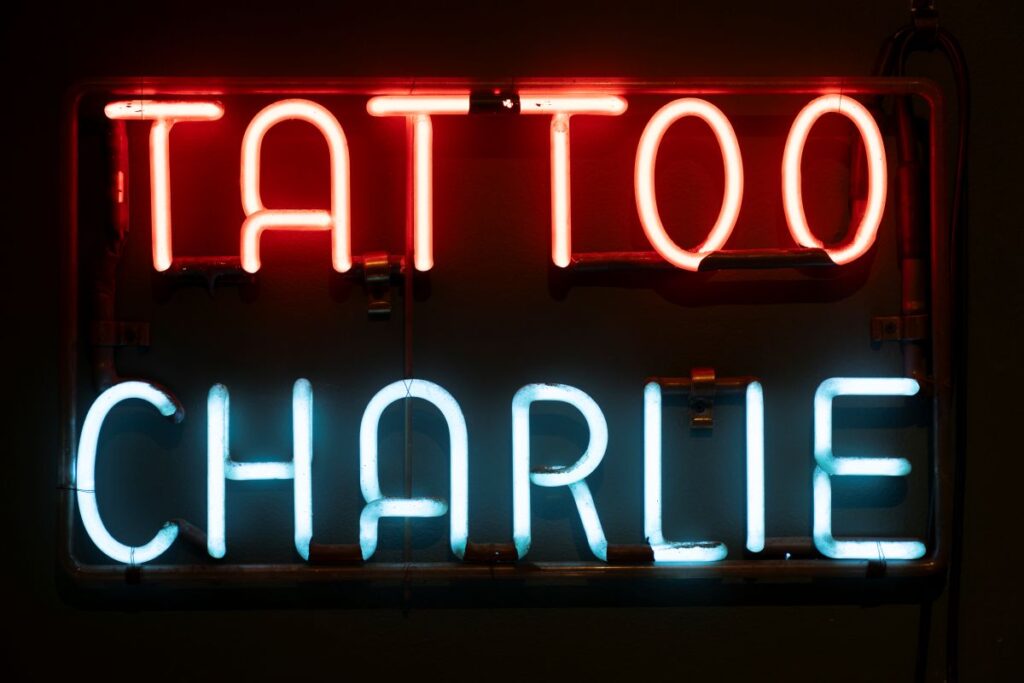
Elizabeth HazenThe curators highlight the idea that a collection, like history itself, is never static.
These diverse objects fall under the theme “We Are Growing,” one of several “We Are” categories that organize the artifacts in the Collecting Maryland exhibition. Each section has a theme that not only delves into Maryland’s rich history but also gives visitors insight into museum curation itself.
By featuring such a wide-ranging group of objects in “We Are Growing,” the curators highlight the idea that a collection, like history itself, is never static. Items continuously come to MCHC through donation and purchase, creating new conversations with the existing inventory. Part of the fun of Collecting Maryland is seeing the breadth and depth of Maryland’s history and considering the interplay among the many spheres of that history. Rife with artifacts that range in origin from personal to political, domestic to commercial, technological to artistic, the exhibit allows us to consider how these areas intersect and blend to create complex stories that strive to fully and accurately portray the past and help us understand the present.
Anyone who has visited MCHC will be familiar with their more traditional exhibits. In 2023, the popular Jim Henson show provided visitors with an overview of his tremendous career. Currently, there are displays on designer Claire McCardell, the Revolutionary War, painted screens, and other specific topics. Collecting Maryland is different. According to Chief Curator, Catherine Rogers Arthur, “Over the last 20 years or so, exhibitions here have become very tightly focused either on a topic or a time period and they’ve been more heavily designed by an outside designer.”
In contrast, as Assistant Curator Abby Doran explains, Collecting Maryland allows the curatorial team freedom and flexibility “to experiment with new ideas and rotate frequently. We invite our members and larger community to come and learn something new with each visit.” The team can show the collection’s greatest hits as well as highlight new acquisitions and explore topics that are trending in the museum field. The collaborative nature of the project also allows for a broad range of topics. “This was a joint effort,” says Doran. “Our museum assistant Katie Campbell, our registrar Paul [Rubenson], myself, and Catherine all took different sections of it—things that fit our research interests.”
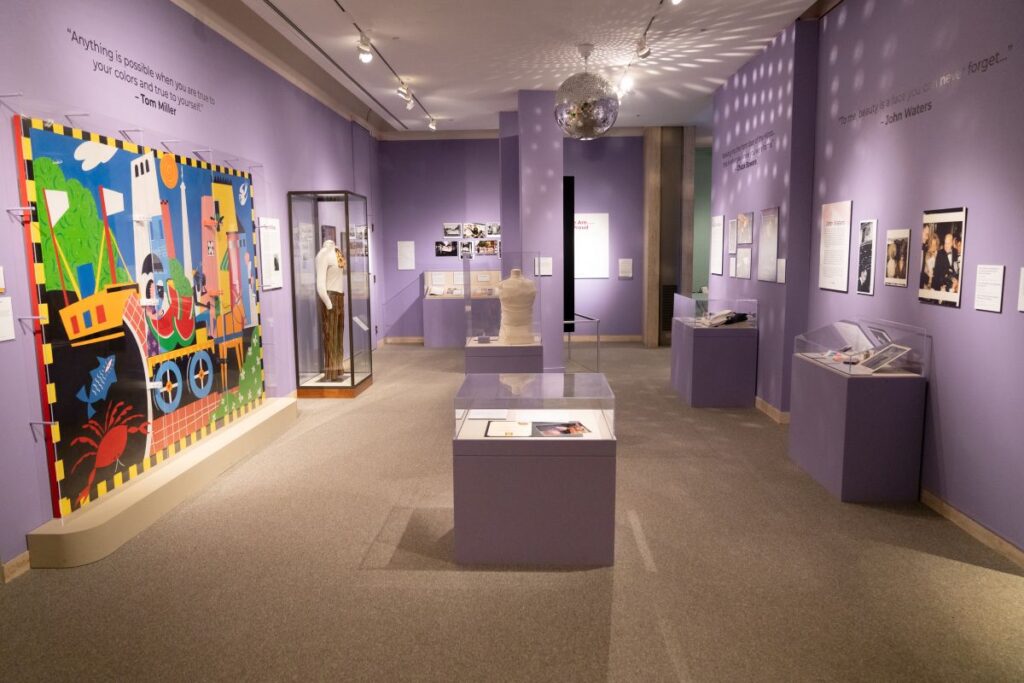
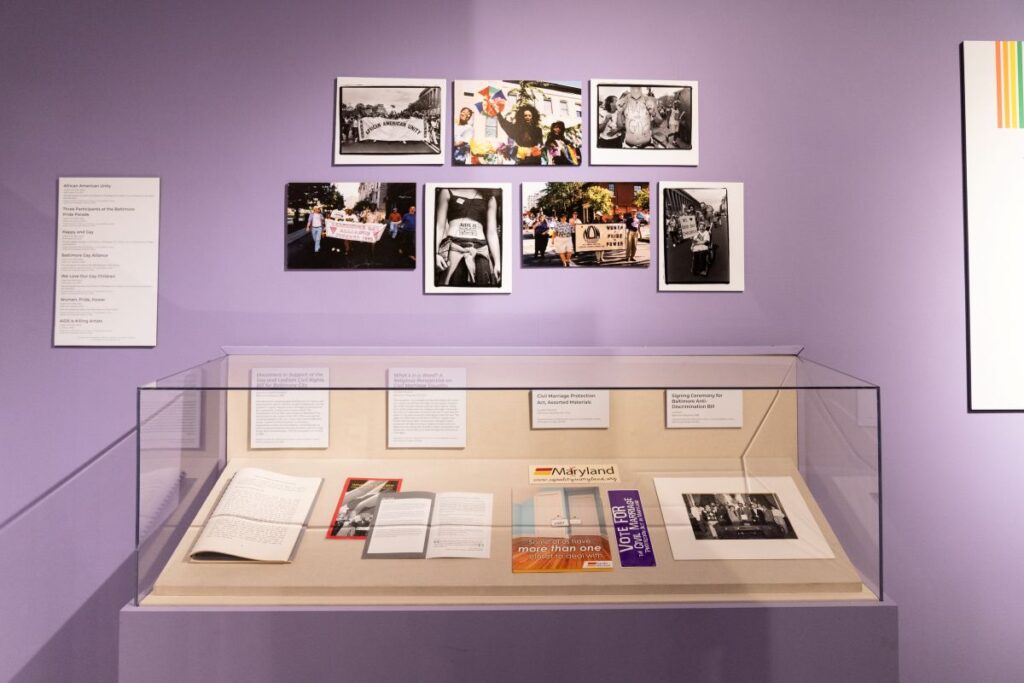
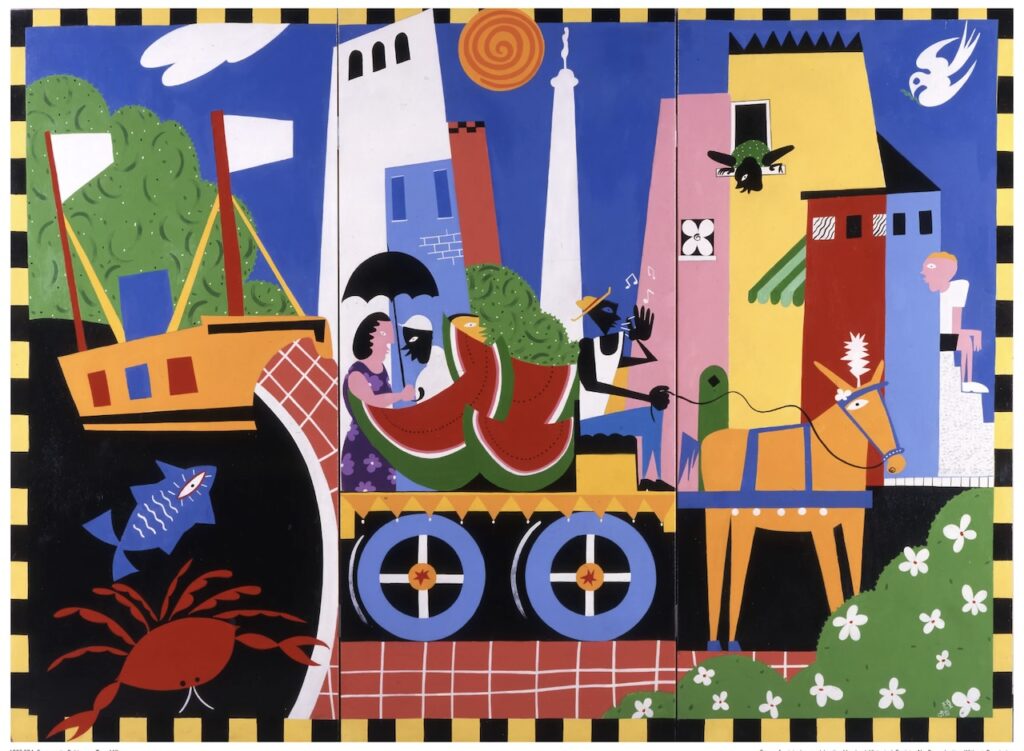
Indeed, the first completed section of Collecting Maryland began as a research project in one of Doran’s graduate classes. “We Are Proud” features artifacts from Maryland’s LGBTQ+ community. There are pictures from Pride parades and gay clubs, ephemera from prominent figures like drag king and activist Devin Cerubini, artist Tom Miller, and filmmaker John Waters.
You can see photographs and the marriage papers from the very first same-sex marriage in Maryland. All this history literally sparkles under the disco ball from the beloved Mount Vernon nightclub, The Hippo. Further emphasizing that recounting our past is never finite, there is a QR code for visitors to scan and add any suggestions for additions to the exhibit.
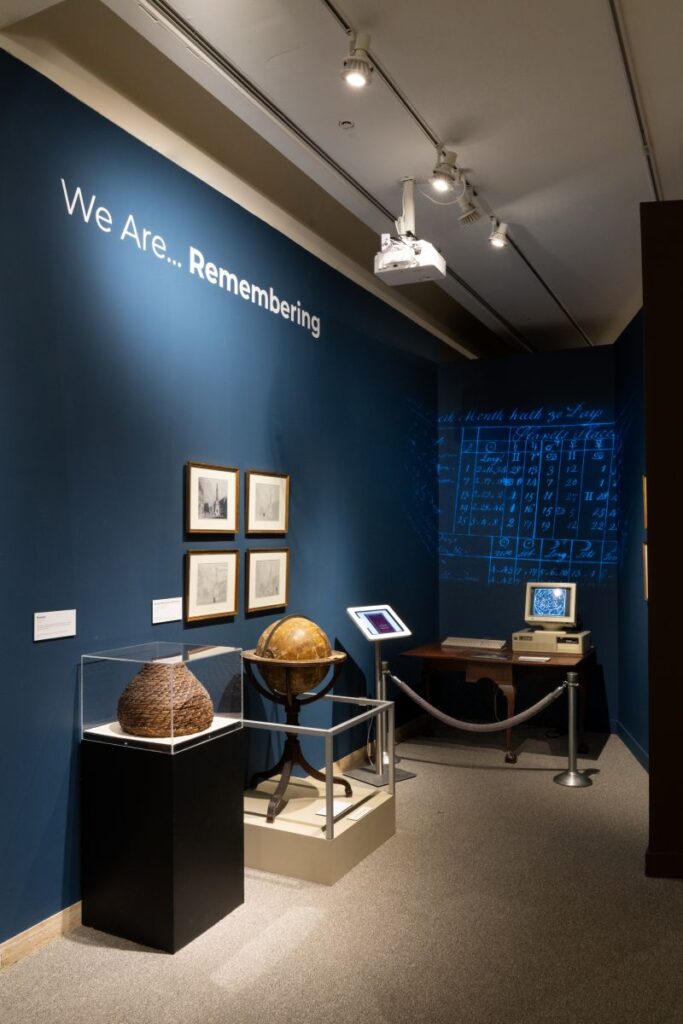
In addition to “We Are Growing” and “We Are Proud,” Collecting Maryland includes sections with the themes: “We Are Remembering,” “We Are Rethinking,” “We Are Celebrating,” “We Are Cherishing,” “We Are Local Traditions,” and “We Are Landmarks.”
These categories draw on MCHC’s core values of Community, Authenticity, Dialogue, and Discovery and provide some framework for an exhibition that is so broad in scope. “It is an extraordinary collection with over 350,000 objects,” says Arthur. “We have a lot of superlatives: the largest collection of album quilts, the largest collection of works by members of the family of Charles Willson Peale . . . the largest number of works by Joshua Johnson who is considered the first African American portrait painter. . . We have tremendous maritime collections . . .” And the list goes on.
MCHC has absorbed collections from the Baltimore Maritime Museum and the Baltimore City Life Museum, and while there is always a great deal to see, like an iceberg, what is visible is only a small percentage of the collection; there are still hundreds of thousands of items in storage.
“Part of what I wanted to accomplish with this Collecting Maryland,” says Arthur, “was to bring out of storage things that we’re known for, things that somebody might expect to see if they were coming to our institution.” The exhibit is also designed to rotate items regularly and change the themes over time, as Arthur notes: “It’s our intent to deinstall and rework various sections.”
Even with the categories to organize the vast collection, the process of selecting objects was not straightforward. “We started with a vignette approach,” says Arthur, “thinking as a curator, thinking of objects that make sense together.” The result is both visually pleasing and intellectually engaging. The section “We Are Cherishing” features many works by Joshua Johnson, the self-proclaimed “self-taught genius.” Johnson is notable not only for being one of the first professional African American portraitists in the United States, but also for building an enthusiastic clientele among the white merchant class.
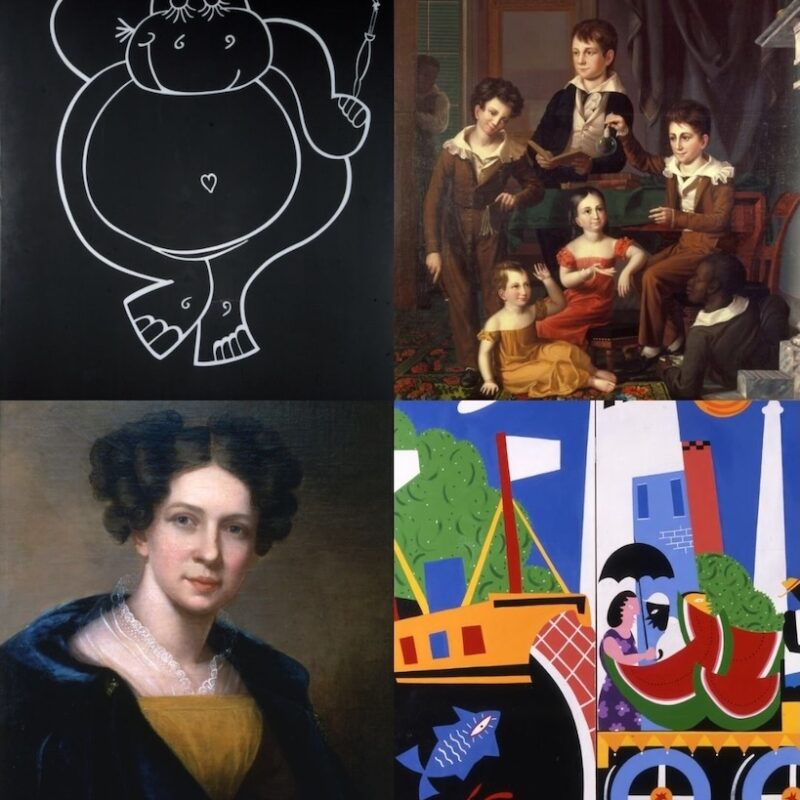
One such commission is a large-scale portrait, “Rebecca Myring Everett (Mrs. Thomas Everett) and Her Children” (1818). The painting features Everett sitting with a baby in her lap, a daughter standing to her left and three sons to the right. All the figures gaze directly at the viewer with slightly bemused expressions, and Johnson has captured the detail of their lace collars with such delicacy that the image seems almost three dimensional. The only sources of color are the baby’s red slippers, the red berries the baby and toddler hold, and the toddler’s bright red outfit which draws the eye to the center of the painting. The family sits on a Late Federal square back sofa; its brass tacks flash gold. Beneath the portrait, the same sofa, tacks and all, is on display.
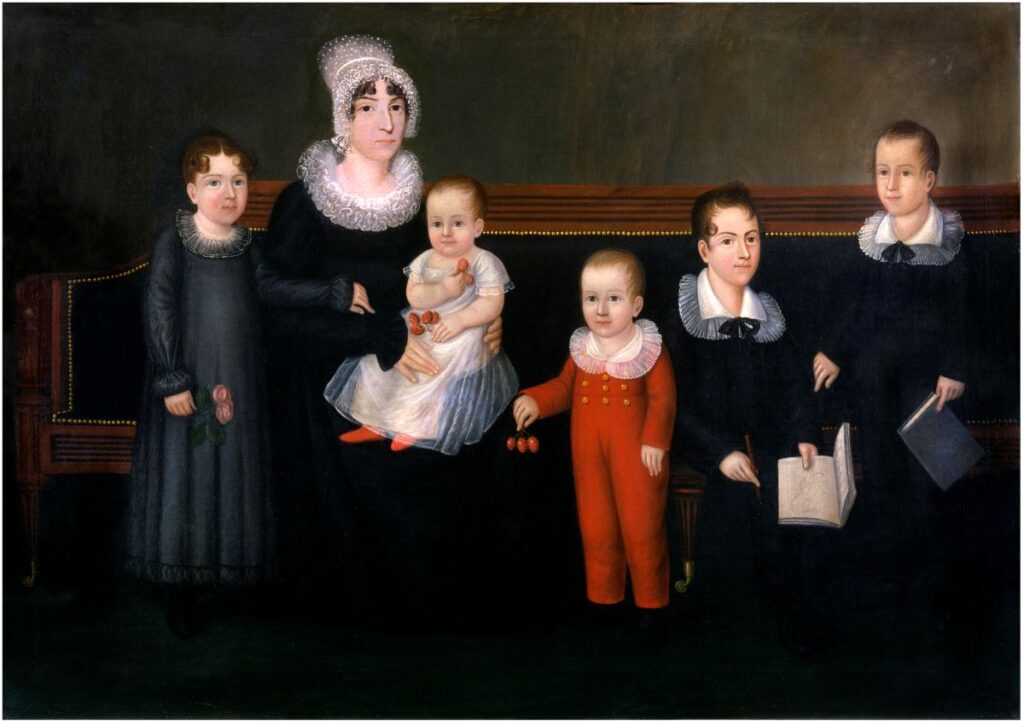
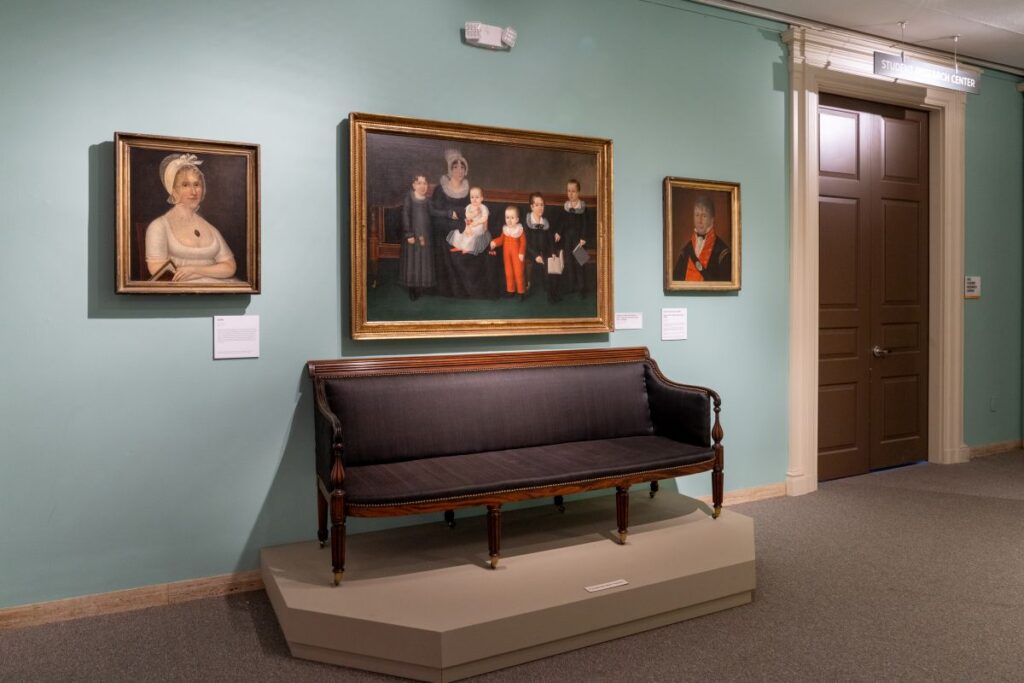
Elizabeth HazenJohnson has captured the detail of their lace collars with such delicacy that the image seems almost three dimensional.
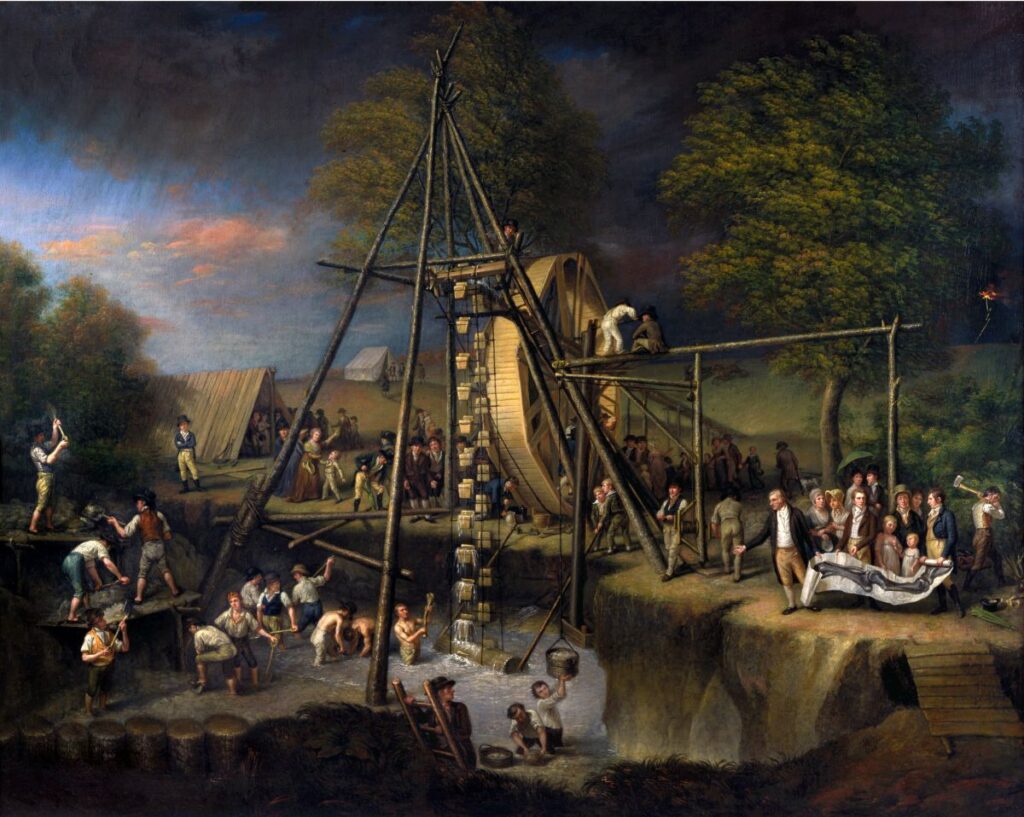
In “We Are Celebrating,” a painting by Charles Willson Peale, “Exhumation of the Mastodon,” portrays a team of men engaged in the arduous task of excavating the massive skeleton using the ingenious device Peale designed to bail water from the site in order to get to the bones. Beside the painting, you can see some of the actual bones of the mastodon. These juxtapositions add literal depth to the experience, as well as a stronger connection to the people portrayed in the two-dimensional artworks. The text adds additional context, bringing the scenes to life.
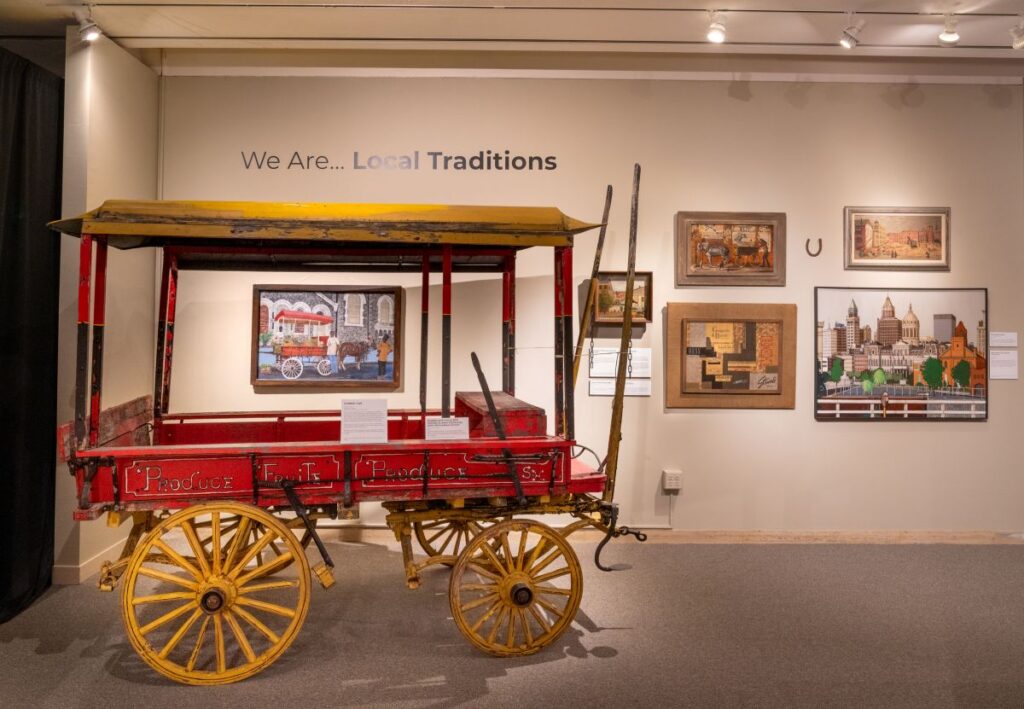
In “We Are Local Traditions,” you will find a nineteenth century arabber cart which is an overwhelming presence on its own, large and imposing in the interior setting. In the same section a late twentieth century painting, “Baltimore Arabber” by Nathaniel Kato Gibbs is displayed beside a twenty-first century painted screen, “Arabber and Cart at 2013.” The former shows two men guiding a red cart very similar to the one on display. Mount Royal Avenue’s Corpus Christie rises in the distance, and the studious horse pulls along the day’s wares. The latter depicts not only the arabber tradition with the iconic red cart but also portrays the celebration of painted screens themselves at the 2013 Painted Screens Centennial. Exhibition text explains that fewer than a dozen active arabbers exist in the city today.
Another powerful aspect of Collecting Maryland is the way in which it provides a look into what has changed in museum curation over time. The sections “We Are Remembering” and “We Are Rethinking” address the ways in which our understanding of certain artifacts has changed over time. These sections harken back to the innovative work by installation artist Fred Wilson in his 1992-1993 exhibition, Mining the Museum.
In this seminal project, Wilson essentially changed museum curation by calling into question the way we portray and perceive history, culture, and race by de-centering the primary story. Through techniques like highlighting unnamed figures in artworks by placing vellum over them and then cutting windows around the peripheral figures, Wilson redirects our attention and forces us to think about the original image in a new way. Wilson’s project changed the way curators did their work, and “We Are Rethinking” includes items that ask viewers to look at history from the point of view of those who were often on the sidelines.
In this section, you learn that with the passing of NAGPRA, the Native American Graves Protection and Repatriation Act, in 1990, any institutions holding indigenous remains or funeral associated objects needed to try to find the rightful owners. This led museum curators to shift their interpretations and center indigenous voices, allowing them to, as Doran explains, “start conversations about complicated subjects like land ownership and the founding of Maryland.”
One of the paintings in “We Are Rethinking,” “Paul with Henry Darnall III” (ca. 1702-1787), was not always known by this title. The image is startling. Paul is standing slightly behind Henry, fading into shadow. He gazes up at his young master, a dead fowl dangling from his hand. Henry stands front and center, a child himself, but dressed up in the garb of a young man and holding a bow and arrow. Light gleams on the silver collar around Paul’s throat. The first known depiction of an enslaved person in America, the work was originally called “Unnamed Attendant with Henry Darnall III.”
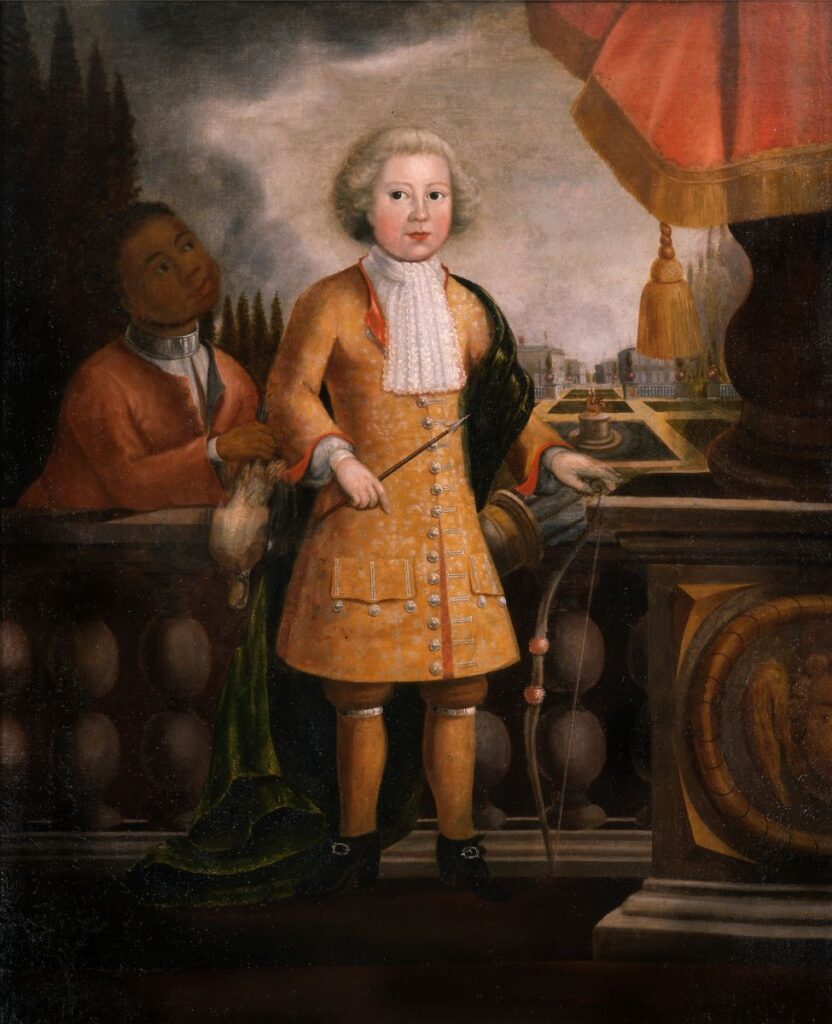
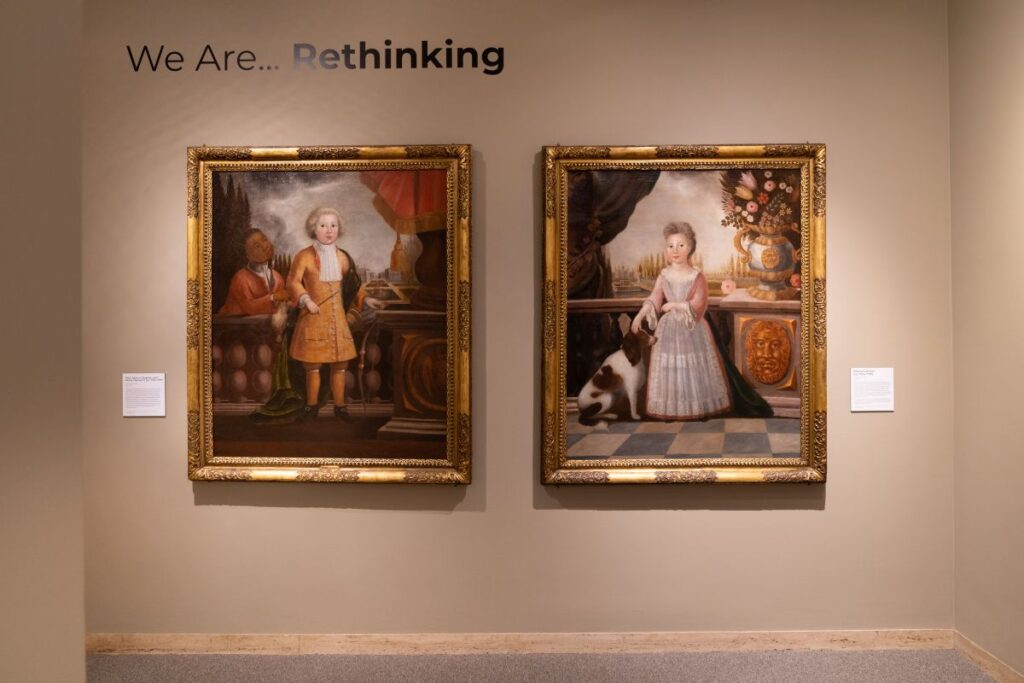
Catherine Rogers ArthurIt’s hard to look at in many ways, but I think it’s more important to be unflinching and truth telling and also to talk about the process of learning and knowing and researching.
In Mining the Museum, Wilson highlighted the anonymity of the enslaved child by animating the picture with a recording asking, “Am I your brother? Am I your friend? Am I your pet?” The painting had been in storage for years, and Arthur wanted to bring it back on display, but this time with the child identified.
Museum assistant Katie Campbell “checked probate inventories and wills, and lo and behold, she was able to find an inventory [for Henry Darnall I] because enslaved people were considered property, so that’s where they tend to show up. At the dwelling house, there are three children listed—Paul, age twelve, Jack, age nine, and Stephen, age seven—and then they were all possible names for this sitter.”
After reaching out to art historian Yael Gordon, the team determined that Paul is the figure in the painting. Arthur continues, “We’re still trying to learn more, and we recognize that it’s hard to look at in many ways, but I think it’s more important to be unflinching and truth telling and also to talk about the process of learning and knowing and researching.”
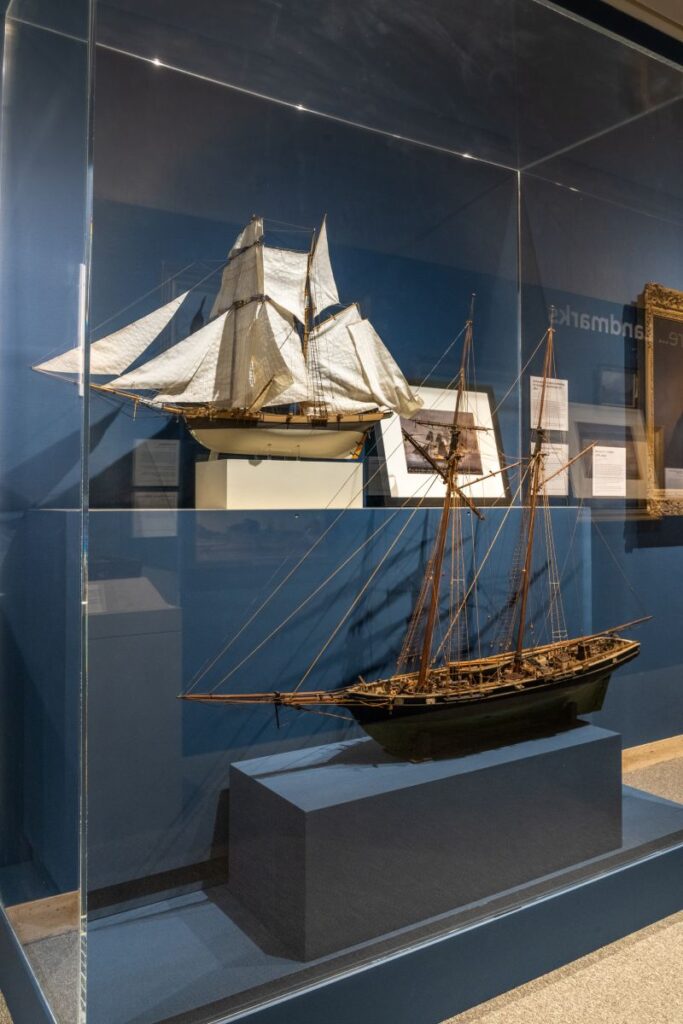
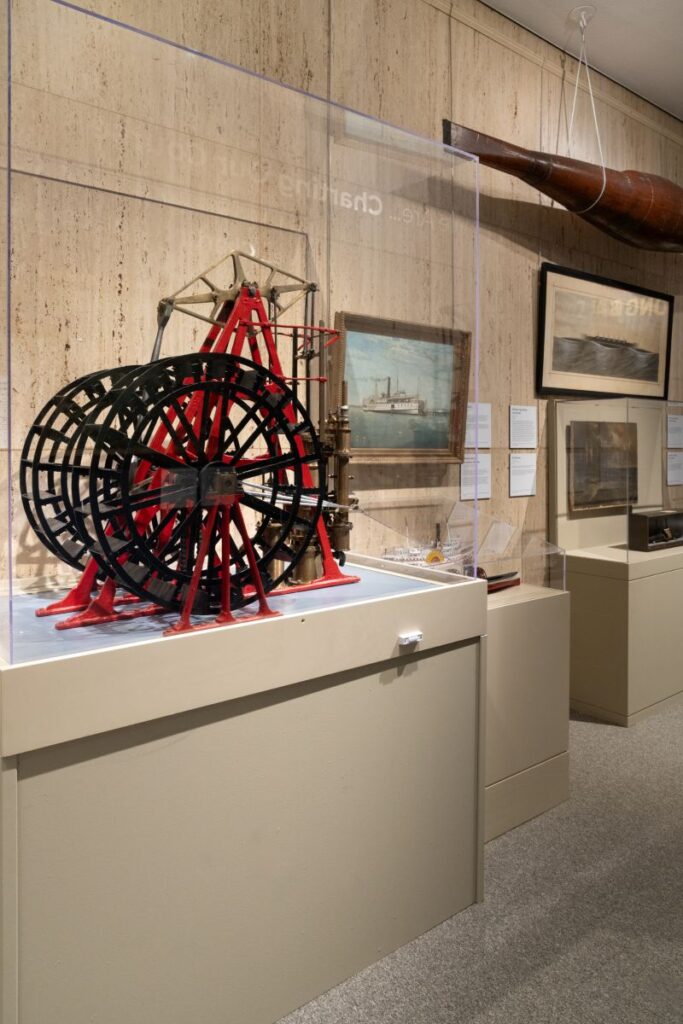
The exhibition is continuously changing and through the thoughtful curation, it suggests less obvious connections and broader views of Maryland’s history. One of the final installations in Collecting Maryland focuses on Maryland’s maritime history with paintings and drawings of the Chesapeake Bay and work craft in the bay, along with ship models and artifacts from the ships themselves.
“We want to keep some of this maritime focus,” says Arthur, “and what we’re talking about doing is a revamp where we focus on the Chesapeake Bay more broadly which will let us talk about working craft. It also is critical as a jumping off point for the Civil Rights story. . . the fact that working as a ship caulker in Fells Point is where [Frederick] Douglass self-emancipates, and he’s able to do so because of the balance between free and enslaved labor. Baltimore is also home to the first Black union of workers. . . This ties to the ship caulkers’ houses which are down on Wolfe Street and have just been restored in partnership with Living Classrooms.”
History is a complex web, not a linear story, and Collecting Maryland allows curators the freedom to explore the many threads so that visitors get a richer, more organic sense of the past. The curation itself even expands beyond MCHC. Under the leadership of Public Programs and Outreach Manager, Chloe Green, MCHC is teaming up with Living Classrooms for boat tours of the harbor and Preservation Maryland for a podcast, “Revolutionary Maryland.”
This expansive view of history and collaboration with other organizations is a powerful way to present the narratives that lead us to the present moment. “It really makes sense and exposes our membership and people interested in us other really great organizations,” says Arthur. “And out of that flow a whole host of new and fun experiences.”
Find more information on Maryland Center for History and Culture and the Collecting Maryland exhibit here.