I apologize to Emma Childs for inquiring about her pig before her paintings.
I am told that Plum the pig—somewhat of a neighborhood celebrity in her own right—is happily sunbathing in the backyard of Child’s absurdly cute 19th century Cathedral Hill rowhouse, enjoying the first warm day of spring while the painter is stuck inside on a Zoom call with me. Meanwhile Biggie, her almost-as-popular Staffordshire Bull Terrier, is sprawled loyally at her feet off-camera.
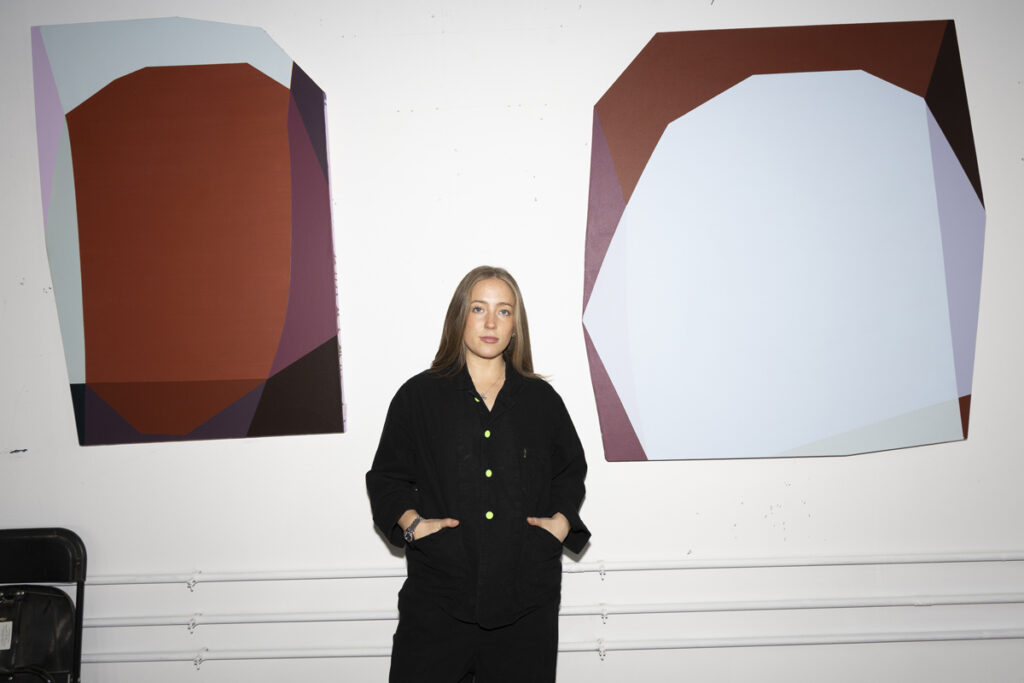
I grimace and acknowledge that I am doing a thing I hate. All too often, the press likes to ask young, glamorous—especially female—artists those kinds of who are you wearing? lifestyle questions instead of focusing on their practice. But I am equally curious about the rising painter and her work. Both have an enigmatic draw I feel compelled to “get.” The painting behind her is titled Slow Burn II, and that’s an apt descriptor of her œuvre as a whole.
Childs laughs incredulously at my apology. “When I’m working in the studio, I wouldn’t describe my day-to-day as particularly ‘glamorous’—but I’ll take it!”
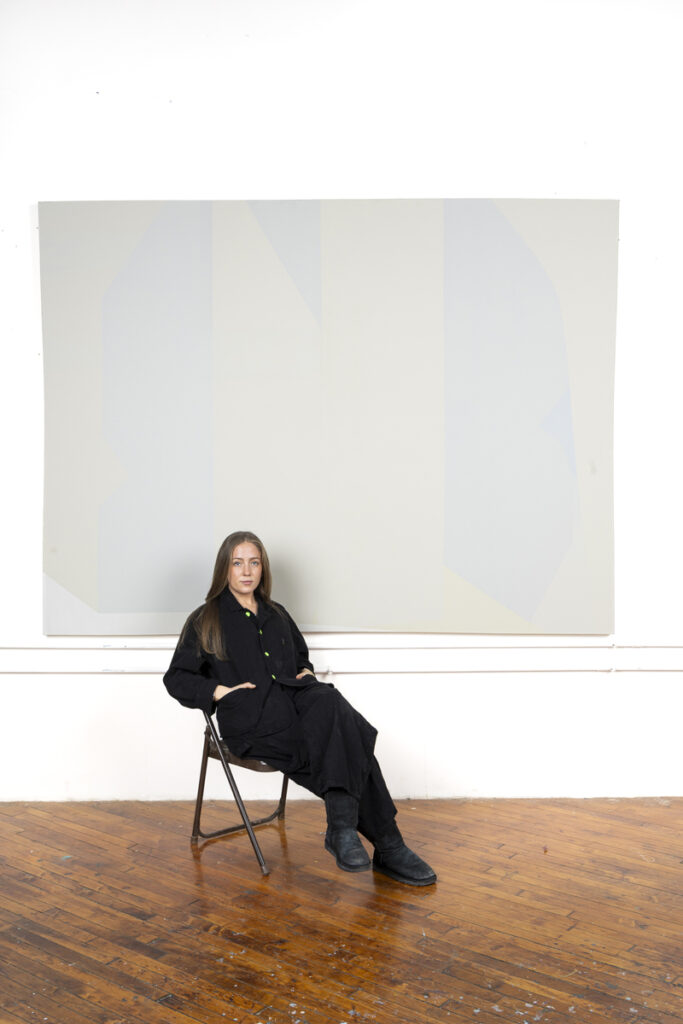
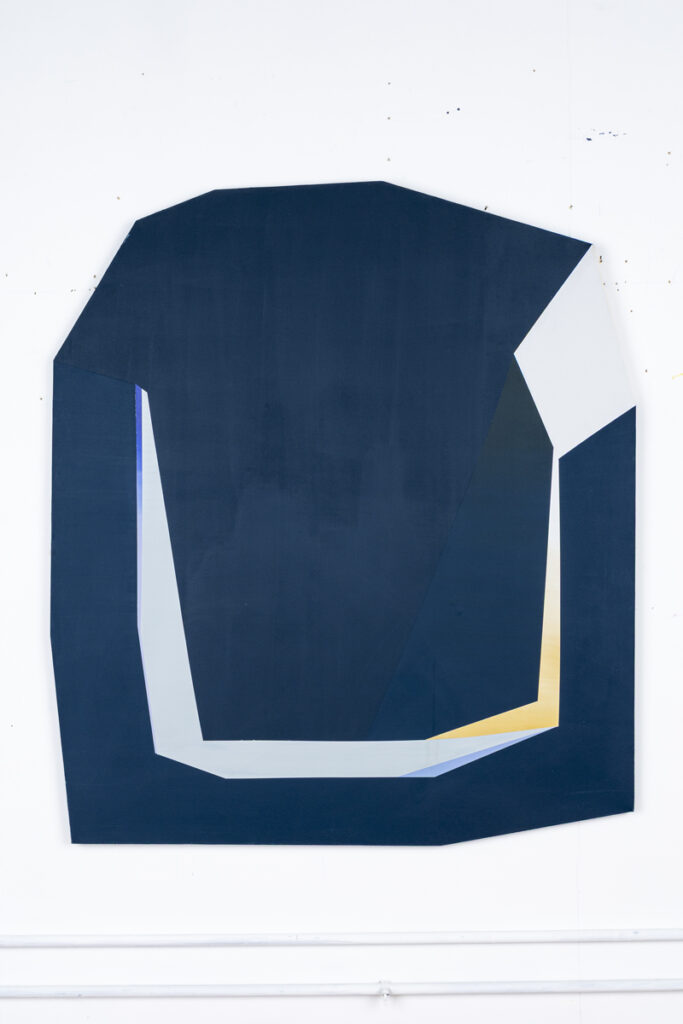
Her irregularly-shaped, deceptively complex abstractions are, in fact, a bit nerdy—in the best way possible. That’s not because, from a distance, some look like they wouldn’t be out of place on the set of an old episode of Star Trek or Doctor Who. Rather, Childs is a total painting and color theory nerd. Over a Zoom call, we grin recalling the giddy unboxing of our first sets of screen-printed Color-aid paper as MICA students (she graduated 2018) and all the limitless possibilities they represented. She still has hers on-hand in her studio, well-used and dog-eared with chunks cut out for Albers-esque experiments. She likes going to hardware stores and buying up interesting cans of “oops” housepaint, tinkering by adding pigments and different acrylic media to arrive at surprising consistencies or saturations. She applies these to hand-built, asymmetrical canvases while carefully maintaining cohesion between strata of different paints with potentially-incompatible surfaces. Her work’s integrity depends as much on knowledge of chemistry and material science as it does the subjective alchemy of color.
Like many people, I first experienced Child’s paintings via photo documentation. Scaled to a backlit phone screen, her compositions read as the kind of tempting, polite, decor-friendly abstraction adored by interior designers. Indeed, her paintings can be found in the lobbies of luxury buildings and skyscrapers from Toronto to Nashville, as well as corporate collections such as the Amazon “HQ2” headquarters outside D.C.
But seeing them in the flesh is one of those “aura”-affirming art experiences that could jolt Walter Benjamin out of his grave. If we’ve grown accustomed to processing painting as an image—Art in the Age of Digital Reproduction, anyone?—Emma Childs aggressively asserts the canvas as an object. Some seem to vibrate. Others suck the viewer’s gaze into an abyss, only to remind you of their “flat” nature with patches of gloss. They are, oddly, the least painterly paintings whose surfaces still manage to function as indices of their own making.
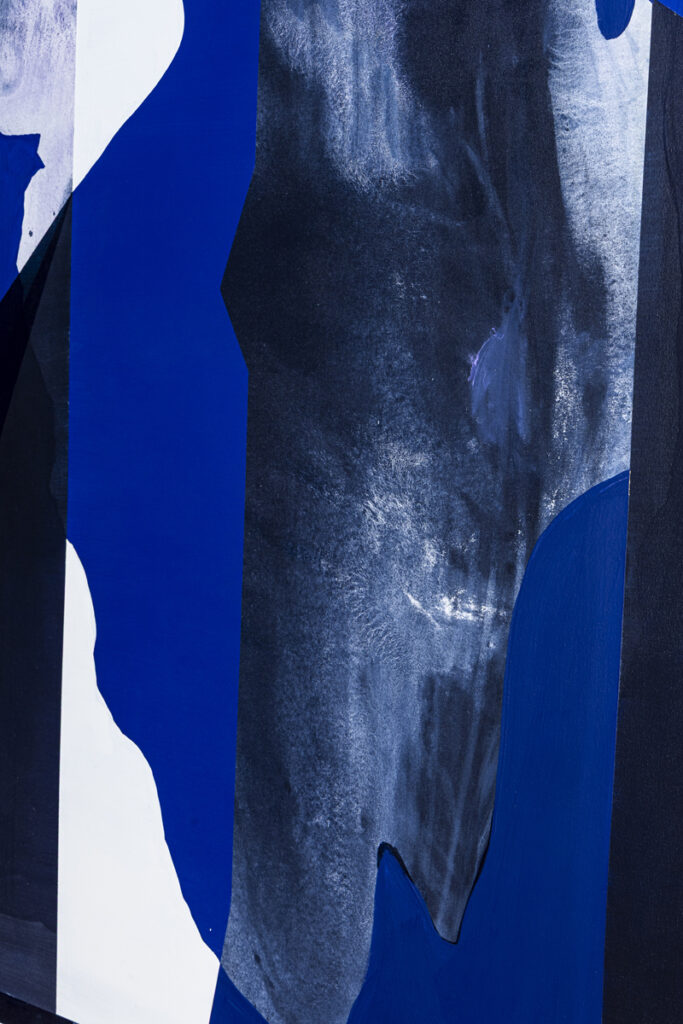
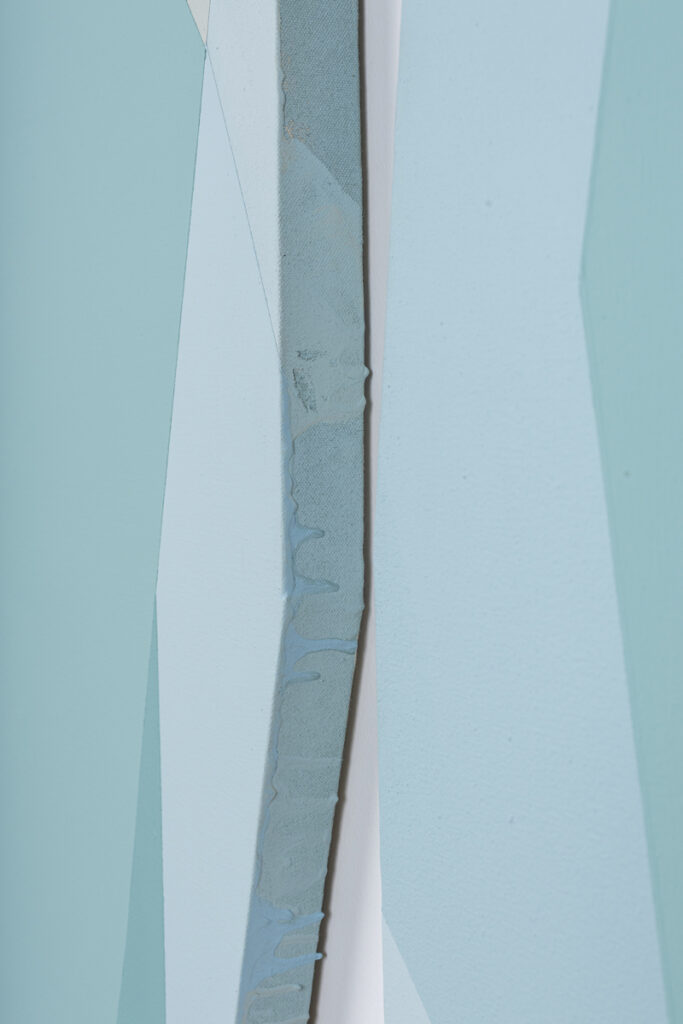
Childs may leave precious few visible brushstrokes, but plenty of other “evidence,” as she phrases it, of how her paintings are assembled. Edges that might look like crisp, hard-edged minimalism in a thumbnail bear marks of tape, drips, and subtle variations in translucency and thickness up-close. “It’s a way of tracking my thought process, and how I came to a conclusion…” Childs says of these details, “It also helps me really not be attached to any part of my work, because it’s so much more about the process. I really like that it kind of tricks you when you see it in person. Because I think my work’s very inviting in a graphic sense—it’s very digestible on a screen—which is helpful in ways.”
But full-size, many of Childs’ largest paintings loom over me (I am 5’11”) when hung on a wall. Some have a muscular bravado that seems to alter the architecture around them—visually pushing the ceiling a little higher, or contracting and warping the corners of a gallery when hung on perpendicular walls. Some command a wormhole-like gravity, though the painter claims to be less interested in the picture plane’s illusionistic space than “where I want weight to fall and where I want rhythm to happen. While I’m figuring out a composition the colors are whack and it’s not like what I want it to look like… but I’m figuring out the light quality, and where I want that light to be distributed on the surface.”

I mention my height because Emma Childs is about a head shorter than me. She just turned 30, but her slight build and something about the way she carries it makes her seem much younger. Except for the times she furrows her brow while discussing paint viscosity or qualities of light, she speaks with a near-permanent mischievous, slightly-aloof twinkle in her eye—as if holding back a dirty joke to be whispered later. Impeccably dressed with nary a drop of paint in sight, she is wholly not how I had imagined the author of the heavy, heady paintings causing such a buzz around town and beyond.
I confess that I had a hard time reconciling my mental image of Childs the painter hunched over dripping, jagged, formalist slabs on sawhorses and Emma the fun neighbor who always has great shoes and a cadre of nightlife personalities.
“It’s funny you should say that, because I think about that a lot… I’m alone all the time in my studio. And my work feels so inner, just internal… And then I have a whole other part of my life that’s very social and feels completely like a totally different experience. I almost forget about the work once it’s done… it almost doesn’t even feel like the part of me that’s outside of the studio.”

Emma ChildsWhen I’m working in the studio, I wouldn’t describe my day-to-day as particularly ‘glamorous’—but I’ll take it!
In the year before I met Emma Childs, I heard her name constantly in conversations around the Baltimore art scene—usually followed by disbelief that I didn’t yet know her. That stylish girl in fabulous sunglasses walking a pig around Mount Vernon!? She’s like, the hottest painter in Baltimore now! You’ve definitely seen her at parties! She’s friends with everyone! If this city had a slightly gossipy-er arts-and-culture rag—think The Village Voice in Manhattan’s hipper heydays—we likely would’ve seen headlines to the effect of “Does Baltimore Finally Have a Downtown ‘It’ Girl?” Something about Childs’ seemingly effortless cool does, in fact, suggest she could’ve stepped out of a 1990s photo from some Lower East Side loft happening alongside Parker Posey or Chloë Sevigny. And much like those references, all the gays I know love her.
But thankfully Childs is unscathed by New York neuroticism. The painter grew up in pastoral Monkton, Maryland—far enough outside the city to retain a sense of wonder about it, but close enough that she fell into its gravity well. She attended the all-girls Garrison Forest in suburban Owings Mills, where the director of the art department, BJ McElderry, encouraged her to apply to MICA.
It was there she met another mentor who would change her life: the late, legendary painting professor Timothy App. “With his passing, I went back and found my notebooks from his class—because it was just so formative for me. I would write down everything he said,” a wistful look weighted by reverence washes over Childs’ face, “He said, ‘A good painting puts out more energy than it took to create it.’ I just love that. It gives you permission to call something done when you start to feel that.”
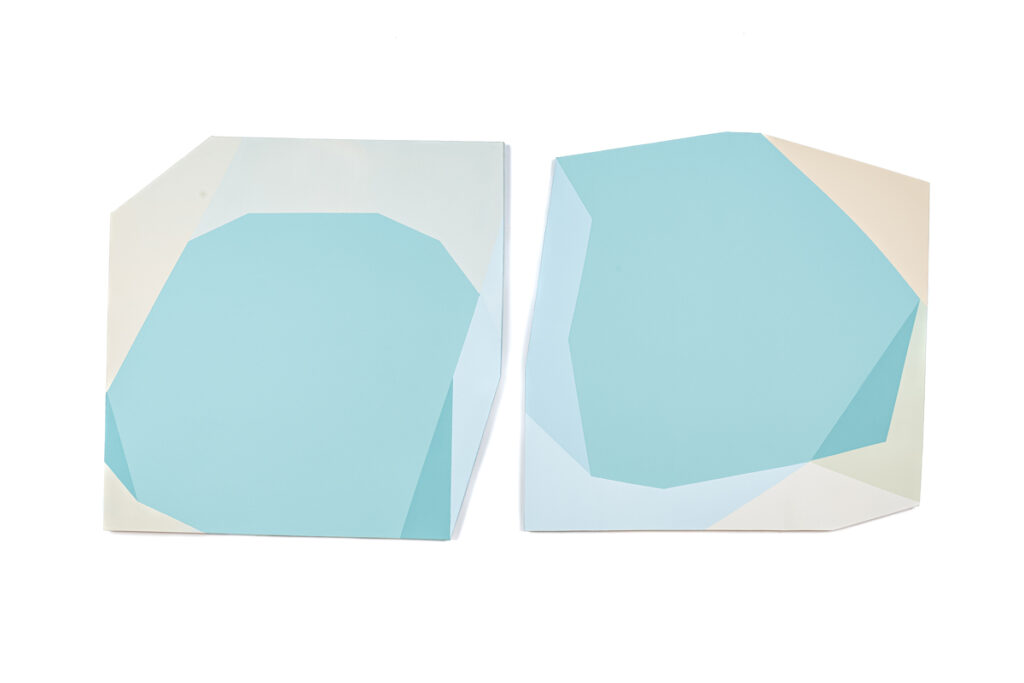

Putting out energy, I think to myself. That’s the curious, elusive thing Emma and her paintings have in common. I like to know why I like an artwork (or a person) and Childs and her inscrutably simple/layered/familiar/surprising/cold/inviting/retro/futuristic paintings had presented me with a mystery I felt compelled to interrogate. In much the way her angular canvases seem to warp and brighten whatever space they occupy, hanging out with Emma makes the people in her orbit feel more glamorous themselves.
I finally did meet Emma Childs for the first time last year outside Swann House, where we both had attended an afterparty for the inaugural SCOUT Art Fair. Childs’ booth at the fair had sold well, and everyone wanted to keep the party going. We ended up back at her house a few blocks away, which—like many things about Childs’ life and practice—feels cozy but uncluttered, save for stacks of art books and publications. Lounging on a vintage couch and overhearing conversations between curators and public health workers or attendees of the art fair and attendees of a vogue ball the night before, I imagined what it must’ve been like to sit in Gertrude Stein’s salon in Interbellum Paris. I think I blurted out, “Okay! We really do need to be friends!”
A few weeks later, among hundreds of thousands of people in the crowd at Barcelona, Spain’s Primavera Sound music festival, I spotted someone familiar. Against all odds, I ran into Childs in the front row of the mosh pit in the VIP area during Turnstile’s set—she is, of course, good friends with the Grammy-winning hardcore punk band.
But if my associations with Childs seem a bit anachronistic and geographically scattered—1920s Paris! 1960s Outer Space! 1970s Washington Color School! 1990s New York!—she’s very much of 21st century Baltimore. The young artist has deftly wielded social media to extend her paintings’ reach far beyond the beltway—with over eleven-and-a-half thousand (and counting) Instagram followers, @emmechilds might be one of the most visible young artists working in the city today.
And Childs’ future is as bright as an elusive warm blue pigment. At her studio in the Crown Industrial Park—appropriately assembly-line-like—she bops around tweaking roughly two-dozen paintings of varying shapes and sizes at different stages of drying. At times she props them up and rearranges them to see how they speak to one another, “always waiting to be surprised.”
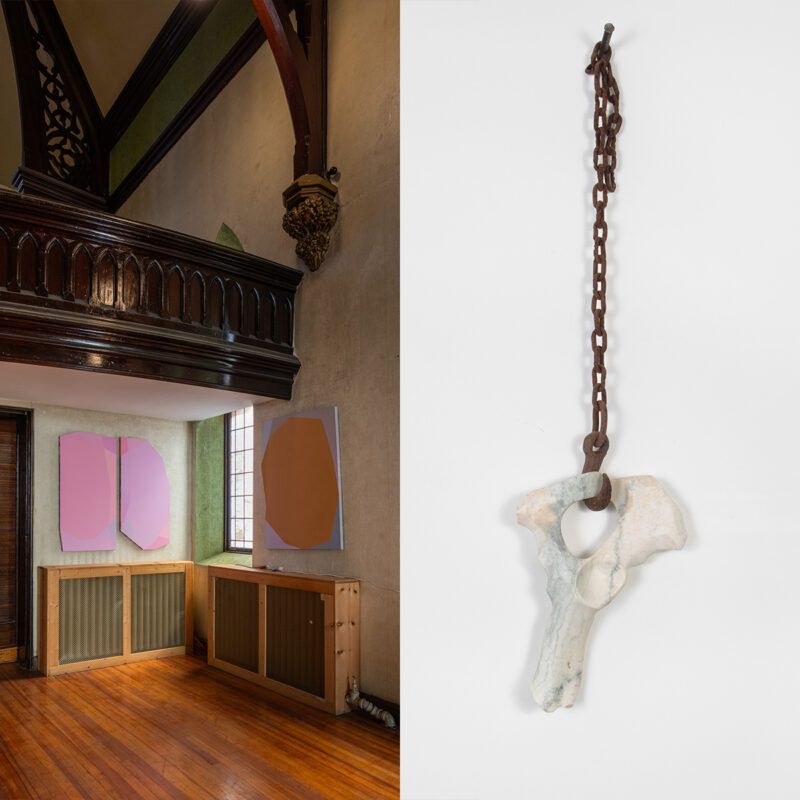
The most ambitiously-scaled canvases are destined for Chora, a site-specific exhibition in Mount Vernon Place Church, organized with curator/BmoreArt contributor Teri Henderson, which will open September 25th and remain on view until February of 2027. I imagine how Childs’ luminous paintings will dialog with the Norman Gothic revival interior. Her carefully-considered layering of vivid, oft-translucent colors do recall stained glass windows. But while that medium was historically employed as a sort of proto-cinema—architecture as narrative/propaganda—Childs’ abstractions are a visceral, purely aesthetic experience. If the architects of cathedrals famously proportioned some arches to relate to human bodies, what scenes could we, the viewers, imagine stepping into via two-meter-tall Emma Childs canvases?
Bigger on the inside, I think back to Doctor Who. Or, perhaps more appropriately, the classic Star Trek episode City on the Edge of Forever—in which a glowing, geode-like portal also offers the potential to travel across time and space.
One thing is almost certain: like the artist herself, the show will be stunningly photogenic—but even more engaging face-to-face in Charm City.
Chora opens Friday, September 25th, 6–9 p.m. at Mount Vernon Place Church (10 E. Mt. Vernon Place, 21202). RSVPs are appreciated at [email protected].
Open Hours: Saturdays, September 25 – February 1. The exhibition is also available to view by appointment. To schedule a viewing, please email [email protected].
Additional events and activations, including pop-up performances, workshops, and receptions, will be announced in the coming weeks.