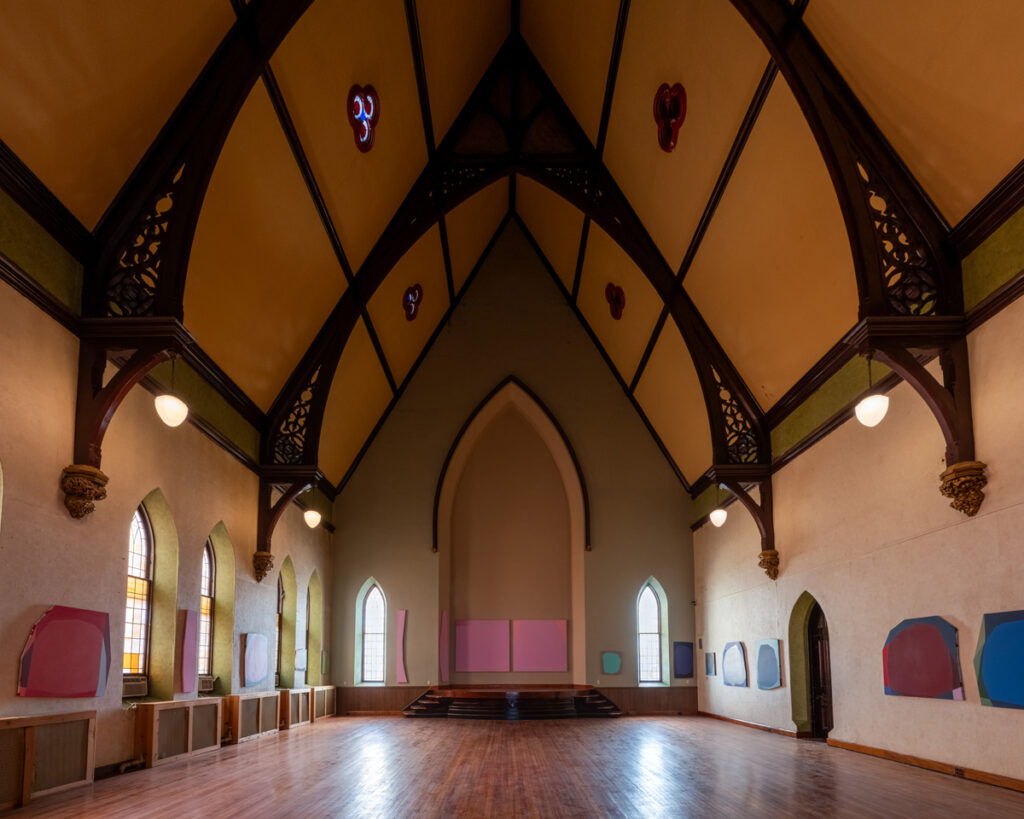
Baltimore’s fall art season remains busy but prioritize these two must-see shows. Painter Emma Childs and curator Teri Henderson (editorial disclosure: a BmoreArt contributor) are presenting Chora, a site-specific exhibition of Childs’ work at Mount Vernon Place United Methodist Church. Featuring over 50 new paintings completed in a prolific six-month span, Chora finds Childs working at the largest scale of her career.
Red Giant is exhibiting Minor Monuments, a showcase of stonework featuring art by Sebastian Martorana, a local Baltimore artist alongside Candice Russell, Louis Sarowsky, Stephen Shaheen, and Paul Tucci, who collectively live and work further up the East Coast. Taken together, both shows offer a complementary experience to see and engage with art in unconventional spaces.
Chora: Emma Childs at the Mount Vernon Place United Methodist Church
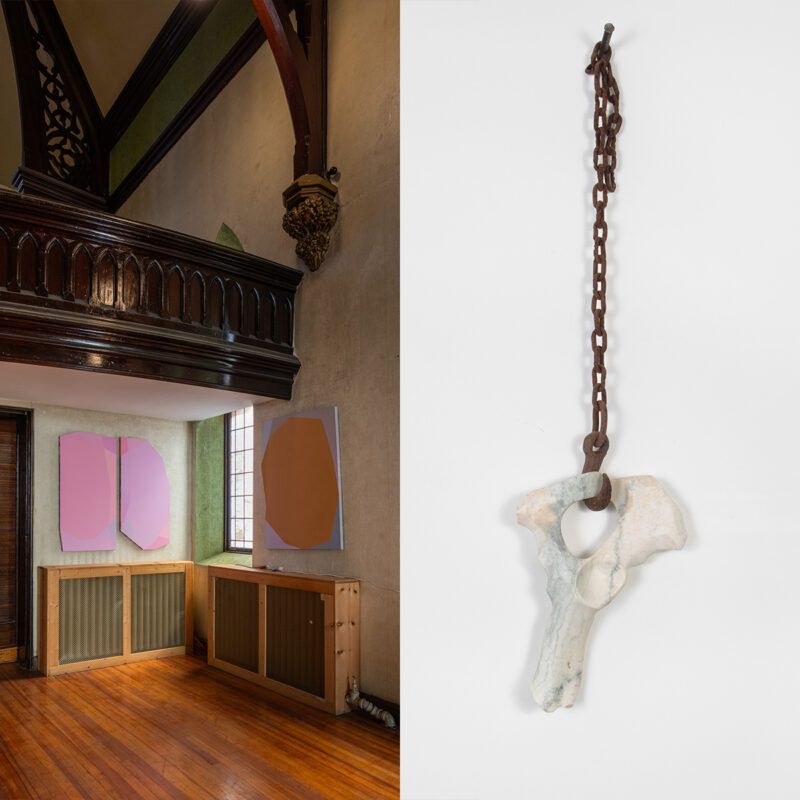
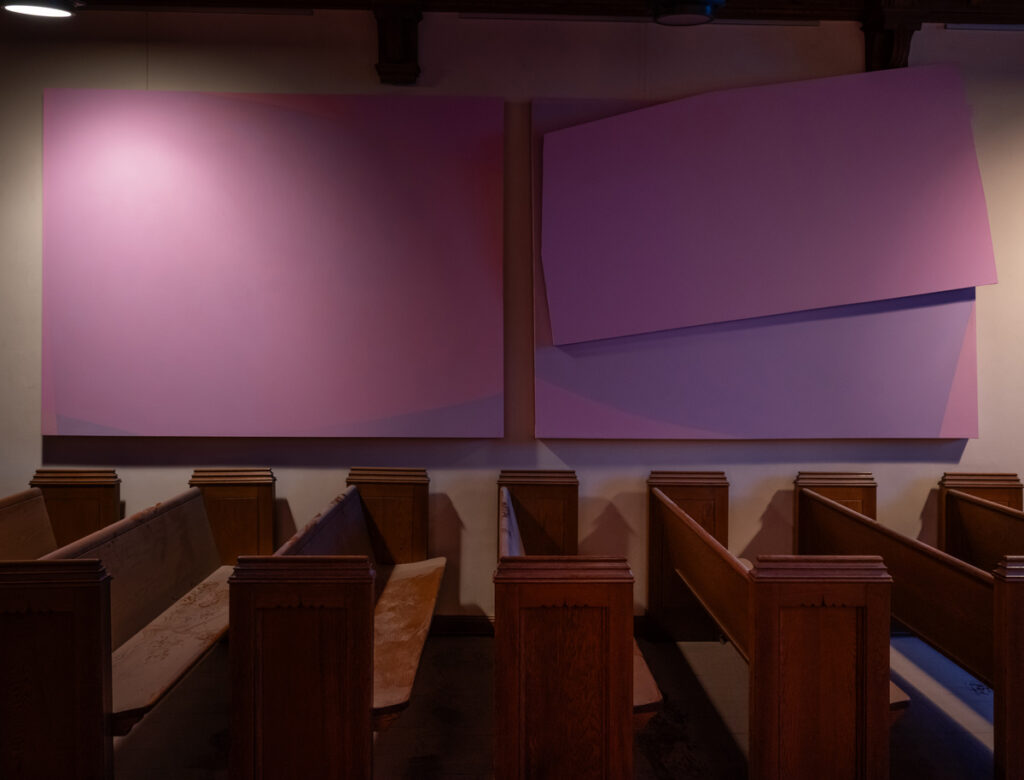
Chora begins in the Bosley chapel, with four large pink canvases, two of which are kinetic. Childs’ moving paintings suggest a universe of potential orientations, an interactive element that alters as you move in and out of the chapel. Bathed in cathedral light, these paintings carry reverence. In place of saints or priesthood, however, devotion emerges through pure color and craft. Throughout the day the shadows change as light filters in through arched stained-glass windows. As such, Childs’ angles and polygons alter depending on the time of day you visit and where the shadows play on the canvas.
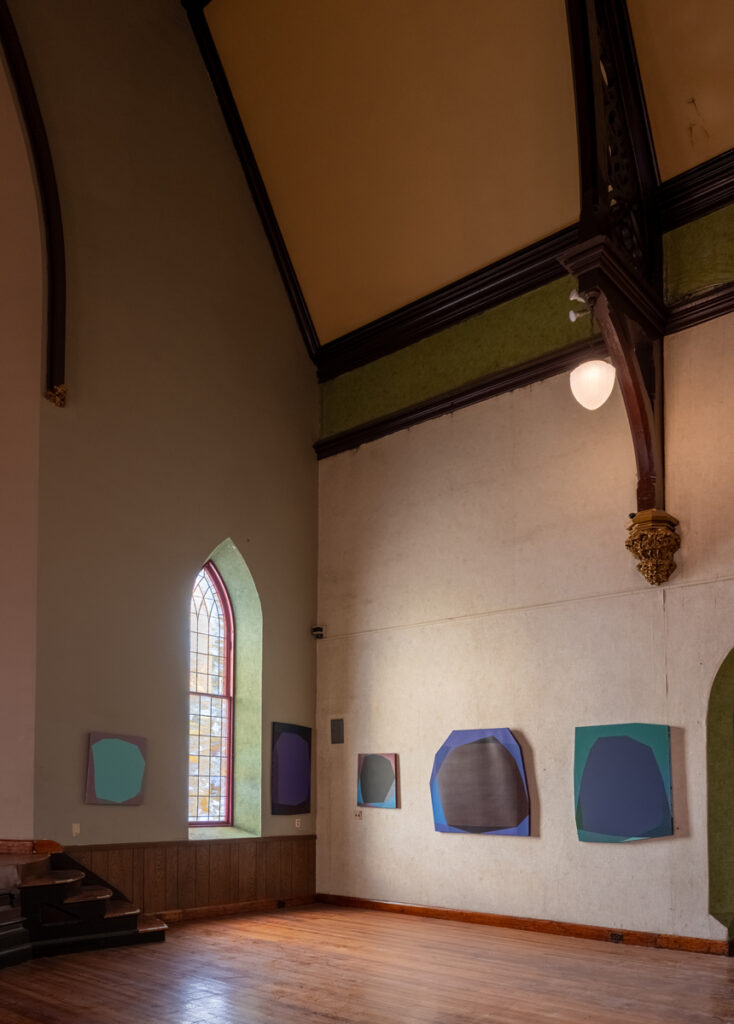
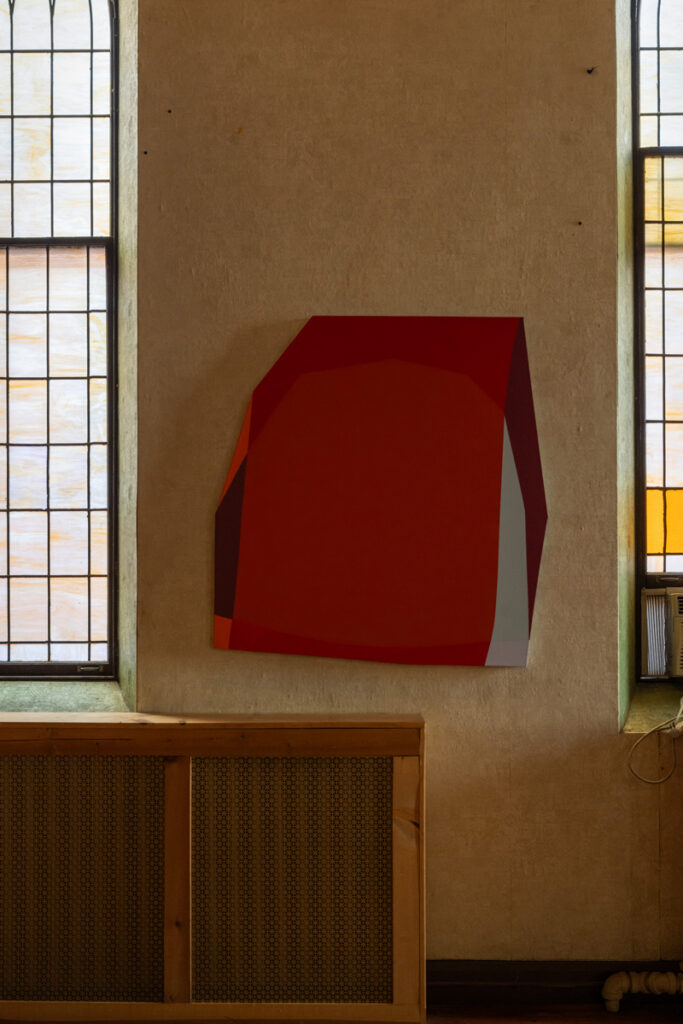
Upstairs in Davis Hall, “Moongate (Study)” pulls viewers into the space. At 48 x 48 inches, hand-built and hand-stretched, Childs’ hand-cut painting/portal offers a field of sky blue with hues of lavender and purple. Should we step through, we wonder what may be on the other side—the moon, perhaps. Meanwhile, “Shiny Empty Tower” feels like looking into a giant well or a black hole. Its hewn polygonal edges sprout pockets of luminous dark blues and purples. It reads as perfectly otherworldly, encounterable in the stratosphere.
Across the room hangs “Starling #2.” The painting’s simplicity and clean lines only draw the viewer into Childs’ realm. A heavy block of Diebenkorn orange persists throughout the canvas, sitting against lavenders and light purples. Here, Henderson and Childs have cultivated a kind of Rothko Chapel. Hung amid Gothic stained-glass windows, Childs’s canvases seem in direct conversation with the space itself—powerfully charged and iconic—painted with its architecture in mind. The juxtapositions between the paintings, symmetrical walls, and archways provide a breathtaking experience.
For Henderson, these paintings act “as thresholds that make a fixed building feel flexible and immediate, making something ancient feel contemporary and familiar.” Despite the enormity of the church’s ceiling which pulls the eyes upward, Childs’ polygonal edges force the viewer’s eyes to stay on the painting, such that we can’t look away.
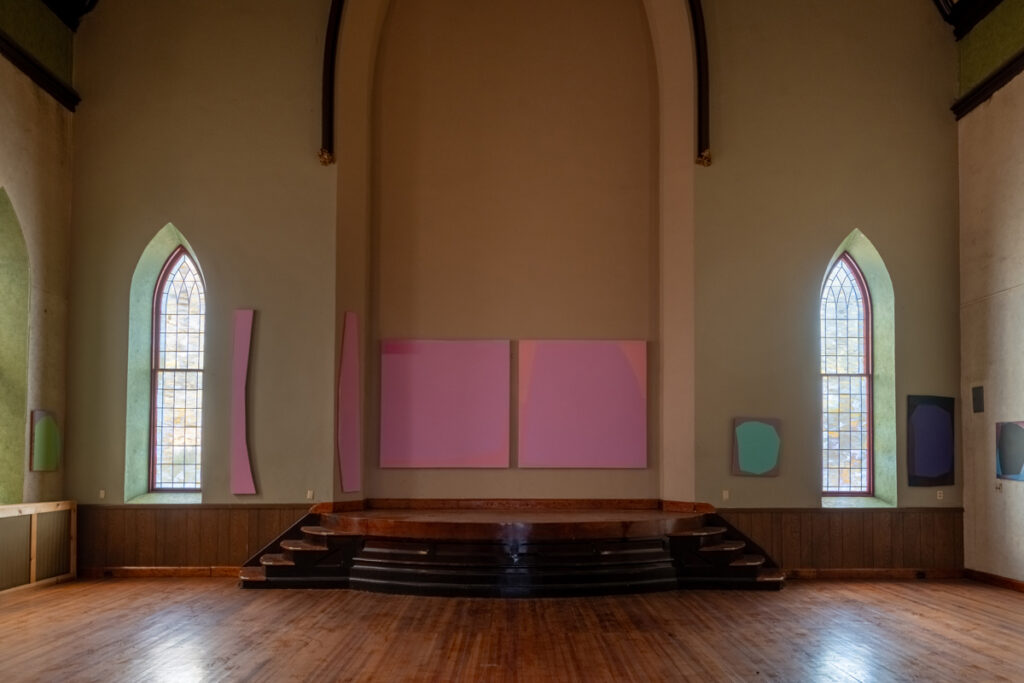
Toward the back of the room, two large pink canvases flank the stage. While the scale alone in “Davis Hall Diptych” is enough to overwhelm, hung side by side, these rectangular canvases seem to call and respond to each other as companion pieces. At right, we see a cavern of light pink surrounded by coral paint that evokes flesh. At left, Childs employs the same colors differently, opting for an all-over light pink composition. The bottom of the painting reuses that familiar flesh coral tone while the top offers a brilliant streak of a darker pink gradient. It yields the diptych forceful movement. Given the scale, you get sucked in, as with a Rothko, bewildered in depth and light.
The more time spent with these canvases only validates her vision. We see a field of burnt umber, in “Teeth” offset by a sliver of white and purple paint. Childs’ brushwork at the top center portrays a continuous jagged line which serves as a boundary. Extending upward, a dark red polygon emerges. Like a tennis match, our eyes constantly shift between these angles and colors. At left, two small polygons of purple and orange form a final edge, a continuation of a train of thought, which Childs says, informs the ways in which she interprets her work.
Minor Monuments at Red Giant
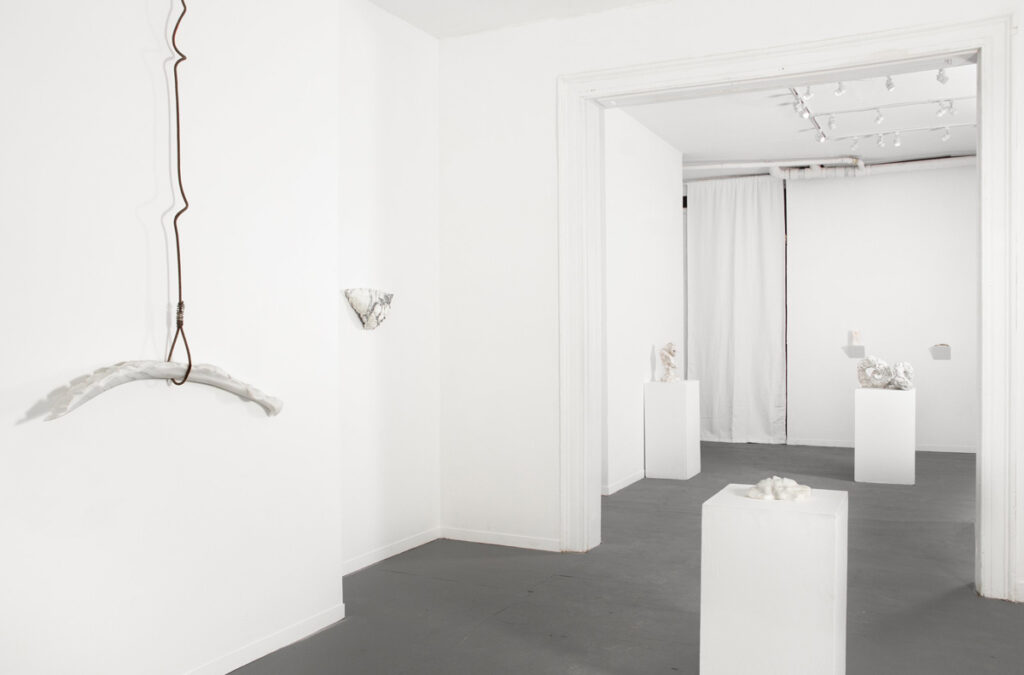
Meanwhile, Minor Monuments at Red Giant, a renovated rowhome in the Bromo Arts District, interrogates who and what gets preserved and memorialized. Artist and co-founder Patrick Bell understands the value in curating a multifaceted show balancing heavy stones, abstraction, and conceptual play.
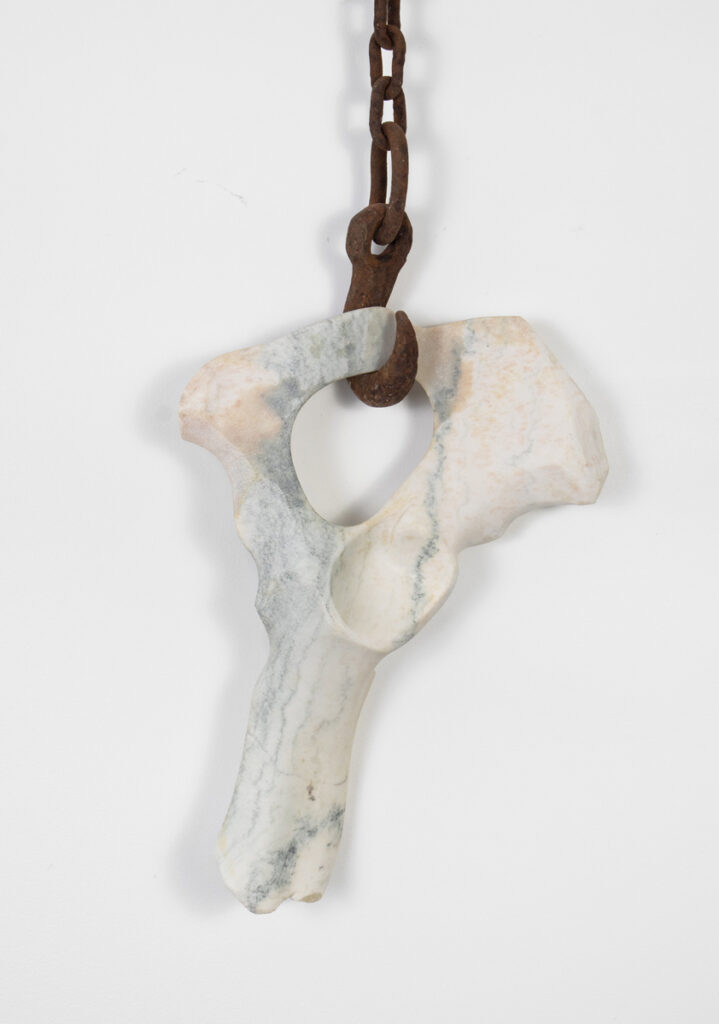
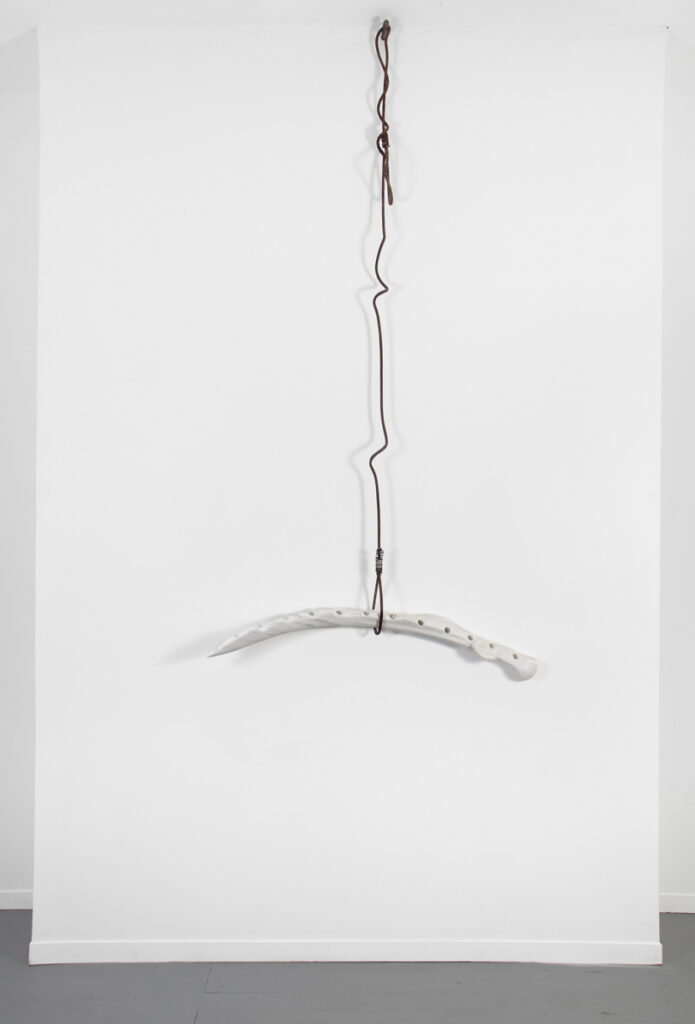
The tension between Stephen Shaheen’s weight and gravity feels immediate. Suspended by an iron chain and mounted from a steel railroad tie, “Defunto (1)” appears strikingly bone-like, substantial. The smooth, white marble blends perfectly into the walls, while the rusted chain and iron chisel provides a harsh contrast in texture and weight. Nearby, “Flake”—a colossal tusk-like bone hangs from a long cord of braided steel wire. To be near it is to confront the object head-on. Here, Shaheen builds more drama within the gallery hang, emphasized by a looped wire from which the tusk hangs.
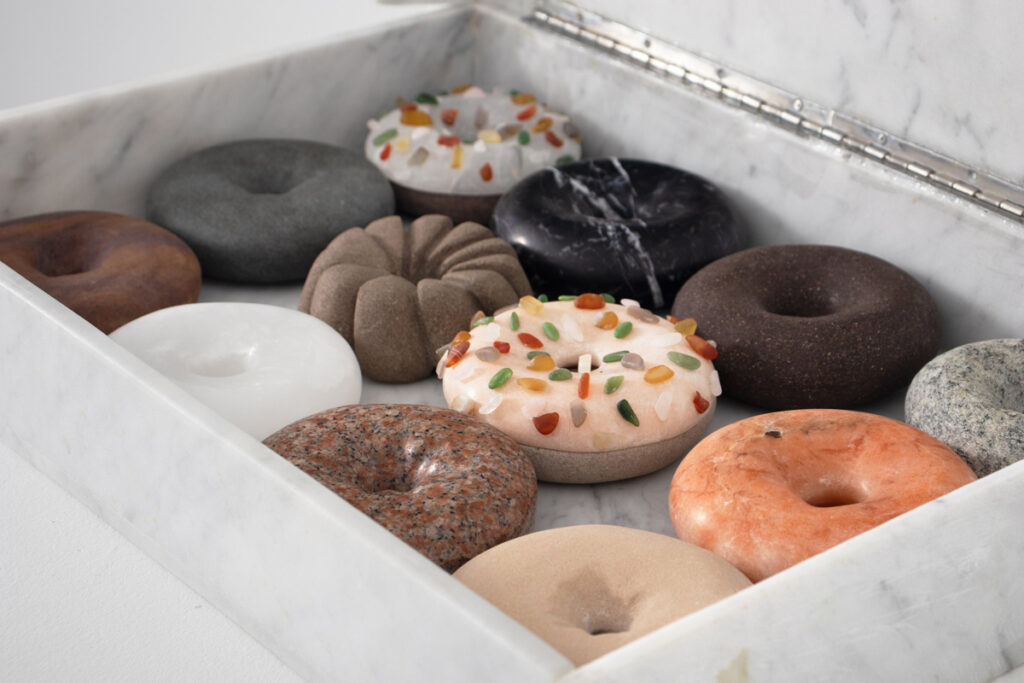
Where Shaheen finds gravity in raw materials, Sebastian Martorana and Louis Sarowsky find it by subverting everyday objects. Martorana injects playfulness into the show with “Icon: Kermit,” a bust of the popular television puppet, his mouth agape in mid-conversation. Martorana also pulls from personal history in “Baby Steps.” Placed directly on the gallery floor sans plinth, the artist references the iconic marble stoops that scatter Baltimore neighborhoods while simultaneously evoking his children’s first steps. Sarowsky takes this subversion a step further, fashioning a marble case of a dozen donuts in “It took time to make the donuts.” Carved from Portuguese pink marble, Indian limestone, and tumbled agate, each donut and glaze tempts us to touch. Alongside a stone cannoli, toaster pastry Pop-Tarts, and a candle with an undying flame, Sarowsky’s ability to reimagine mundane objects from stone makes him a true standout.
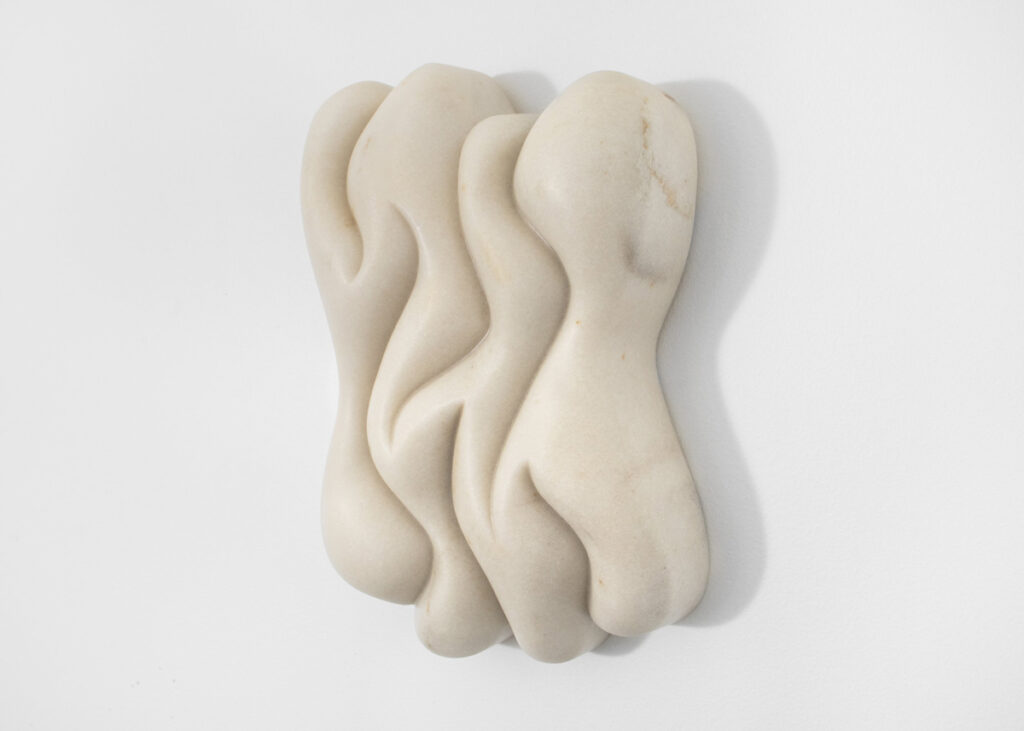
Woven between these playful moments, Candice Russell and Paul Tucci lean into abstraction to examine visual harmony and antiquity. Exemplifying this, lies “Mary 2“ a monument of a textural pillow rendered from Alabama marble. A bevy of visual information abounds through color and stone, such that its interpretation seems flexible. Although familiar, we remain intrigued due to the pillow’s rich texture, partly woven, unearthed. Meanwhile, Russell’s “The Marriage of Cupid & Psyche” features two entwined tentacles nodding to ancient myth. Nearby, “Fall,” a marble figure’s head lies upside down on the floor like a relic from a fallen empire. Tucci’s abstract sculptures carve out a complementary dialogue. Made from White marble, “Breathe the Doubt” uses bold lines that hold form like a tooth. Elegant curves lend visual harmony and interconnectedness as each shape slots into place. Similarly, “Occhio 2” resembles a body enveloping itself, head cocked to the side at rest.
What results from the exhibition is a narrative that critically prods at the ways in which histories are remembered and whose story gets etched in stone. Relationships and connections between these disparate objects reveal themselves in unexpected ways, from texture and abstraction to the materials being used. Ultimately, the exhibition shows the manifold ways in which these stoneworkers find and create meaning within these stones. It effectively asserts even the most mundane objects warrant preservation and remembrance.
Be it a church or renovated rowhome, these galleries home in on the big ideas being formed in Baltimore arts communities. Childs’ solo exhibition shows the painter working prolifically and at the height of her career. Calculations of light, color, and scale unfold and leave you off balance, caught up in the angles between canvases, architecture, and space. While Minor Monuments makes the case for monuments that celebrate the everyday, Bell helps ground these gestures into something deeply accessible. His curatorial eye encourages us to find beauty, comedy, and the quotidian in stone. When these artists question form and function and push the boundaries of space and scale, they translate abstract artistic visions into a fully lived experience, and it sticks with us long after the gallery closes.
Chora is on view at Mount Vernon Place United Methodist Church 10 E Mt Vernon Pl until January 2027. Minor Monuments has a closing reception on Friday October 16th 6-8 pm and ends on October 17th at 403 N Paca St. Mark your calendars while you still can.