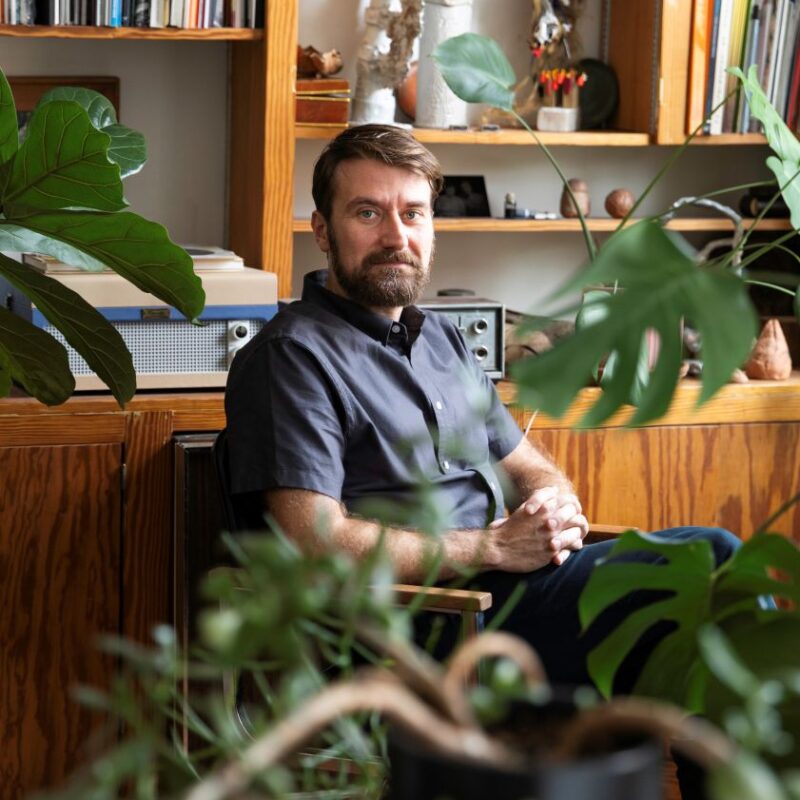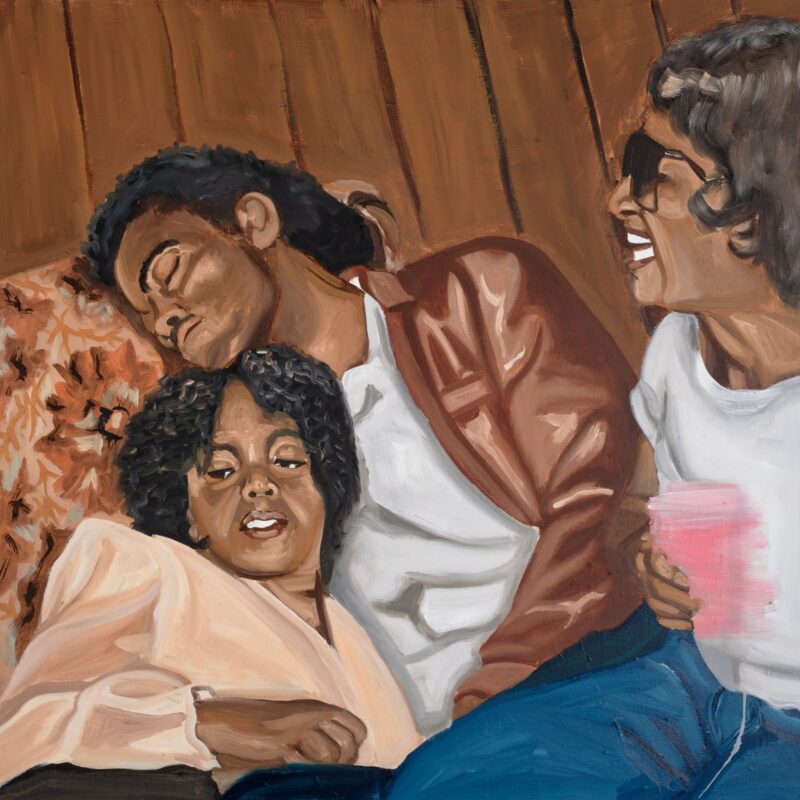
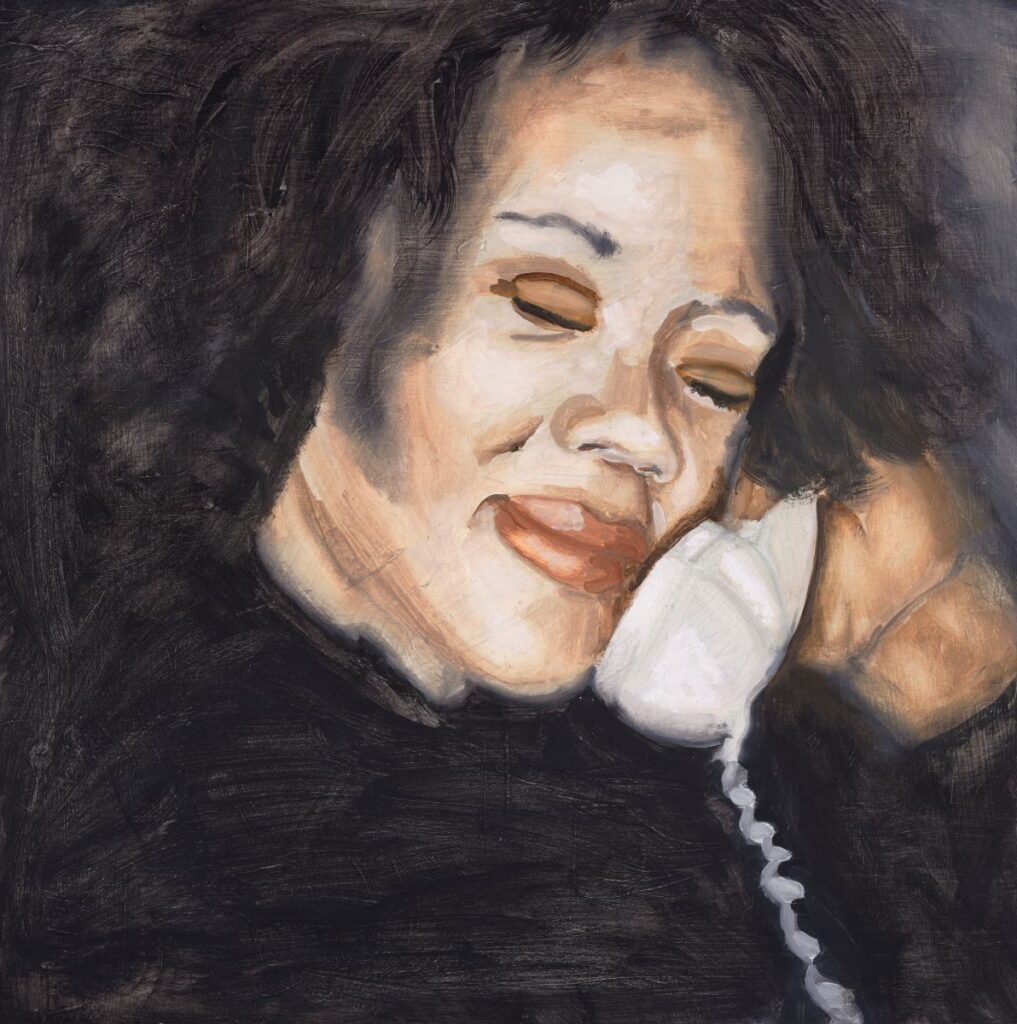
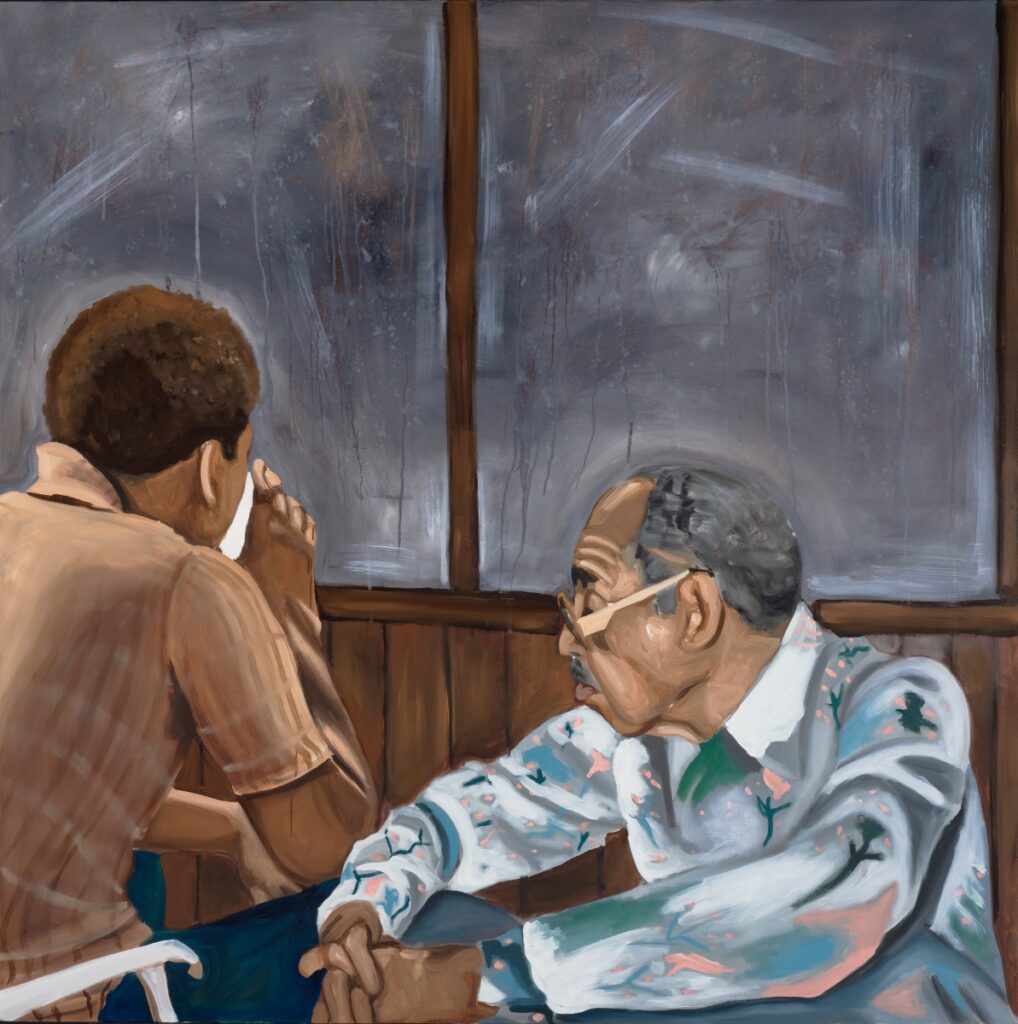
This holiday weekend, as many of us take a pause for family and reconnecting with home, Jerrell Gibbs is on my mind. The Baltimore-born painter has dedicated his practice to capturing the extraordinary in the ordinary of domestic life. Now, in the artist’s first major museum solo at the Baltimore Museum of Art, Come home with me, Gibbs invites viewers into this contemplation in a prolifically immersive way.
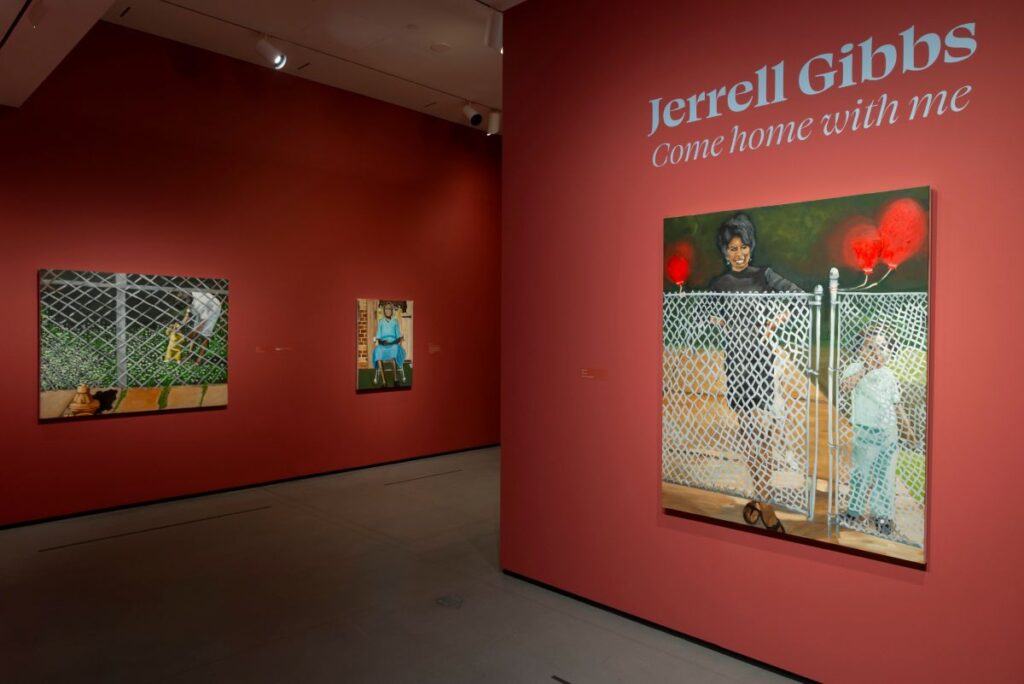
With 32 new paintings inspired by the artist’s own childhood memories, five curated rooms in the BMA are transformed into Gibbs’ aunt Ella’s house in Baltimore. A bowl of dusty plastic fruit. A sprinkler on a summer lawn. A basement bar that could be a juke joint in Mississippi. A chain-link fence that runs through the show like a thread. As we are called to stand before these home spaces, portraits, and captured moments of connection across generations, the works are compellingly intimate. At the same time, they extend beyond the story of one artist’s life, into one that felt deeply familiar to my own experience. This is precisely the artist’s intention.
In our conversation, Gibbs walks me through where these moments come from, why scale is never arbitrary, and the experiment of translating memory into a conversation about what home means to all of us.
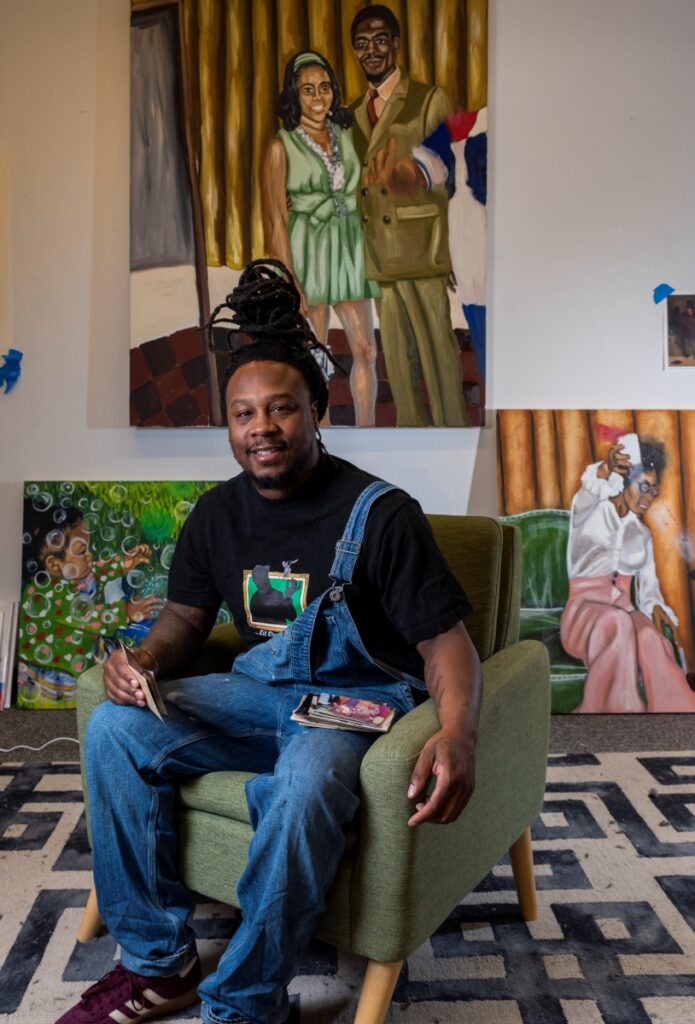
For people outside Baltimore who haven’t seen the show yet where are your roots? Where are your people from?
I’m from Baltimore, born and raised. My family did a lot of moving over the years, so I’ve lived in pretty much any part of West Baltimore you can think of. My mother’s side of the family is from Blackstone, Virginia. They moved north during the latter part of the Great Migration to find work and landed in Baltimore in the late ’60s. They found their forever home there, and a lot of the photos I use are sourced from the house my uncle lived in. The basement bar was my grandmother’s home, my mother’s mother, and she lived two doors down from my aunt. Everybody lived in close proximity.
The last room of the show, in the basement, includes photographs. Where do those come from?
Those are from my family photo albums. Including them was actually Annie’s idea, Annie Roberts, the curator of the show. I’ve never put the photos I use as source material in a show, or really shown them to anybody. She thought it would be a great touch to give viewers an example of where I’m getting these ideas from.
When you’re painting, are you working from memory, directly from the photographs, or a mixture?
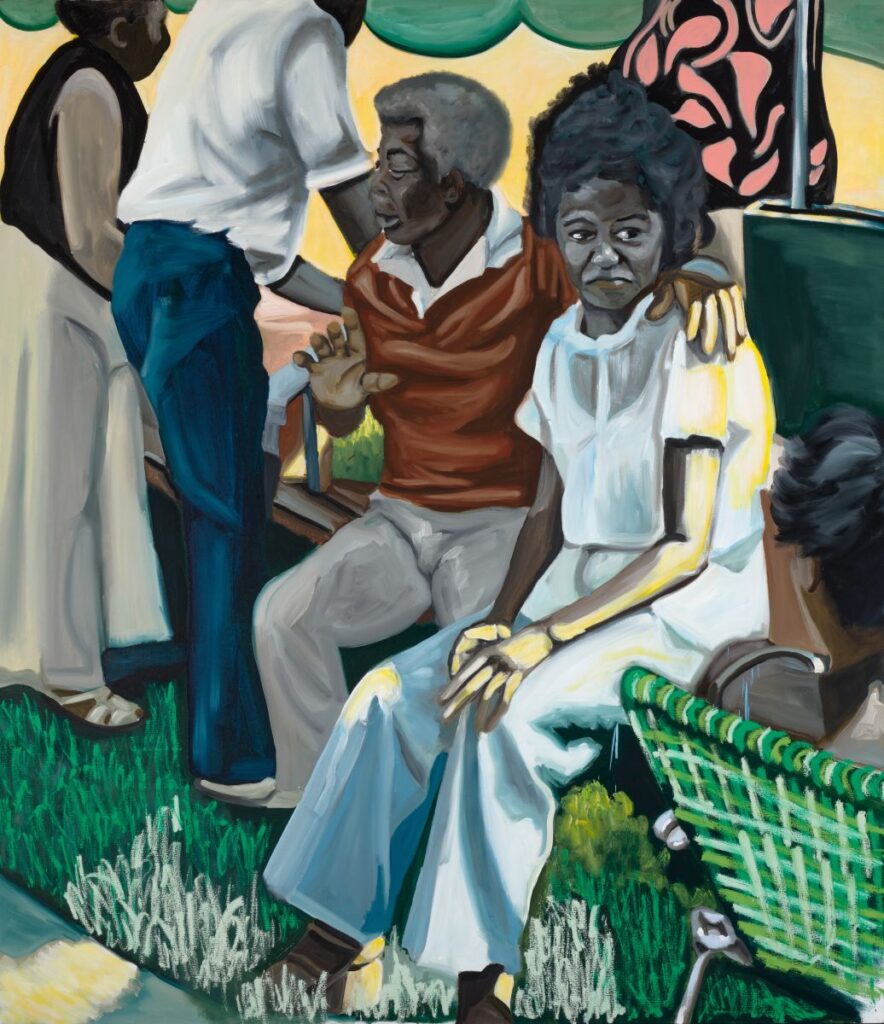
The paintings all come from personal experiences I’ve had. I’m interested in using photos of moments I’ve lived or experienced in some way because they let me invoke the energy, the emotion, the sensation in the painting. Without that understanding of a moment, I wouldn’t be able to get into the nitty-gritty of the feeling of the work. The photos may not be of me. They may be from a different time period. But they relate to my personal experience and my upbringing in some capacity.
Jerrell GibbsIn addition to moments I’ve lived, I’m looking for moments that are relatable, opportunities for other people to be involved in the conversation. These are mundane experiences people overlook.
The basement bar reminds me of a juke joint you’d see in New Orleans or Mississippi. It isn’t a universal experience, exactly, but there’s a familiarity.
That’s what I’m searching for. In addition to moments I’ve lived, I’m looking for moments that are relatable, opportunities for other people to be involved in the conversation. These are mundane experiences people overlook, but a lot of people engage with them. Universal experiences are where it’s at, because that’s our day to day. There are so many more of those opportunities than the extraordinary moment, the goal that we reach. If you hit the goal one time a year, you’re missing 364 other opportunities.
Is it fair to say this body of work is about remembering intimacy, interiors, Black interiority?
I always like to say this: there are three things I want you to think about when you look at my paintings and my practice in general. One is historical references, paintings that people consider masterworks and that have inspired my practice as a painter. Whether they’re by Kerry James Marshall, Peter Doig, Rembrandt, Matisse, Monet, van Gogh, I could go on and on. I’m thinking about how to recontextualize those paintings in a way that’s authentic to me, authentic to 21st-century America, and authentic to African American culture and experiences, a Black man growing up and living in Baltimore, all of those things.
I’m also thinking about universal experiences that we can all share and create dialogue around. When you see a domestic interior that resembles a place you’re familiar with, it’s because I’m filling these paintings with very specific cultural references, symbols, moments that were very real in the period I grew up in. That’s why I always say the paintings are universal, but the specificity of the work is very personal. That’s very Jerrell, that’s very Black culture, that’s very ’70s, ’80s, ’90s and beyond. The overarching context is recontextualizing these older paintings and making them relevant for today.
When did you find out about the solo exhibition, and how did the invitation come?
It was 2024. I was in New York. I had just opened my show at James Cohan Gallery, my first solo in New York, and I’d been spending time at Frieze. I was in an Uber with my wife, Sheila, heading back to our hotel, and Asma texted me. She said she’d heard the show was a great success, and that we’d be in conversation really soon about some really big things. She didn’t exactly say it, but that was the first hint. Then around late September or October of that year, I found out we’d be doing a show.
Was it important to you to make all new work?
I’m always trying to make new work, as long as I have the capacity to do so. The works I create represent where I am in real time, and I want people to be aware of that when they see my work. Unless it’s a retrospective.
Which is going to happen. And when it does, you’ll have all these distinct chapters.
I receive it.
We were the first audience in the galleries at the press preview. How did that feel?
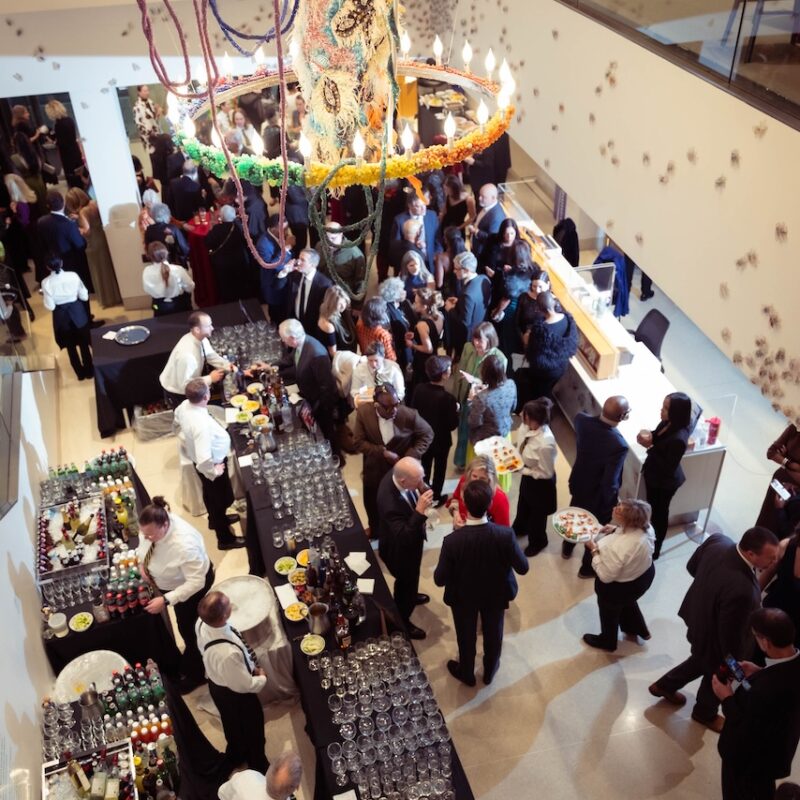
It felt good, almost like a rite of passage. I’d been conceptually thinking about these paintings for over two years and then executed them in four and a half months. It was a total grind. Having community come in and see the work for the first time felt like the moment I was officially done, because people were seeing it and there was nothing else I could do. It’s real. It’s here.
Walk me through that sprint. How did you maintain your focus?
Honestly, a lot of prayer and a lot of faith. I’m rooted in my faith, and God gave me the strength to do things that felt daunting and impossible. That’s the only credit I can give, because regular me wouldn’t have been able to do it. It was so much, and on top of the show, my regular life is a lot right now.
I like to keep my studio practice consistent because of my family, but the methodology I used to use didn’t work this go-around. Our youngest threw everything for a complete loop. Her sleep wasn’t consistent, so I had to piecemeal it. I went in whenever I could, and that was mostly at night. I’d work through the night, and by 6 a.m. I’m pulling up from the studio when she’s waking up. It was literally exhausting. There were a few times I felt like, I don’t know if I can do this, man. That’s why I’m taking so much time now to rest and get myself back together.
I was also in my head about it being my first major solo, and that’s because you care. I want to put on for everybody. The people who supported me, the people who went out on a limb to offer opportunity, I want everybody to be like, okay, he did it. I want to do right by everybody involved.
You did. I remember you used to work on multiple paintings at once. Is that still how you operate?
I go with how I’m feeling. There are certain rules I abide by in my studio, and there are certain things I allow to happen. If I’m working on one painting and I get stuck, or I’ve lost the experience and have to regain it, I’m not going to force anything in that moment. I’ll leave it and start on something else, and when it comes back, I’ll return. But typically I would much rather create one painting at a time, because I can get all of the energy out in that moment, right onto that canvas. My paintings are about the sensation.
Do you think being an artist is your calling?
Oh, certainly. At every show I have somebody coming up to me crying. It’s not because I’m that great of a painter. It’s because of the stories I’m bringing to the forefront. I’m touching on moments that mean something to people. They’re not paintings just for the sake of paintings. These are real-life moments we share and hold dear, and they offer people from all walks of life an opportunity to engage and talk about their upbringing.
Jerrell GibbsAt every show I have somebody coming up to me crying. It’s not because I’m that great of a painter. It’s because of the stories I’m bringing to the forefront. I’m touching on moments that mean something to people.
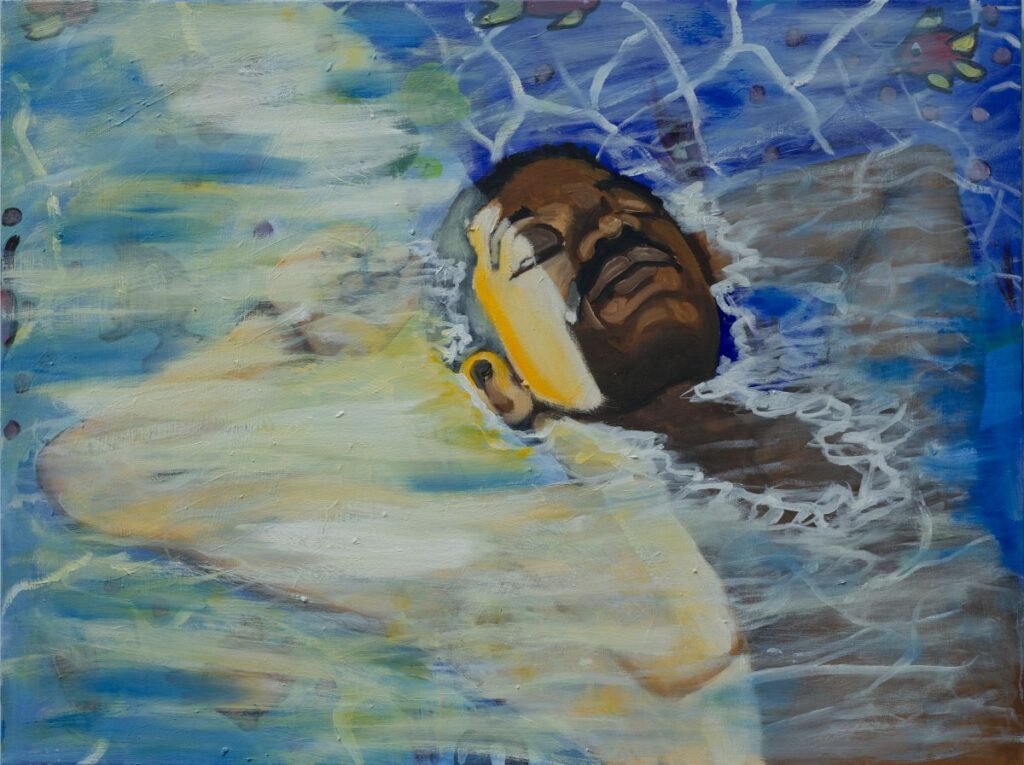
My favorite is “Blue Plastic Pool.” The person in it is at peace, and I loved that it was smaller than some of the other works. Was that intentional?
The scale is never arbitrary. The size of a work speaks to how I want the viewer to engage with it. If it’s a smaller work, it’s an intimate moment. I want you to feel like this is just between us, and it’s quiet. When it’s large, I want you to feel like you’re almost there, like you could walk into the painting and touch the person or be the person, because you could fit in the painting.
Then there’s “Sprinklers.” That painting blew my mind. How did you do it?
That’s me thinking about another one of the pillars of my practice: making a painting about a painting. Allowing the paint, the materiality, the medium, to be a part of the conversation, to tell a story and create a sensation as well. For that piece, I had to figure out how to best convey the water coming out of the sprinkler without literally rendering every drop.
It’s not about right or wrong. It’s just how I like to think about painting. I’m not interested in making paintings that are true to life, where the figures are anatomically correct and everything is painted perfectly. I’m thinking about how the way the oil sits on the canvas can create a sensation that you’ve experienced and recognize.
These are moments you do have memories of. You may have just forgotten them. They’re dormant because we did them so much they became second nature, so you overlook them. I want to make works so sensitive in the way they’re made, I want the paint on the canvas to be so vivid and so real, that you’re like, “Oh my gosh, I know exactly when I did the same thing.” You can feel the water on your skin looking at the sprinkler.
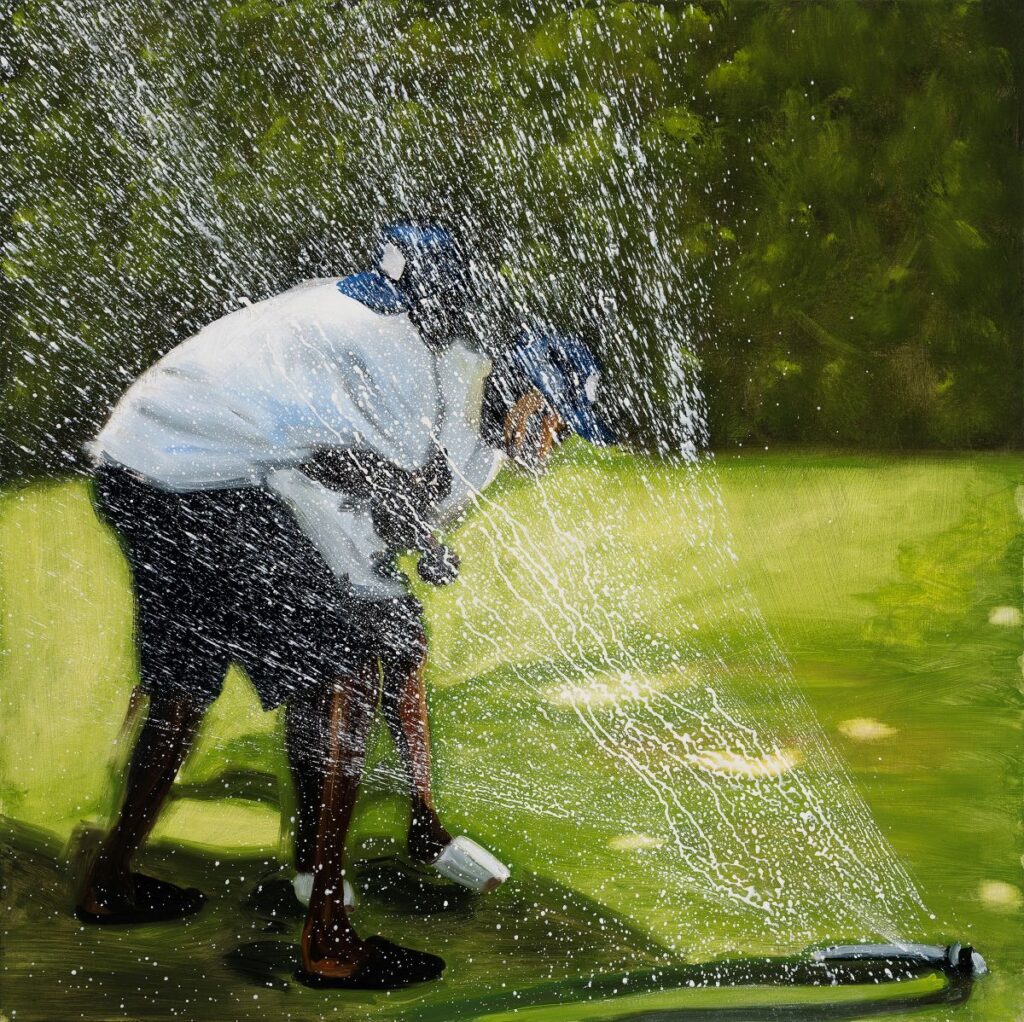
And that’s still oil paint?
It is. I’ll sit and ponder something for a long time, and then I’ll just go do the act. For that piece, I went through a process over a few days. Unless you’re working at a very large scale, where you can just throw paint, it’s really hard to manipulate oil paint to the point where it’ll move like that. So I knew I’d have to make it way more loose and transparent than I’m accustomed to.
When you dilute oil paint with turpentine or Gamsol, it thins out to the point where it becomes almost translucent. So then I asked, how am I still going to make sure people can see what’s happening? I diluted it a little with turp and Gamsol, and then I mixed in some water and some gesso, which is basically what you cover the canvas with before you start painting. It was very loose, but it still had the consistency to adhere and be present.
Then I have this brush I’ve used as a gesso brush for about six or seven years. The bristles are real thin and loose and wavy. I dipped it in the solution, tested it out on cardboard, and it worked. Then I just went for it. It’s almost like being a scientist.
Do you have a favorite painting in the show?
That’s so tough. It depends on what day it is. I don’t know if I have a favorite, but I love that each one does its own thing. That’s what I was after. When I was thinking about a show with five rooms, I didn’t want it to be stale. I also wanted to show people the progression of my practice, what my paintings used to look like. So I could give viewers different touch points from a painterly standpoint, while these moments are still housed in the same concept. Each painting has a way of being painted that is specific to that painting.
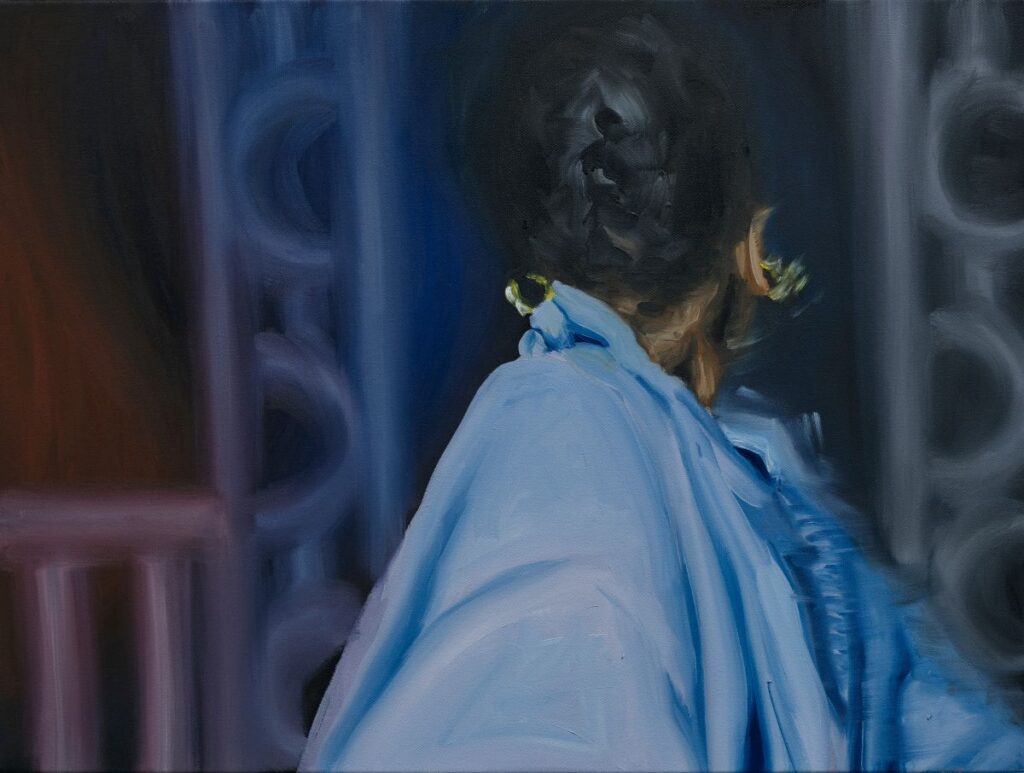
Think about “The Alize drinker” in the basement. That’s almost a psychological thriller, because it’s painted in a way that suggests you’re in the mind of the person who’s drinking. Things are blurry, everything is distorted, like fog. None of the other paintings are painted like that, because none of those moments speak to that. Same with the swing. That’s the only painting with that motion, because it wouldn’t make sense in anything else. It’s really about executing each painting in a way that creates the sensation.
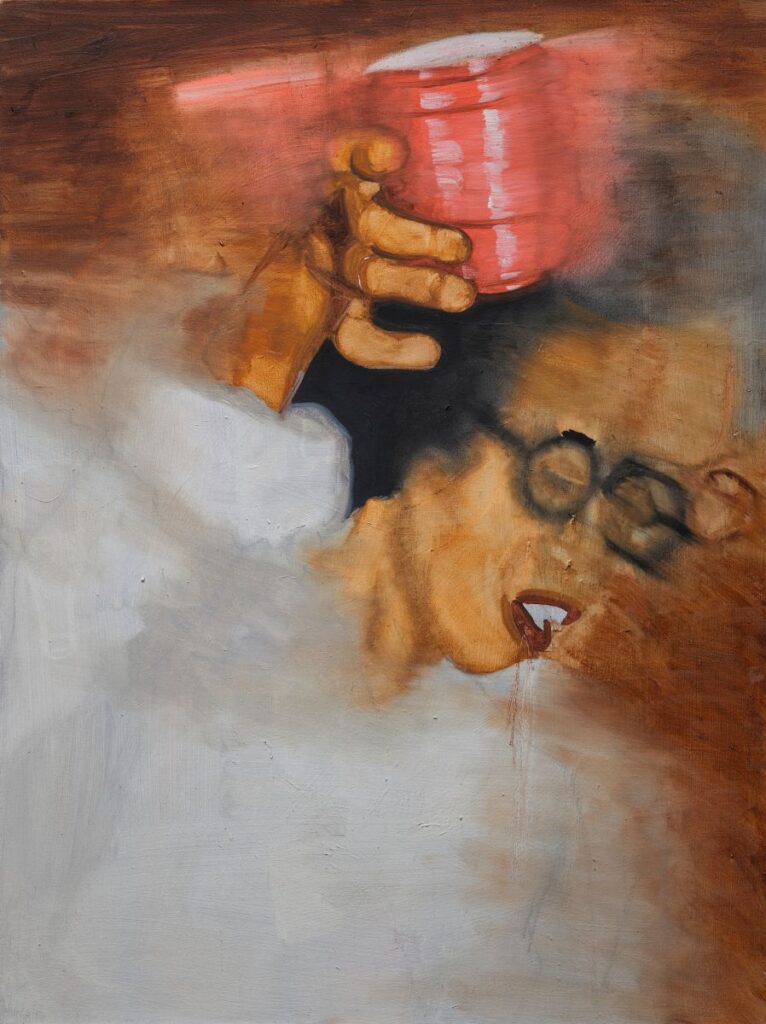
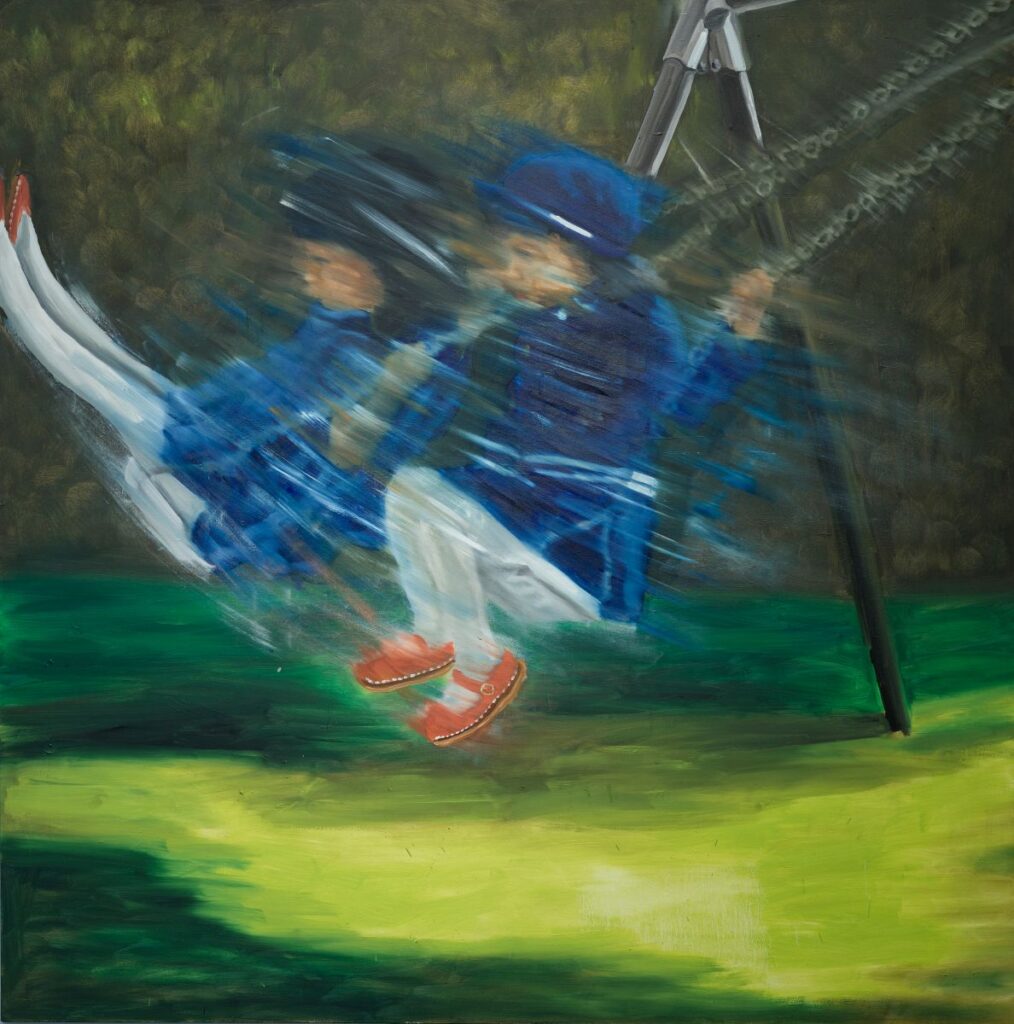
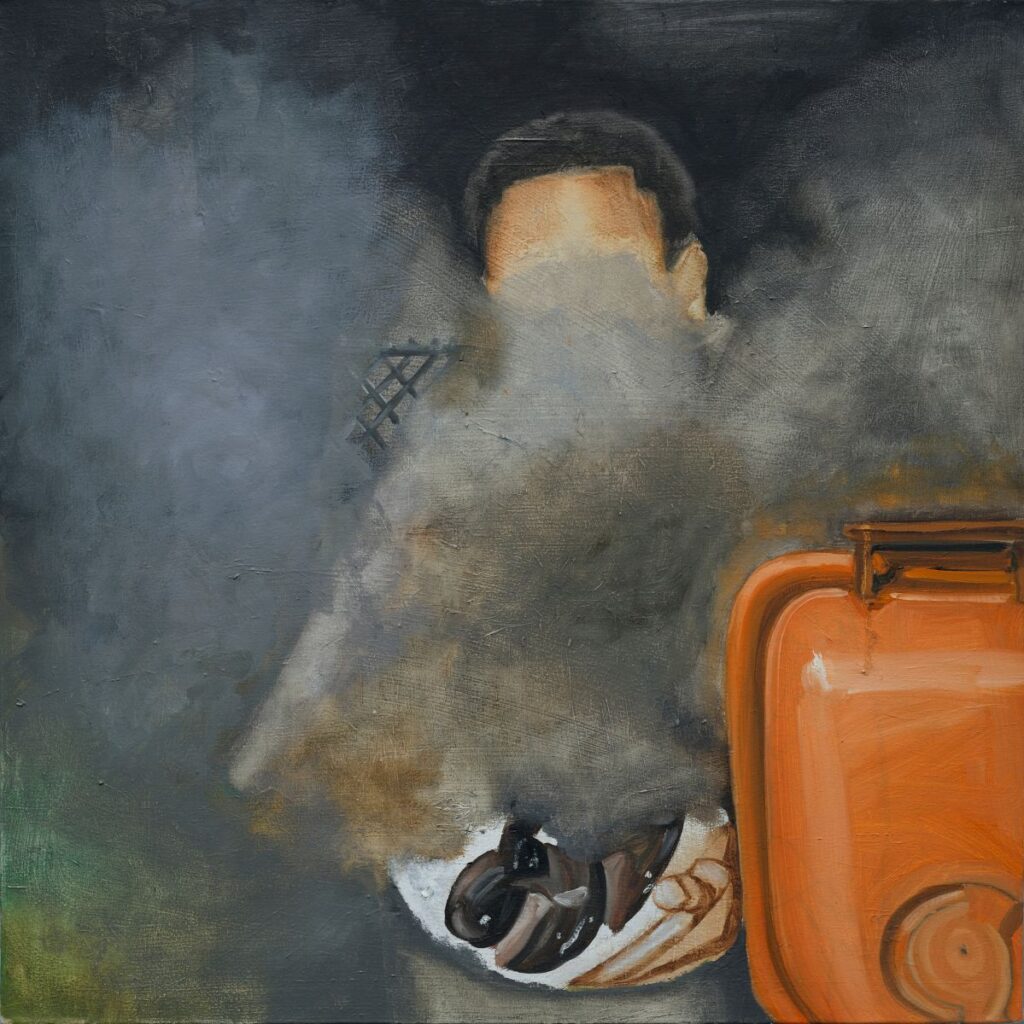
Jerrell GibbsIt’s really about executing each painting in a way that creates the sensation.
I love seeing the fence throughout the show. It all feels like it comes from the same universe, but each painting is its own character. Who’s in “Open Slow”?
That’s actually me, when I was a kid.
What were you listening to while you were making the show?
Everything. I needed so many different types of music to get me through this. I didn’t even just listen to music. I listened to podcasts, because it felt so long and I felt like I was going through so many different stages of my life while doing this. Sometimes it was gospel, sometimes podcasts about football, sometimes Jay-Z. I was working on the show when Jay did that show in New York, and we went. Came home bumping Jay for a little bit. It was all over the place.
Do you ever write or journal about the paintings?
I do a lot of note taking. I’ve got notes everywhere, and I can never find them when I need them.
Same. One day I have to get organized for real.
One day.
Without asking what’s next, because you need a break: what have you learned about yourself through all of this?
What I’ve learned is that it’s best if I just continue to double down on the things I’m familiar with. To keep honing in and mining everything that’s part of my experience, and using it in a creative way, as opposed to just finding new things. I can continue to mine what I know. I just have to approach it from a different perspective.
_______
Jerrell Gibbs: Come home with me is currently on view at The Baltimore Museum of Art through May 2, 2027.