The Corderie of the Arsenale lends itself to dramatic exhibition hangs. In 2024, I described the curation as cinematic. And this year, with many large-scaled, richly-detailed sculptural works under moody lighting, it feels theatrical. Or perhaps, more accurately, ritualistic.
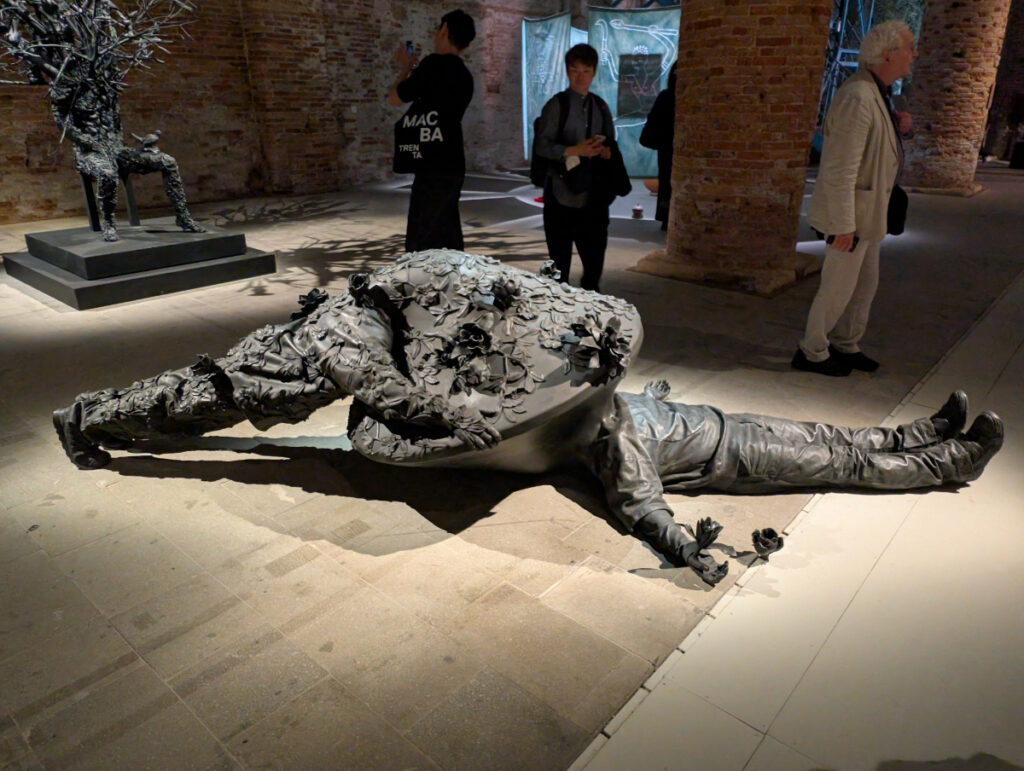
Among myriad works in In Minor Keys that touch on loss and care, ornament and protest, violence and healing, or the body and nature, I think of Nick Cave’s figurative bronzes as the central cast of this grand mise-en-scène. Five sculptures from his A·mal·gam series are spread among the cavernous exhibition hall and surrounding grounds. Similar to Cave’s famed Soundsuits, their identities are masked—shielded by anonymity but sometimes disconcertingly positioned in poses of vulnerability. Collectively, along with two other recent sculptures incorporating found objects, they speak to stages of grief. And in Venice there’s a lot to mourn this year.
Apart from the specters of war, genocide, the climate disaster, and other acts of state violence documented and debated across nearly every show in town—more to come in a different article—the 61st Biennale is grieving its curator. Koyo Kouoh, the first African woman to helm the world’s most important art exhibition, passed away suddenly almost exactly one year ago.
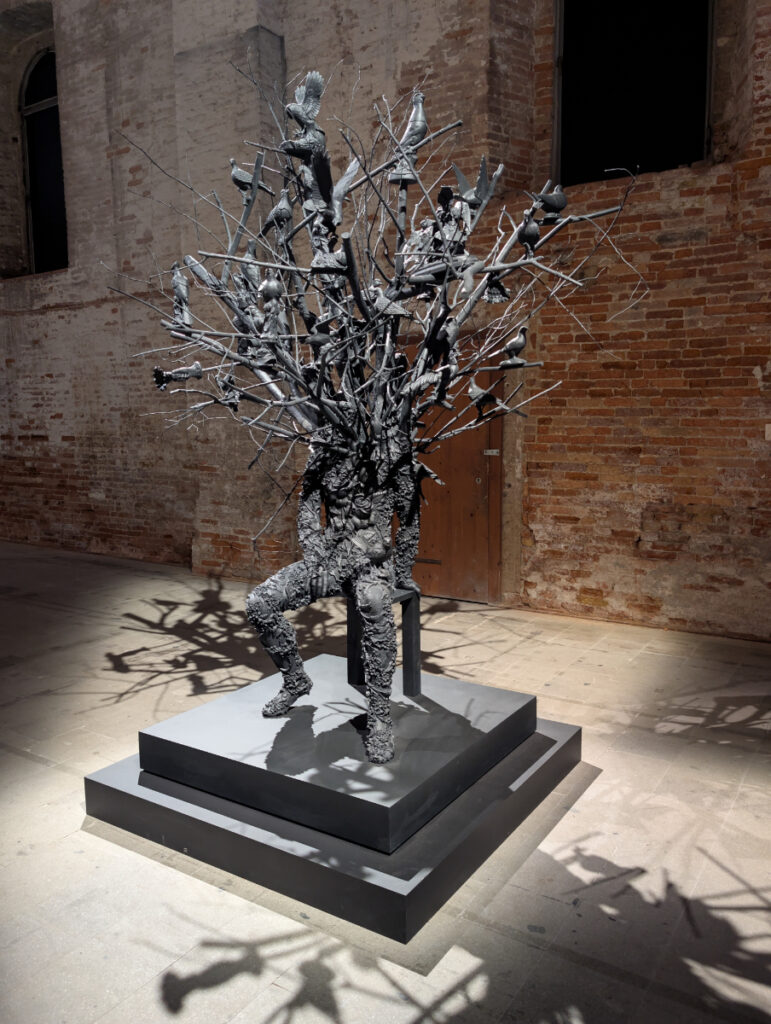
That loss was felt especially acutely by the artists she championed, and standing in front of several altar-like installations in the Corderie, one gets the impression of a grand memorial. Especially in this context, Cave’s prone figures covered by flowers, or seated and adorned with regalia of branches and birds, read as gestures of deep care.
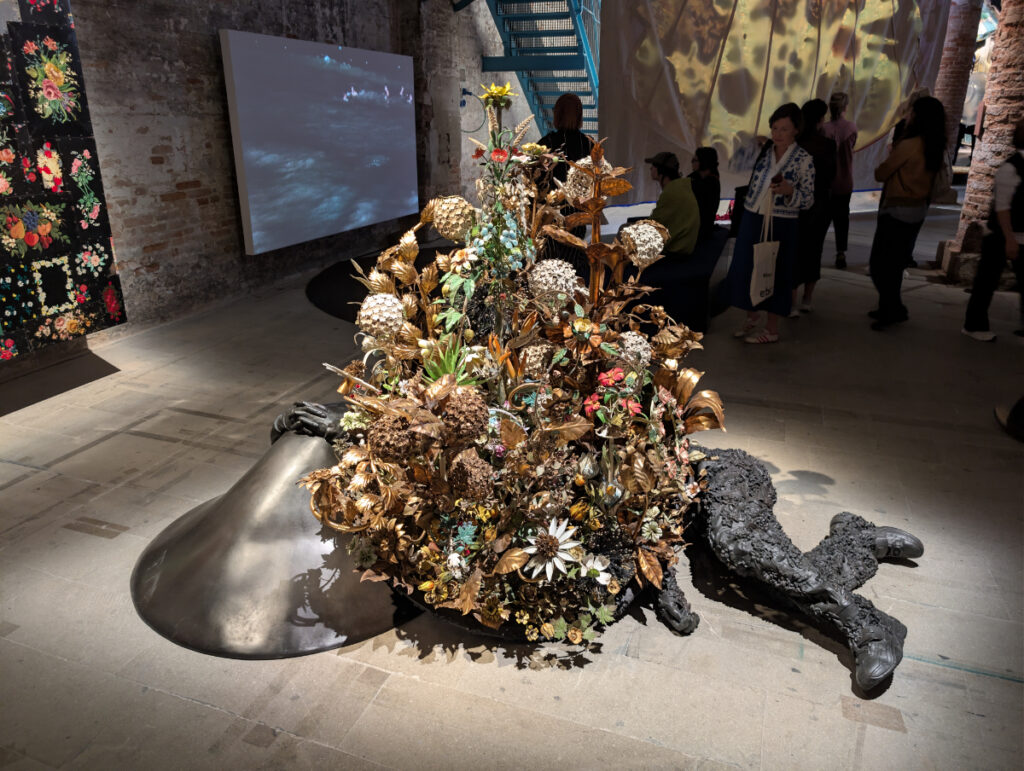
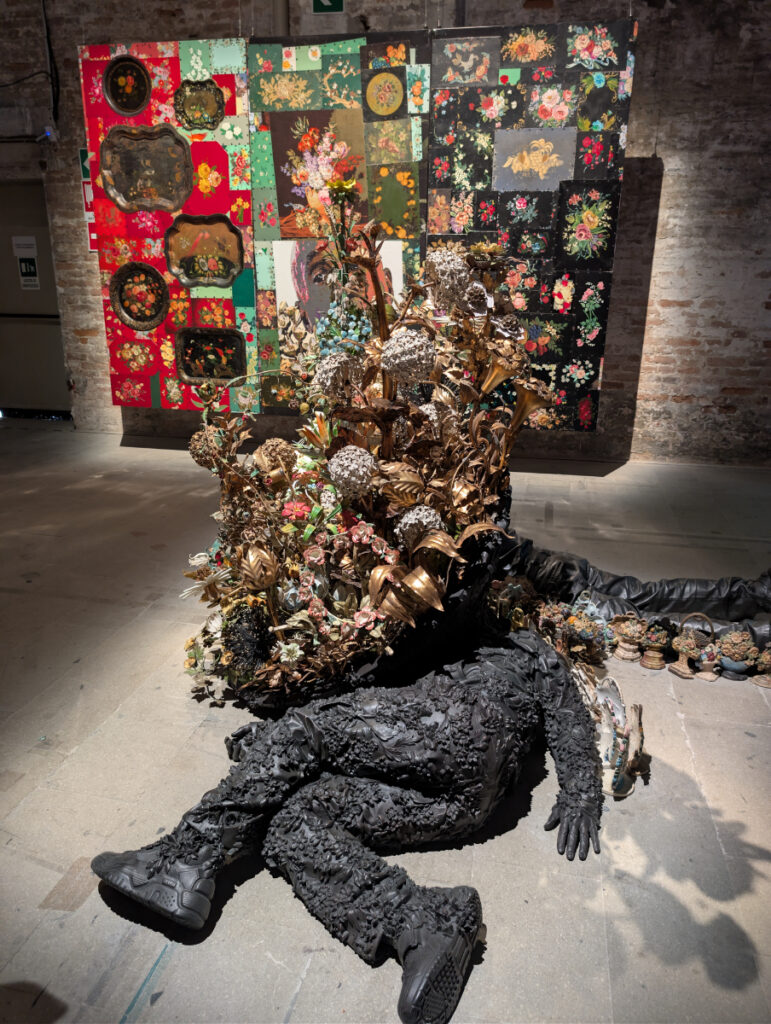
In “Amalgam (Plot)”, two bodies lie crumpled beneath a floral arrangement. It’s disconcertingly evocative of familiar images of victims of police brutality or war. The sculpture from 2025 is installed directly in front of one of the artist’s “Grapht” assemblages from 2024, comprising vintage serving trays framing a needlepoint self-portrait. The artist’s gaze is melancholy and slightly averted—here positioned as if looking away from the faceless figures.
In another sculpture from 2025, “Siren,” interlocking bronze arms form a totem-like pillar sprouting vintage gramophones. Some appear to have fallen from the chain, implying a communication breakdown or loss of cohesion in a collective. And yet the larger bronzes outside project stability, strength, and peace. The body of work is a powerful emotional rollercoaster—aesthetically stunning and leading to acclaim that might be the one thing upon which everyone in Venice this week seems to be in agreement.
I caught up with Cave to discuss this body of work, the unprecedented context of Venice 2026, and why we need collective art-viewing experiences like this.
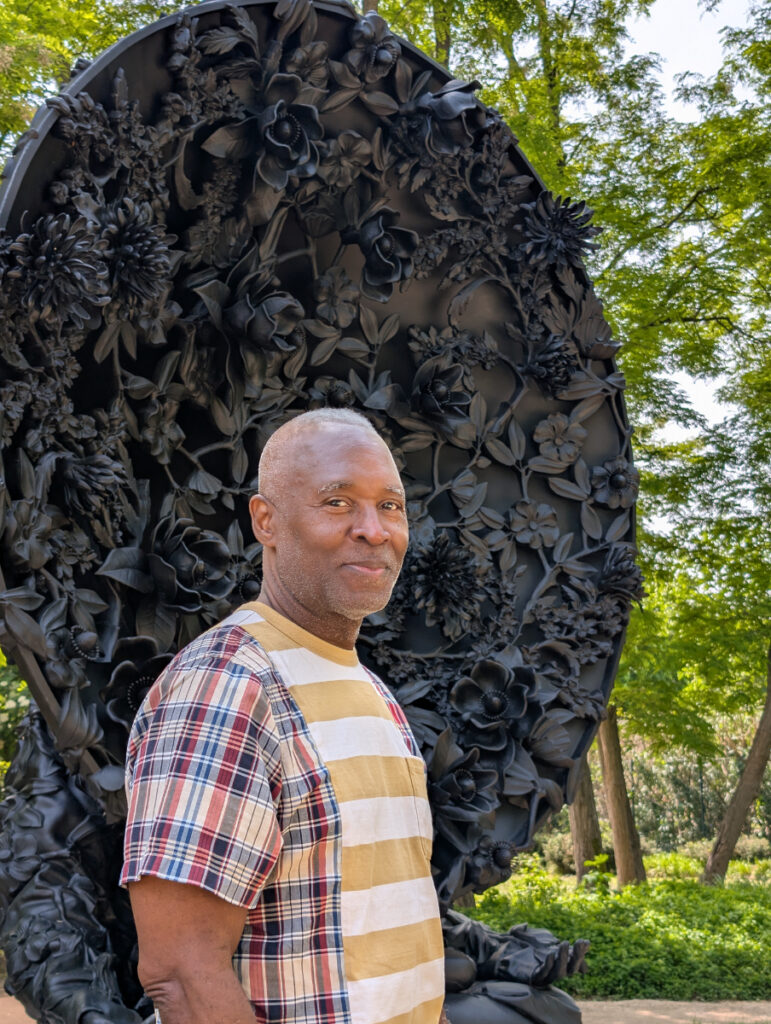
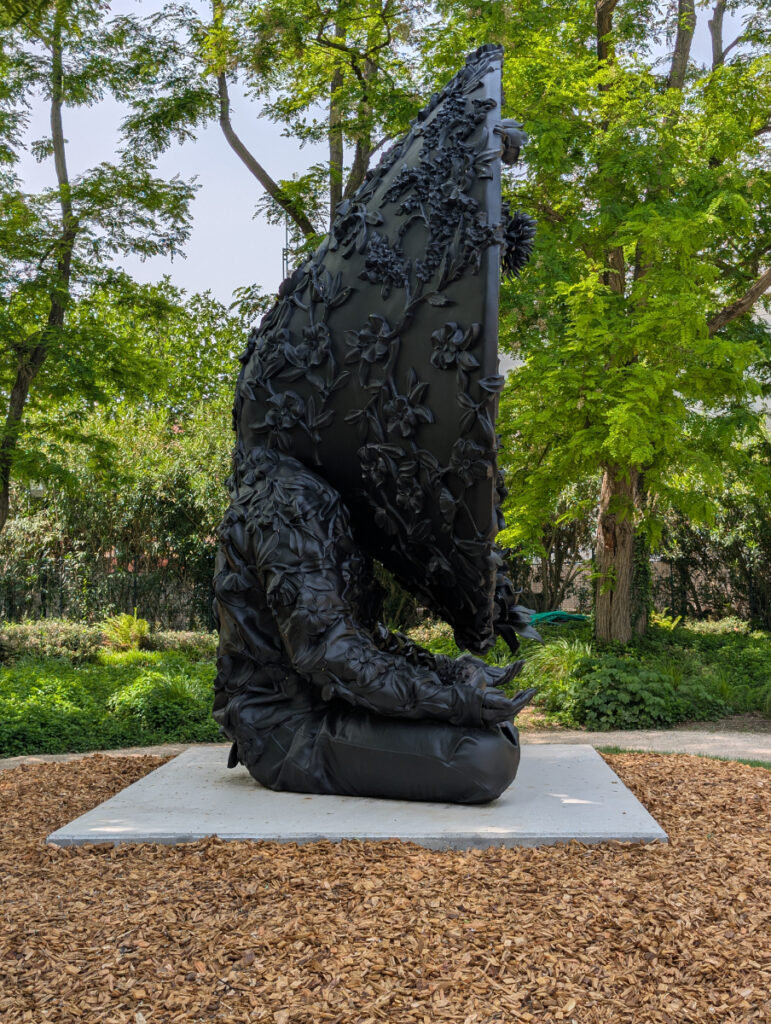
Michael Anthony Farley: So I was wondering which pieces were newly-created for the Biennale and which ones existed? The logistics of these massive, heavy, monumental bronzes must’ve been a challenge!
Nick Cave: Well it was really one piece that existed—and there’s a total of seven works included in the Biennale—and so it was really this feat to pull the team together working with a number of foundries on both the West Coast and East Coast to help facilitate the making of the work. It was really quite amazing—the whole production—just so you know that it takes, really, a team effort in order to pull something like this off.
You mentioned earlier that this edition of the tallest work, “Amalgam (Origin),” is here on loan from a collector in the UK. I have been thinking about how that work specifically feels like a sort of benevolent peacekeeper colossus standing sentry over the Arsenale, amidst so much chaos…
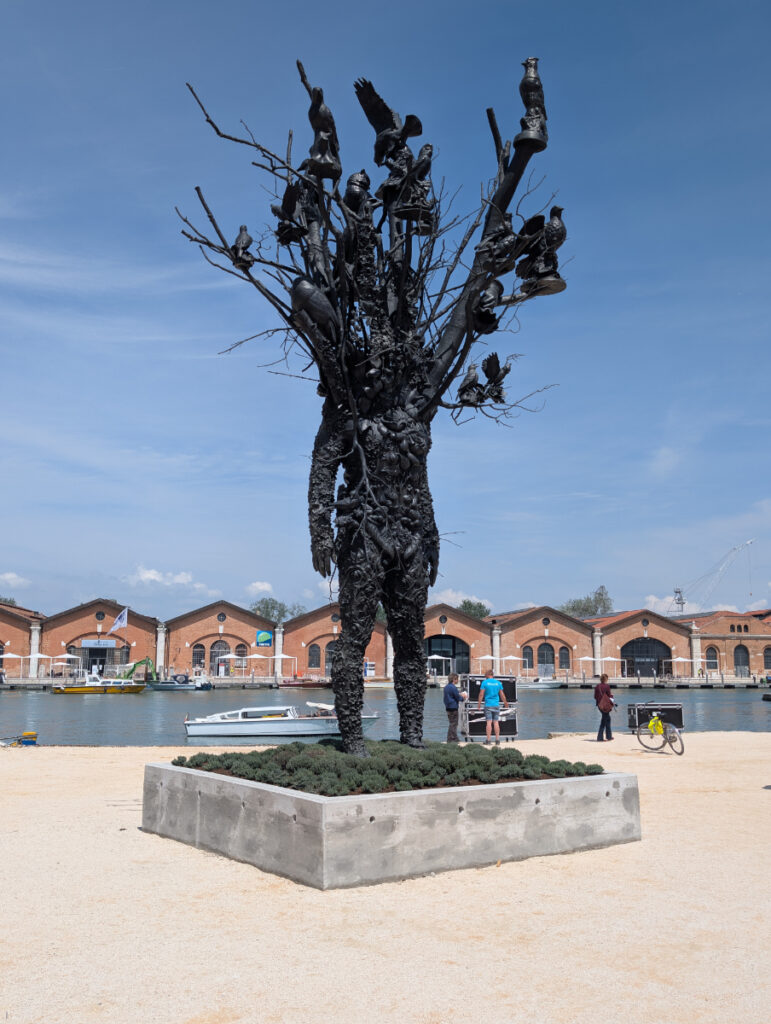
It’s really the stance of the body. [Cave gestures in an assertive position, leaning forward, arms extended as if pushing towards the ground] It is the stance of a protestor.
You know we really are in a critical moment in time. The world is hemorrhaging in so many ways with these wars, what’s going with voter rights in America, access to food, health care, education… It’s important for me to ask: how do I stand up to that? How do I push back against it?
And I think with our bodies. Our bodies also become our protectors and so we have to shield—create some form of shield—to allow us to have a bit of a distance when needed, as well as having the sort of consciousness to do what is right.
Completely by happenstance today I think I viewed your figurative works in an order that felt like a very deliberate procession leading here, and leading to what you were just saying. Your first piece I encountered inside was “Amalgam (Plot)” and I was unexpectedly struck by the way that the figures feel vulnerable—almost hiding but exposed—and I had this moment of thinking Wow. Sticking my head in something is very much something I would love to do—something many people would love to do—at this moment in time where we’re just surrounded by tragedy and bad news… but then encountering the strength and reassurance of “Amalgam (Origin),” and of course ending here at “Amalgam (Meditation)”…
…We’re standing in front of “Meditation” right now. We all have to also think about wellness and what do we put in place in our day-to-day existence to take care of ourselves? And so for me it’s about how do I create moments of silence? Can you imagine if we all had to sit in one hour of silence every day? How different we would be?
But we don’t. We’re just consumed with our phones with technology and noise and just everything. It’s just… nothing stops. And so we have to sort of think: in order for us to be productive, we’ve got to be well.
I think that leads well into the next question I had: what was it like working with Koyo Kouoh? Were you surprised seeing her curatorial decisions executed? Or surprised by any of the ways you found your work in dialogue with the rest of the show?
Koyo… I mean working with her was amazing. And, you know, I knew her and I really like her vision in terms of how she thinks. Now, decisions made around the exhibition I really have no sort of insight on—how the design was decided upon—and she’s not here anymore. So we really don’t know how this conclusion, in terms of the design of the exhibition, how those decisions were made.
I think it goes beyond that. It’s really, for me to be here on her behalf, it is everything. It’s not really about me—yes I’m thrilled and humbled and honored to be here—but this is all for her, and so that’s really what’s important to me.
I asked that because I think there’s something really lovely specifically about how your work fits into the kind of grander composition… which I think has all these moments of healing—taking these small moments of beauty to heal. It’s a show that obviously confronts a lot of the larger geopolitical mess of the world…
Yeah, and right now we’ve been moving through all the pavilions. And there’s a lot of pushback. There’s a lot of protests. A lot of pavilions that are striking, and really standing against some of the issues and that is again okay. I think that’s the beauty of the arts—it’s a point of reference. It’s a point of view.
And so when I think about the show overall it’s interesting how many things we have in common and a lot of us with the same concerns. The majority that are struggling and really trying to be the voice for those that can’t be heard… and so it’s nice to be able to sort of put the dots together and see the link that ties us all together. And then I’m just excited that there are moments that as you come out of the show, you have this moment to reflect… A moment to sort of just be in your body in a different way.
I love that as we’ve been talking people have been coming over and mimicking the pose of the sculpture—there’s something very approachable and inviting about it even though it’s this hard material.
When I think about what’s approachable, it’s the floral sensibility. There’s sentiment there. There is sensitivity. There’s empathy. There’s compassion. So I think that all provides a softness that again creates another sort of balance.
We’re sensitive human beings, we have feelings, we have emotions.
I mentioned to you when I arrived I was so struck by the empathic response your sculptures inside the Corderie provoked… something about them just exposes so much vulnerability? I felt this totally unexpected kinship with these figures… the urge to bury yourself, but being unable to hide…
That’s the thing: we can’t hide. We can’t hide humanity, and assault on humanity is real. And so I’m forcing you to do a lot of things—I’m forcing you to look down at this work. It’s not like here, where I can create a distance. So it’s your whole body sort of taking in and absorbing that isolated moment, with the work inside, where you are one with the object. It just brings you to is this real as it can be? Is this as raw as it can be?
That’s such an interesting thing I wouldn’t have considered… that the positioning of the work and where your detailing is placed and draws your gaze—it really does almost choreograph the viewer’s body into a position where you have this sort of autonomic empathy response.
Damn! That’s so smart… well done!
And then you’ve got “Siren” with the arms that are linked together… when you think about protests we all are collectively locking arms like this and we’re standing in line—or however we’re standing—we have made a decision that we are standing together.
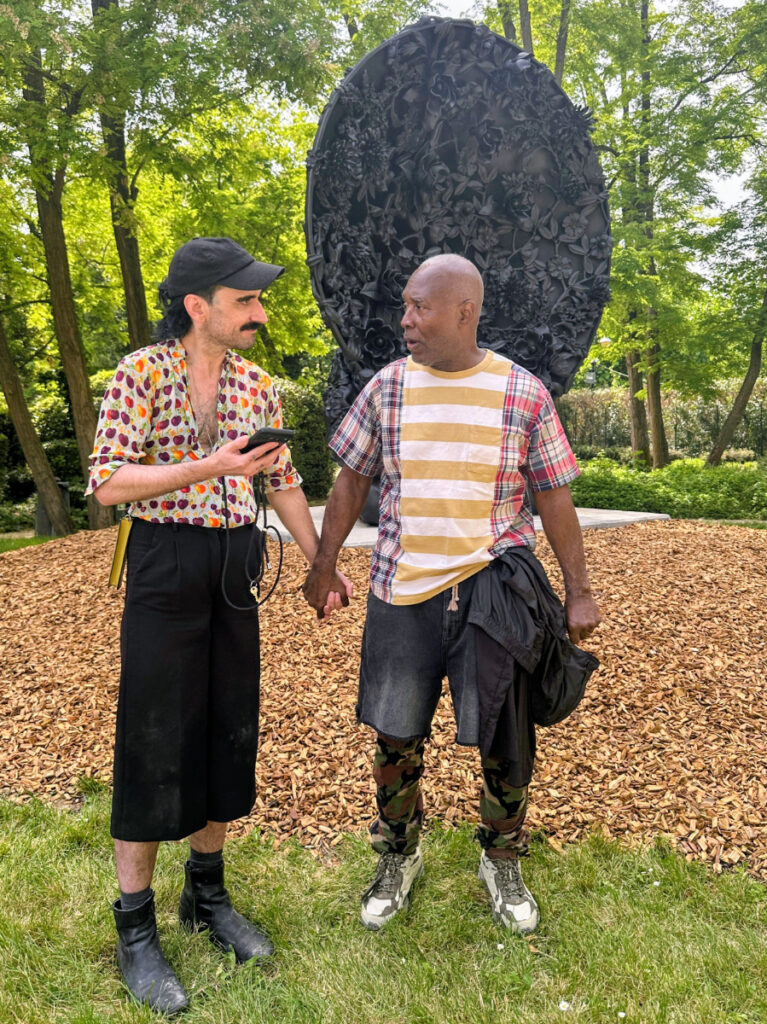
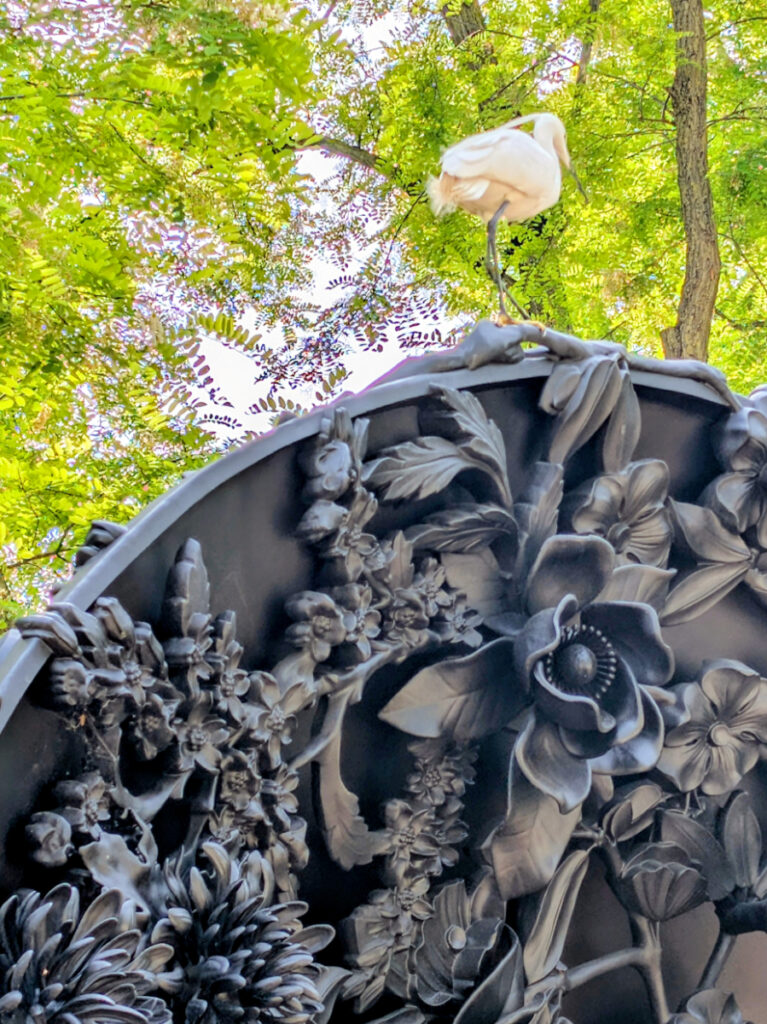
[Cave grasps my hand to demonstrate, and at the same time a white bird lands on the bronze foliage of “Amalgam (Meditation),” recalling the imagery in “A·mal·gam,” the first bronze of the series.]
And so with that piece there is this sort of link, but then it also crumbles and falls apart. Wait… look up! She was up there!
I love that this beautiful bird (is that like a little egret?) just came to approve! So on that note is there anything else you’d like to add? She distracted me and now I forgot what I was about to ask you…
Yeah, joy! Love and togetherness. It’s what we need.
I do think that this is a biennial that has so many moments of joy mixed in with politics and grief. Yesterday I went to a little remembrance event at a pub here, put together by the organizers of the EVA International biennial in Ireland, which Koyo Kouoh curated ten years ago. They had this get-together for the arts workers and artists involved in that edition to share their memories of working with her. I never met Koyo, but I figured this would be a good place to get some context about her. And the thing everyone brought up was what a joyful person she was. That she would bring these fabric animal toys for their kids because she had a great sense ofplay that the people who knew her see in so much of the work she was drawn to. And I am so glad that I had those conversations, because I think they informed me seeking out those moments in the show?
And here there are moments where we are gathering for many different reasons. Maybe that’s a performance. Or maybe we’re gathering around one of the sculptures. There are moments within this biennial where we are collectively standing together with these shared experiences—and everyone’s from all over the world—but yet, these art phenomena bring us together in this way of conditioning and believing and caring and sharing.