I am writing this from a booth at Rocket to Venus. A woman has just apologized for startling me as she leaned over my shoulder to scan a QR code on the wall above the banquette. She wasn’t looking for a menu, but information about the photography show hanging behind me.
I am chuckling, because I am here on my laptop writing about the death and life of art-viewing venues and hadn’t even noticed a perfectly nice show in the bar I frequently dip into on my way to/from the house where I am staying in Hampden, the BmoreArt office, and the myriad exhibitions and events I have been trying to cram into the past few weeks.
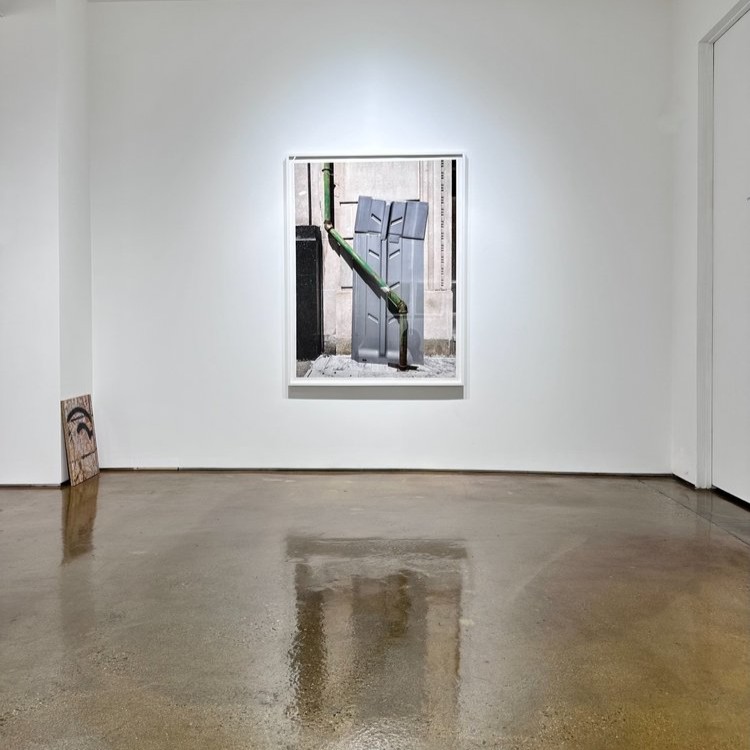
In my defense, Lewis Francis’ Urban Spelunking—the series now on view at Rocket to Venus—almost blends in too well with the bar’s retro-futuristic decor. Francis’ photos of eerily empty interiors and midcentury industrial infrastructure are printed on aluminum panels that soften contrast and have a sci-fi vibe that lends the impression they’ve always been here.

But I came here to write about other shows, and something BmoreArt’s Founding Editor Cara Ober said to me earlier in the day: “I like going to a bar to drink, but I don’t think it’s the ideal place to see art… that’s why we have galleries!”
I am not sure I always agree. I sometimes like seeing art in a bar as much as I like drinking at art galleries, which is quite a lot—a penchant I suspect many in this city’s art scene may have observed once or twice. And while Baltimore will always have bars, even the galleries we’ve come to think of as institutions don’t have immortal lifespans. Slinging alcohol is arguably the world’s second oldest profession, yet the fickle economics of the art market aren’t exactly at their best presently. So I am intrigued by the potential of hybridizing the two business models (one tried-and-true, the other usually terrible) as a survival mechanism for culture high and low alike.


Cara and I had been discussing Amos Badertscher: Do You Go Out? (on view through Nov 30) at The Club Car, a combination queer bar/art space/performance venue that opened last year with the intention of nurturing culturally-minded nightlife. I have long been a fan of Amos Badertscher, the late photographer who documented decades of Baltimore vice and sleaze, but realized I have rarely seen his work actually displayed in public. I had seen precious few of his original, hand-annotated prints of sex workers, drag queens, or other personalities on loan from private collections for museum shows abroad, but missed his hometown posthumous retrospective at UMBC in 2023. The vast majority of my experience with Badertscher’s work has been in publication form—most recently the monograph of his work Images and Stories Phaidon released earlier this year. (See my review here).
Both Images and Stories and Do You Go Out? were organized by Hunter O’Hanian, the Founding Director of the Leslie-Lohman Museum of Gay and Lesbian Art in New York, and a tireless advocate for Badertscher’s art-historical-canonization. Here, did I agree at first with all of the curatorial decisions? Not quite. The images are printed on large sheets of a glossy vinyl-like material that’s not ideal for disco lighting and flaps as crowds walk or dance by. It’s not the intimate experience of holding a book or getting close to a small framed photo by which I had been previously spoiled. For a context like this I would rather have seen small lightboxes or even big, mural-sized xerox wheatpastes—something that either elevates the reproduction to something precious or leans-in to the grittiness of cheap glamour.
But I suppose there’s a utilitarian logic to these economic prints: in a high-traffic dancefloor these portraits of bygone drag queens and nightlife personalities are less vulnerable than they were in life, safe from sweat and splashing drinks. When I asked O’Hanian about the prints, he pointed out each image only cost $51 to print at UPS and “were made to have a short temporal life. After the exhibition they are free to find their ways.” This makes me like them more. I can see these being upcycled into some truly wild drag garments or even living outside as a temporary public intervention on a chainlink fence. It’s these images that are just passing-through this bar, stand-ins for absent figures briefly rubbing shoulders with the regulars.


I found myself thinking about the fate of truly irreplaceable art objects when I swung by C. Grimaldis Gallery to see The Last Picture Show, which closes to the public, along with the gallery’s longtime brick-and-mortar space in Mount Vernon, on Saturday, November 22. For decades, Grimaldis has been a cornerstone of Baltimore’s commercial art scene as well as a lifeline between the city and the larger art world via participation in international fairs and inclusion of out-of-town artists in their roster. (Pick up the latest Icons Issue of BmoreArt in print for more about gallerist Constantine Grimaldis and his legacy!)
I am so sad to see Grimaldis go. It was always a place I took comfort in knowing was there to duck into when I had an hour to kill in the neighborhood, or even fifteen minutes waiting for a bus on Charles Street, and could walk out of having seen at least one artwork I would love. The Last Picture Show is a survey of some of the greatest living and deceased artists Grimaldis has shown in its impressive run: John Van Alstine, Elaine de Kooning, José Manuel Fors, Grace Hartigan, James Hennessey, Hidenori Ishii, Heejo Kim, Jae Ko, Dimitra Lazaridou, Eugene Leake, Ben Marcin, Rania Matar, Giorgos Rigas, John Ruppert, Nora Sturges, Amelie Wang, and John Waters. Seeing the disquieting portraiture of Rania Matar with the tongue-in-cheek work of John Waters and dreamy, acerbic paintings of Heejo Kim all in one place amongst moving boxes, it truly sunk in what a void this gallery’s closure is going to leave.


Mostly, I can’t stop thinking back to Grace Hartigan’s 1968 “Barbara Guest Archaics.” The 21” x 28” collage transmutes the expressive gestures of Hartigan’s famed, monumental paintings to a playful jumble of fingers with manicured nails. It’s funny (which is rare in my experience of her storied oeuvre) and gorgeous and has an informal quality that’s so very charming. It’s one of those artworks that feels important without neatly fitting into any one art historical chapter—a Pop-Art-adjacent collage by one of the leading women painters of Abstract Expressionism, too late for Surrealism, too early for the feminist “Pictures Generation.” It’s also one of the few artworks of Hartigan’s I’ve seen from that era that gives me the impression that she wasn’t making this for someone else’s consideration. It feels personal and fun and approachable and weird.
It is my sincerest hope that this ends up in an institutional collection—ideally that of the Baltimore Museum of Art, which has a relatively sizable collection of Hartigan’s work, specialized expertise in conserving works on paper, and a commitment to including more women in the canon.


Some of you, dear readers, may have noticed that BmoreArt has a new look. Since switching over to our new site last week, I have been randomly clicking around our archives to check that links still work and how formatting has translated. Shortly before heading to Current Space for the openings of Johab Silva’s solo show Terra de Ninguém (No Man’s Land) and the group exhibition Traces—both of which close on December 6 with artist talks at 7 pm—I had just happened to have revisited my report from the Miami art fairs almost exactly a year ago.
In that article, I asked “remember when the fairs were full of stuff like iPads playing performance documentation frozen in chunks of ice alongside acrylic nails and tubes of neon wearing track pants and live plants growing out of taxidermy rats and shit?? … Let’s bring back the glory days of the paragraph-long materials list for artwork that cannot possibly hang above anyone’s sofa!”
This was fresh in my mind when I walked into the gallery, and I beamed ear-to-ear upon seeing Silva’s show. The Brazilian new media artist draws parallels between old-timey colonialism and the present day tech boom through references to consumerism, extraction, and the “exotic” landscape. (Apparently the tropical plants are from the gallery’s patio bar, and were a last-minute addition because, happily, the install coincided with the gallerists winterizing their outdoor space for the season.)
In one VR headset, an AI voice narrates over a swampy-tropical landscape in which the alien colors of the sky and water alternate between seductive and sinister. The disembodied voice reminds us that it is very much not disembodied—everything from the minerals in its hardware to the land upon which its server farms sit and the water used to cool them is very much real. We might like to think of AI and “the cloud” as abstractions, but they’re actively consuming the landscapes we could be enjoying IRL. Disproportionately, those resources are extracted from the places with populations least likely to ever experience virtual reality or use Chat GPT to make a sexy anthropomorphic wombat nurse with six boobs recite the Second Amendment and be bad at math (this is what people use AI for, right?? I honestly just don’t get it…). All our first-world desire for digital content leaves a very messy wake of pollution and ruin in the global south.


It’s a testament to the artists in Traces—Amy Golden, Francis Dooley, Hannah Erwin, and Jason Herr—that their group show comprising “boring” old conventional materials (charcoal and graphite on paper, ceramic, colored pencil, et al.) not only manages to hold its own against the sleek multimedia spectacle next door, but actually upstaged it in terms of retaining my ADHD-ravaged attention span. Francis Dooley’s “Steel Seeking Skin,” a life-size steel sword that ends with a tiny hand, might just be my favorite art object I have seen in Baltimore all year. I imagine it as a prosthetic for the socially awkward—a tool of “defense” for those intimidated by handshakes or other human contact.
But if it were possible to give a hug to a drawing, I would wholeheartedly embrace those of Hannah Erwin. They’re dark and mysterious interiors, each with a personal association for the artist. I vaguely recognized two of them. It turns out “Martini” depicts Club Charles and “Dust Heart” is the stairwell from “The Mansion,” one of those big old punk houses in Reservoir Hill where half my friends have lived at one point in time or another and we’ve all gone to parties. Here, both spaces are rendered (seemingly) to convey ambivalence or spooky vibes, which is a far cry from the nostalgia they evoke for me.
Just as I was looking at drawings of places I have been drunk, Current Co-Director (and mixologist extraordinaire) Julianne Hamilton offered me one of the gallery’s signature cocktails: a surprisingly autumnal mezcal drink with star anise. It’s so good. It’s a bummer Current just closed their patio bar for the season, because I think it’s one of the secrets to the multi-use art space’s success and longevity. (Current Space is now 21! Older than I was the first time I came to a show at their old digs Downtown! That’s like 120 in artist-run-space years!) But in all seriousness: having regular bar hours and diverse performance/event programming give Current’s exhibitions an unparalleled amount of foot traffic, social life, and revenue stream amongst art spaces in this town. Selling cocktails and paintings don’t have to be mutually-exclusive endeavors!

I thought about that as I finally got a chance to check out art hall—one of those project spaces with a killer curatorial ethos but few excuses/opportunities to spontaneously swing by. Thiang Uk’s solo show Middle Distance is on view there by appointment through December 13. This more abstract series is a departure from Uk’s earlier paintings I had seen, which often feature hints of landscape, figures, animals, and other symbols alluding to a cryptic mythology. Those always immediately drew me in because they present an inviting mystery to the viewer, clues teasing further investigation.
Middle Distance is a bit more of a challenge to penetrate, but a worthwhile one. Here, Uk alludes to fog, Buddhism, explosions both violent and celebratory, and expanses of horizonless sea. Most compositions are diptychs, a few feature collaged pages from sketchbooks, and a limited color palette defines each work. Getting up close to these and observing the painter’s hand, surface, and process is a real treat.
This exhibition marks Thiang Uk’s first solo show featuring all-new work, and it’s one of those moments that makes me glad Baltimore has always fostered curatorial projects like art hall. I was a little sad to hear that owner Shawn Mudd plans the space to have a deliberately limited lifespan, and will eventually sell the building after a dozen exhibitions or so.


Dear Baltimore art people, let’s please keep this one in the family! I could just picture this place becoming the kind of multi-hyphenate art space (a-la-Current) of which we need more. The building was a former Hell’s Angels clubhouse, and practically screams for full-time activation. This little corner at the fringes of Old Goucher/Barclay/Station North is severely lacking in “third spaces” and street life and I could so see an indoor/outdoor cafe on the ground floor, with music upstairs, and plenty of people coming and going to actually appreciate the art hidden in its improbably crisp inner white cube.
The phenomenon of artists-as-proprietors-of-social-businesses is nothing new, of course, but now that we’re in the midst of an era in which dedicated galleries are dropping like flies while gentrification threatens to scrub all the fun out of city life, it’s starting to feel like a necessity. In the latest print issue of BmoreArt (pick one up!) I wrote about how a group of artists came together to buy the iconic Mount Royal Tavern and ensure its survival. One of those artists is Marlon Ziello, whose sneaky conceptual project is currently installed at the Tavern, and it is probably my favorite show on view in Baltimore—at any bar, museum, gallery, et. al.—right now, through December 3.


For his “day job” Ziello runs a high-end framing business in New York. Whenever a client comes in wanting to replace an artwork’s interesting old frame with something more contemporary, Ziello saves the old one. He then cuts a sheet of mirror to fit the frame, which is a kind of absurd reversal of the easier task of cutting a frame to fit a mirror. The resulting objects are both practical and ontologically interesting. Here, the mirror serves as a non-image—a place-holder for an absent artwork fossilized by its proportions—that reframes the frame as the subject.
So far, Ziello has sold a mirror cut to fit a frame from a Warhol, and in my absolute favorite twist of irony, a frame originally made for a Picasso is now installed in the Mount Royal Tavern’s bathroom—reflecting back Les Demoiselles d’Maryland (that’s a pun that almost kinda works if you say it out loud in a Bawlmor accent, FYI).
But mostly, this assortment of irregular mirrors in frames of unlikely provenance scattered around the Mount Royal Tavern offers a new perspective for people watching at one of the world’s all-time-best people watching venues.
And really, isn’t that half the reason we usually go to galleries at openings instead of by appointment?